Modern research aims to answer important questions, solve real-world problems, and generate evidence that can guide decision-making. Whether a study is conducted in education, healthcare, business, social science, or environmental science, selecting the right research design is one of the most important decisions researchers make. A well-planned design influences how data is collected, how results are interpreted, and whether meaningful conclusions can be drawn.
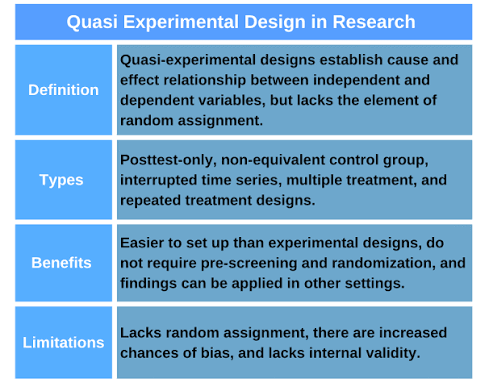
Among the many types of experimental design, the quasi-experimental design has become one of the most widely used approaches when conducting research in real-world settings. Unlike a true experiment, where participants are assigned to groups through random assignment, a quasi-experimental approach investigates the effects of an intervention when full randomization is impractical, impossible, or unethical.
For example, imagine a school district introducing a new mathematics curriculum to improve student performance. Because students are already enrolled in their classes, school administrators cannot randomly move them into new classrooms simply for the purpose of an experiment. Instead, researchers compare existing classes before and after the intervention. This practical scenario illustrates why a quasi-experimental design is invaluable in many disciplines.
Although a quasi approach lacks the strict control associated with a true experimental design, it can still produce strong evidence about a causal relationship when designed carefully. By reducing threats such as selection bias and accounting for potential confounding variables, researchers can improve internal validity and strengthen the credibility of their findings.
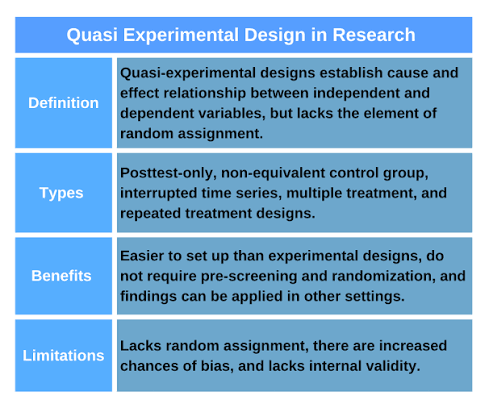
In this comprehensive guide, you’ll learn what quasi-experimental design means, why it matters in modern research, its defining characteristics, how it differs from other research methods, and when it should be used. You’ll also explore its major types, practical examples, strengths, limitations, and best practices for conducting a successful quasi-experimental study.
What Is Quasi-Experimental Design?
A quasi-experimental design is a type of research design used to evaluate the effect of an intervention or treatment when random assignment of participants to groups is not feasible. While it shares many features with an experimental design, it differs because participants are placed into existing or naturally occurring groups rather than being randomly assigned.
In simple terms, a quasi experimental research design allows researchers to investigate cause-and-effect questions in situations where conducting a true experiment would be difficult, expensive, or unethical.
For instance, governments cannot randomly assign communities to receive or not receive a public health campaign simply for research purposes. Similarly, schools cannot randomly redistribute students into different academic programs midway through a semester. In such situations, a quasi experimental method provides a practical alternative.
Rather than relying entirely on randomization, researchers use carefully selected comparison group strategies and statistical techniques to estimate the causal effect of an intervention.
A Simple Example
Suppose a hospital introduces a new patient education program to reduce hospital readmissions.
Instead of randomly assigning patients to receive or not receive the program, the hospital compares readmission rates before and after implementation or compares two hospitals where only one adopted the new program.
Although this is not a true experiment, the study can still generate valuable insights into whether the intervention improved patient outcomes.
Why Quasi-Experimental Design Is Important
The ability to establish causality is one of the central goals of scientific research. However, many important questions cannot be investigated through strict laboratory experiments.
Imagine attempting to answer questions such as:
- Does increasing teacher training improve student achievement?
- Do public smoking bans reduce respiratory illnesses?
- Does a new government policy reduce unemployment?
- Does a workplace wellness program improve employee productivity?
Randomly assigning people to experience or avoid these conditions is often impossible or unethical. Consequently, researchers rely on quasi experimental research to evaluate interventions under naturally occurring conditions.
This makes quasi-experimental studies especially valuable in:
- Education
- Healthcare
- Public policy
- Organizational management
- Community development
- Market research
- Public health
- Environmental science
By studying interventions in real-world settings, researchers often produce findings with stronger practical relevance than tightly controlled laboratory experiments.
Why Research Design Matters
Before selecting any methodology, researchers must first understand why research design is important.
A research design serves as the blueprint for the entire study. It guides how participants are selected, how variables are measured, and how conclusions are reached. Choosing the wrong design can undermine even the most interesting research question.
An effective research design helps researchers:
- Collect reliable evidence.
- Reduce bias.
- Improve validity.
- Strengthen confidence in findings.
- Support meaningful data analysis.
- Produce trustworthy recommendations.
When designing any investigation, researchers typically begin with a clear literature review to identify existing knowledge, research gaps, and appropriate methodologies. This background helps determine whether a quasi-experimental approach is the most suitable option.
Unlike some research methods that prioritize observation alone, quasi-experimental approaches actively evaluate interventions and compare outcomes between groups.
Key Characteristics of Quasi-Experimental Design
Although every quasi experimental study differs depending on its objectives, several defining characteristics distinguish this approach from other forms of experimental research.
1. Absence of Random Assignment
The defining feature of a quasi-experimental design is the lack of random assignment.
Instead of randomly allocating participants, researchers work with naturally existing groups such as classrooms, hospitals, communities, or organizations.
For example, one school may adopt a new teaching strategy while another continues using its existing curriculum. Because students remain in their original schools, there is no randomization.
This limitation introduces challenges but also makes the design practical for real-world investigations.
2. Comparison Between Groups
Every strong quasi-experimental investigation requires a meaningful comparison.
Researchers usually compare:
- Existing treatment and comparison group populations.
- Outcomes before and after an intervention.
- Different locations.
- Different time periods.
The quality of this comparison largely determines the credibility of the conclusions.
3. Focus on Cause-and-Effect Questions
Although causal inference is generally stronger in a true experiment, a well-designed quasi-experimental approach can still provide evidence about a likely causal relationship.
Researchers strengthen their conclusions by:
- Carefully selecting comparison groups.
- Measuring outcomes consistently.
- Controlling for observable differences.
- Using appropriate statistical methods.
The goal is not merely to identify associations but to estimate the likely causal effect of an intervention.
4. High Practical Value
One reason quasi-experimental designs are widely used is their practicality.
Organizations rarely have the flexibility to randomly assign people to programs simply for research purposes.
Instead, researchers evaluate interventions exactly as they occur in everyday life.
Examples include:
- New hospital procedures.
- Educational reforms.
- Business training programs.
- Government policies.
- Community development initiatives.
Because studies occur under realistic conditions, findings often translate directly into practice.
5. Strong Emphasis on Internal Validity
A common misconception is that quasi-experimental studies lack scientific rigor.
In reality, experienced researchers devote considerable effort to improving internal validity by reducing alternative explanations for observed outcomes.
Strategies include:
- Matching participants with similar characteristics.
- Selecting equivalent comparison groups.
- Measuring baseline outcomes before interventions.
- Applying advanced regression techniques.
- Controlling statistically for potential confounding variables.
Although internal validity may not equal that of a perfectly controlled true experiment, thoughtful planning can substantially improve the reliability of findings.
6. Balancing Validity and Realism
One of the greatest strengths of quasi-experimental design is its balance between scientific rigor and practical application.
Laboratory experiments maximize control but sometimes sacrifice realism.
Quasi-experimental studies accept slightly lower control in exchange for greater relevance to real-world settings.
This balance often produces findings that decision-makers can implement more confidently.
When Should Researchers Use Quasi-Experimental Design?
A quasi-experimental design is most appropriate when the objective is to evaluate the impact of an intervention, but full experimental control is not possible.
Researchers commonly choose this design when:
- Random assignment is unethical.
- Existing groups cannot be reorganized.
- Policies have already been implemented.
- Large-scale community interventions are being evaluated.
- Organizational programs are already in place.
- Time or financial constraints prevent conducting a controlled experiment.
For example, evaluating the effectiveness of a national vaccination campaign, a workplace safety initiative, or a new school curriculum would often require a quasi approach because participants cannot realistically be assigned randomly.
The challenge for researchers is to design the study carefully enough to reduce threats to validity, strengthen comparison between groups, and produce credible conclusions that can inform practice.
Types of Quasi-Experimental Design
Not all quasi-experimental design approaches are the same. Depending on the research question, available data, ethical considerations, and the setting in which the study is conducted, researchers may choose from several well-established designs. Each has unique strengths, limitations, and appropriate applications.
Selecting the right experimental design is essential because it affects the quality of the evidence, the level of validity, and the confidence that can be placed in the findings.
1. Nonequivalent Groups Design
The nonequivalent group design is one of the most common forms of quasi-experimental design. Instead of using random assignment, researchers compare two or more existing groups that already differ naturally.
For example, suppose one university introduces a new online learning platform while another continues using traditional classroom instruction. Students remain in their original institutions, making randomization impossible. The two universities become the treatment and comparison group.
Although the groups are not randomly created, researchers can strengthen internal validity by collecting baseline information, matching participants on important characteristics, and using statistical controls during data analysis.
Best suited for:
- Educational interventions
- Workplace training
- Community development programs
- Healthcare service evaluations
2. Interrupted Time Series Design
The interrupted time series design evaluates whether an intervention changes outcomes over time by examining repeated measurements before and after implementation.
Instead of comparing different groups, this design compares the same population across multiple time periods.
For example, a city introduces stricter traffic laws to reduce road accidents. Researchers analyze monthly accident data for two years before the policy and two years afterward. If a clear shift occurs immediately after the intervention, this provides evidence that the policy may have produced a meaningful causal effect.
This approach is particularly useful when historical data already exist.
Advantages include:
- Strong trend analysis
- Reduced influence of short-term fluctuations
- Excellent for evaluating public policies
However, researchers must consider whether other events occurring at the same time could influence the results.
3. Regression Discontinuity Design
The regression discontinuity design is considered one of the strongest forms of quasi-experimental design because assignment to the intervention depends on a predetermined cutoff score.
Imagine a scholarship program available only to students scoring above 80%. Students who score 79% receive no scholarship, while those scoring 80% or higher do.
Researchers compare students immediately above and below the cutoff. Since these students are often very similar, differences in outcomes can provide strong evidence for causality.
This design relies heavily on regression techniques to estimate treatment effects accurately.
It is commonly used in:
- Education
- Public policy
- Healthcare funding
- Social welfare programs
4. Pretest–Posttest Design
The pretest posttest design measures participants before and after an intervention to determine whether meaningful change occurs.
For example, a company introduces a leadership development program. Employee productivity is measured before training and again six months later.
If performance improves significantly, researchers may conclude that the intervention contributed to the observed improvement.
Because no comparison group may exist, it is important to consider external factors that could also explain the results.
5. Natural Experiment
Sometimes real-life events create situations that resemble experiments without being intentionally planned by researchers.
These are known as natural experiments or a natural experiment.
For example:
- A government unexpectedly changes tax policy.
- A natural disaster affects one region but not another.
- A new environmental regulation applies to one state but not neighboring states.
Researchers take advantage of these naturally occurring events to evaluate their effects.
Although they lack randomization, natural experiments often provide unique opportunities to study questions that cannot be investigated through traditional experimental research.
Quasi-Experimental Design vs. True Experimental Design
One of the most common sources of confusion among students is understanding the difference between a quasi-experimental design and a true experimental design.
Although both attempt to examine cause-and-effect relationships, they differ in important ways.
| Feature | Quasi-Experimental Design | True Experimental Design |
|---|---|---|
| Random Assignment | No | Yes |
| Existing Groups | Yes | Usually No |
| Level of Control | Moderate | High |
| Internal Validity | Moderate to High | Very High |
| Practicality | High | Moderate |
| Ethical Flexibility | High | Moderate |
| Real-World Applications | Excellent | Sometimes Limited |
| Cost | Lower | Often Higher |
The defining characteristic of a true experiment is random assignment, which helps eliminate systematic differences between groups.
In contrast, quasi-experimental design works with naturally existing groups, making careful planning essential to reduce selection bias and improve validity.
Despite these differences, both approaches remain valuable depending on the context and the objectives of the research.
Threats to Internal Validity
A major challenge in any quasi experimental research is maintaining strong internal validity.
Without randomization, other factors may influence the results.
Some of the most common threats include:
Selection Bias
Selection bias occurs when treatment and comparison groups differ before the intervention begins.
For example, comparing highly motivated students with less motivated students could produce misleading conclusions.
History Effects
Events occurring outside the study may influence participants.
For example, an economic recession during a job-training program could affect employment outcomes regardless of the intervention.
Maturation
Participants naturally change over time.
Children mature.
Employees gain experience.
Patients recover.
These natural changes may affect results independently of the intervention.
Attrition
Some participants withdraw before the study is completed.
If dropout rates differ between groups, findings may become biased.
Instrumentation
Changes in measurement tools or assessment procedures may affect observed outcomes rather than the intervention itself.
How Researchers Strengthen Validity
Although quasi-experimental studies face several challenges, experienced researchers employ numerous strategies to strengthen validity.
These include:
- Selecting similar comparison groups.
- Matching participants based on demographic characteristics.
- Measuring baseline performance.
- Using repeated observations.
- Applying advanced regression techniques.
- Controlling statistically for potential confounding variables.
When implemented carefully, these strategies improve confidence in the estimated causal relationship between an intervention and its outcomes.
Advantages of Quasi-Experimental Design
The growing popularity of quasi-experimental design reflects its ability to answer important questions under realistic conditions.
1. Practical Implementation
Many organizations cannot reorganize employees, students, or patients simply for research purposes.
Quasi-experimental approaches allow investigations to occur within existing systems.
2. Ethical Flexibility
Some interventions cannot ethically be withheld.
For example:
- Emergency healthcare programs
- National education reforms
- Public health campaigns
Using existing groups allows researchers to evaluate these initiatives responsibly.
3. Strong Real-World Relevance
Unlike laboratory experiments, quasi-experimental studies examine interventions as they naturally occur.
This often improves the applicability of findings to everyday practice.
4. Cost-Effective Research
Because existing groups and administrative data are frequently used, these studies are often less expensive than controlled laboratory experiments.
5. Broad Applications
Quasi-experimental approaches are widely used across disciplines, including:
- Education
- Medicine
- Business
- Economics
- Psychology
- Public administration
- Market research
- Environmental science
Their versatility makes them one of the most valuable experimental methods available to applied researchers.
Limitations of Quasi-Experimental Design
Despite its strengths, no research design is perfect.
Understanding limitations allows researchers to interpret findings appropriately.
Limited Randomization
Because random assignment is absent, treatment groups may differ before the intervention begins.
This makes causal conclusions more cautious than those from a true experiment.
Greater Risk of Bias
Without careful planning, selection bias may distort findings.
Researchers must therefore invest significant effort in creating meaningful comparisons.
Lower Internal Validity Than Controlled Experiments
Although many strategies improve internal validity, completely eliminating alternative explanations is often impossible.
Complex Statistical Analysis
Advanced data analysis techniques, including regression, matching procedures, and sensitivity analyses, are often required to strengthen conclusions.
Difficulty Controlling External Factors
Real-world environments are dynamic.
Unexpected policy changes, economic conditions, organizational restructuring, or social events may influence outcomes alongside the intervention.
Choosing Between Experimental and Quasi-Experimental Designs
There is no universally “best” experimental design.
The appropriate choice depends on the research objectives.
Choose a true experimental design when:
- Random assignment is feasible.
- Maximum control is required.
- Laboratory conditions are acceptable.
- Ethical concerns are minimal.
Choose a quasi-experimental design when:
- Existing groups must remain intact.
- Ethical considerations prevent random allocation.
- Policies or programs are already implemented.
- Real-world effectiveness is the primary focus.
The strongest researchers understand that methodology should always fit the research question, not the other way around.
By selecting the design that best aligns with the problem under investigation, they maximize both scientific rigor and practical usefulness.
Real-World Applications of Quasi-Experimental Design
One of the greatest strengths of a quasi-experimental design is its versatility. Unlike a true experiment, which often requires controlled laboratory conditions and strict random assignment, a quasi-experimental approach allows researchers to evaluate interventions in real-world environments where people, organizations, and communities function naturally.
Because of this flexibility, quasi-experimental design has become one of the most widely used approaches in applied experimental research.
1. Education Research
Education is one of the most common fields where quasi experimental research is conducted.
Schools rarely allow students to be randomly reassigned to classrooms simply for an experiment. Instead, researchers compare existing classes, schools, or districts using a carefully selected comparison group.
For example, a school introduces a new digital learning platform for Grade 10 students while another school continues using traditional teaching methods. By comparing academic performance before and after implementation, researchers can estimate whether the intervention improved learning outcomes.
Although selection bias may exist because students were not randomly assigned, statistical controls and baseline assessments help strengthen internal validity.
2. Healthcare and Public Health
Healthcare professionals frequently use quasi-experimental design to evaluate treatments, hospital policies, and community health interventions.
Imagine a hospital implementing a new infection prevention protocol. Rather than randomly assigning patients to receive different levels of care, the hospital compares infection rates before and after the protocol is introduced.
Similarly, public health officials may evaluate vaccination campaigns, smoking cessation initiatives, or nutrition programs using an interrupted time series design or a well-matched comparison group.
These studies provide evidence that supports policy decisions while maintaining ethical standards.
3. Business and Market Research
Businesses constantly introduce new products, employee training programs, pricing strategies, and marketing campaigns.
In market research, organizations often compare sales performance between different branches or regions where a new strategy has been implemented.
For example, one retail chain launches a customer loyalty program in selected cities while other branches continue operating normally. By comparing purchasing patterns, researchers can estimate the effectiveness of the initiative without disrupting normal business operations.
Such studies generate valuable insights that help organizations make informed strategic decisions.
4. Public Policy
Governments frequently rely on quasi-experimental design to evaluate policies affecting large populations.
Examples include:
- Employment initiatives
- Tax reforms
- Crime reduction programs
- Environmental regulations
- Educational reforms
Because policies are usually implemented at the community, regional, or national level, randomization is rarely possible. Carefully designed comparisons and advanced statistical methods help estimate policy effectiveness while accounting for potential confounding variables.
5. Environmental Science
Researchers working in environmental science often investigate conservation programs, pollution control measures, or climate adaptation strategies.
Suppose a government establishes a protected forest area while a neighboring forest remains unmanaged. By comparing biodiversity indicators over several years, researchers can estimate the causal effect of conservation policies.
In many environmental settings, a natural experiment occurs when events such as floods, wildfires, or new regulations affect one region but not another, creating opportunities for meaningful scientific investigation.
How to Conduct a High-Quality Quasi-Experimental Study
A successful quasi experimental study requires careful planning. While the absence of random assignment presents challenges, following a systematic process helps produce reliable findings.
Step 1: Define the Research Question
Every successful study begins with a clear research question.
Ask yourself:
- What intervention is being evaluated?
- What outcome should be measured?
- Who are the participants?
- What evidence is needed?
A focused question guides every subsequent decision.
Step 2: Conduct a Literature Review
A comprehensive literature review helps identify:
- Existing evidence
- Research gaps
- Appropriate theoretical frameworks
- Suitable research methods
- Common methodological challenges
Reviewing previous studies also ensures the project builds upon established knowledge rather than duplicating existing work.
Step 3: Select the Most Appropriate Design
Choose the design that best fits the research context.
Examples include:
- Nonequivalent groups design
- Interrupted time series design
- Regression discontinuity design
- Pretest posttest design
The choice should always align with the research objectives, available data, and ethical considerations.
Step 4: Select Participants
Identify eligible participants and establish a meaningful comparison group whenever possible.
Collect baseline information so that important differences between groups can be considered during analysis.
Step 5: Collect Data
Gather reliable information before and after the intervention.
Depending on the project, data may include:
- Surveys
- Standardized tests
- Administrative records
- Interviews
- Health records
- Business reports
Although qualitative research is not the primary focus of most quasi-experimental studies, combining quantitative findings with qualitative evidence can provide a richer understanding of why an intervention succeeds or fails.
Step 6: Perform Data Analysis
Careful data analysis is essential for producing credible conclusions.
Researchers frequently use:
- Descriptive statistics
- Regression analysis
- Difference-in-differences techniques
- Matching procedures
- Sensitivity analyses
Appropriate analytical techniques strengthen causal inference while reducing the influence of potential confounding variables.
Step 7: Interpret Findings Responsibly
Even when results suggest a strong causal relationship, researchers should avoid overstating certainty.
Instead, discuss:
- Study strengths
- Study limitations
- Remaining sources of bias
- Implications for future research
Balanced interpretation increases scientific credibility.
Common Mistakes to Avoid
Many students and novice researchers weaken otherwise promising studies by making avoidable methodological errors.
Mistake 1: Ignoring Selection Bias
Failing to address selection bias can produce misleading conclusions.
Always compare groups carefully and use appropriate statistical adjustments where possible.
Mistake 2: Assuming Causality Too Quickly
A quasi-experimental design can provide strong evidence, but causality should only be claimed after considering alternative explanations.
Mistake 3: Choosing an Inappropriate Comparison Group
An unsuitable comparison group reduces validity and weakens confidence in the findings.
Groups should be as similar as possible before the intervention.
Mistake 4: Weak Data Collection
Poor measurement tools reduce the quality of the entire study.
Use reliable instruments and standardized procedures whenever possible.
Mistake 5: Neglecting Ethical Considerations
Researchers should protect participant privacy, obtain informed consent where required, and follow institutional ethical guidelines throughout the project.
Best Practices for Researchers
Experienced researchers maximize the quality of a quasi experiment by following several proven practices.
- Clearly justify why a quasi-experimental design was selected instead of a true experimental design.
- Document participant selection procedures in detail.
- Use baseline measurements whenever possible.
- Select the most appropriate comparison group.
- Address threats to internal validity openly.
- Apply suitable statistical techniques, including regression, where appropriate.
- Report limitations honestly.
- Explain how findings contribute to future research and professional practice.
Transparency enhances both scientific credibility and public trust.
Frequently Asked Questions
Is quasi-experimental design quantitative or qualitative?
Most quasi-experimental design studies belong to experimental research within quantitative research because they measure outcomes numerically. However, some projects incorporate qualitative research to better understand participant experiences and explain why observed changes occurred.
Can quasi-experimental research establish cause and effect?
Yes, but with greater caution than a true experiment.
By using strong comparison strategies, improving internal validity, and reducing selection bias, researchers can make informed conclusions about likely causal effects.
What is the biggest limitation of quasi-experimental design?
The absence of random assignment.
Without random allocation, pre-existing differences between groups may influence results, making it more difficult to eliminate alternative explanations completely.
When should researchers choose quasi-experimental design?
A quasi-experimental design is appropriate when:
- Randomization is impractical.
- Ethical concerns prevent experimental manipulation.
- Existing groups must remain intact.
- Real-world interventions need evaluation.
What is the difference between a quasi-experiment and a true experiment?
A true experiment relies on random assignment, whereas a quasi experiment studies naturally occurring groups.
Although true experiments generally provide stronger evidence, quasi-experimental studies often offer greater practical relevance because they reflect real-world conditions.
Conclusion
Selecting the appropriate research design is one of the most important decisions any researcher makes, and quasi-experimental design offers a powerful solution when strict experimental control is not possible. By allowing researchers to investigate interventions using existing groups, it bridges the gap between scientific rigor and practical application.
Throughout this guide, we’ve explored how quasi-experimental design differs from a true experiment, examined its defining characteristics, discussed major types such as the nonequivalent groups design, interrupted time series design, regression discontinuity design, and pretest posttest design, and highlighted strategies for improving internal validity and reducing selection bias.
We’ve also seen that this approach is widely used across education, healthcare, public policy, business, market research, and environmental science because it enables the evaluation of programs and interventions under realistic conditions. While careful planning, appropriate comparison strategies, and rigorous data analysis are essential, a well-designed quasi-experimental study can produce reliable evidence that informs decision-making and advances knowledge.
Ultimately, there is no universally superior experimental design. The best choice depends on the research question, ethical constraints, available resources, and the context of the study. Skilled researchers understand that methodology should serve the problem being investigated—not the other way around. When applied thoughtfully, quasi-experimental design remains one of the most valuable tools for generating meaningful evidence and supporting sound, evidence-based decisions in both academic and professional settings.
Be the first to comment