Every successful research project begins with a clear plan. Whether you’re a university student writing your first research proposal, a postgraduate conducting a research study, or a professional carrying out market research, choosing the right research design is one of the most important decisions you will make. A well-planned design provides the structure needed to answer a research question, collect reliable evidence, perform meaningful data analysis, and produce credible research findings.
Without a sound research design, even the most interesting research idea can fail to deliver valid conclusions. Poor planning may lead to biased data, inappropriate methods, or inaccurate interpretations that undermine the entire study. This is why experienced researchers invest significant time in designing their investigations before collecting any data.
In simple terms, research design serves as the blueprint for a research study. It outlines how a researcher will address the research problem, select participants, gather information, analyze findings, and interpret the results. It connects the research objective with the most appropriate research method, ensuring every stage of the research process contributes to answering the central question.
This comprehensive guide explains what research design is, why it matters, its core components, and how it relates to research methodology and research methods. In later sections, you’ll also explore different types of research designs and learn how to select the right research design for different academic and professional contexts.
What Is Research Design
A research design is the overall strategy or framework that guides how a researcher conducts a study. It specifies the procedures, techniques, and methods used to collect information, organize evidence, perform analysis, and answer a defined research question.
Think of research design as the architectural plan for constructing a building. Just as architects prepare detailed blueprints before construction begins, researchers develop a research design before collecting data. This planning reduces uncertainty, minimizes bias, and ensures that every stage of the investigation supports the intended research objective.
A good research design answers several important questions before the study begins:
- What is the research problem
- What is the purpose of the study
- Which participants or population should be included
- What research methods should be used
- What type of data is needed
- How will data analysis be performed
- How will the findings answer the original research question
Because every investigation is different, there is no universal design that fits every situation. A researcher studying consumer buying behavior may require a different approach from someone investigating patient recovery rates in healthcare or educational outcomes in schools. Selecting the most appropriate design depends on the goals, available resources, ethical considerations, and the nature of the phenomenon being investigated.
Why Is Research Design Important
A carefully planned research design increases the likelihood that a study will produce trustworthy and meaningful results. It serves as the foundation upon which every subsequent stage of the research process is built.
1. Provides Clear Direction
One of the primary benefits of a research design is that it gives the researcher a structured roadmap. Rather than making decisions during data collection, the researcher establishes procedures in advance, improving consistency throughout the project.
2. Aligns the Research Question with the Method
A well-designed study ensures that the chosen research method is appropriate for answering the research question. For example, questions seeking measurable relationships often require quantitative research, whereas questions exploring experiences or perceptions may be better addressed through qualitative research.
3. Improves Data Quality
Careful planning helps researchers collect accurate and relevant information. By selecting appropriate sampling techniques, measurement tools, and collection procedures, the researcher minimizes errors before conducting analysis.
4. Supports Reliable Data Analysis
Effective data analysis depends on collecting the right kind of evidence. A poorly designed study often results in incomplete or inconsistent data, making meaningful statistical analysis or interpretation difficult. In contrast, a strong research design ensures that the collected information aligns with the planned analytical approach.
5. Reduces Bias
Bias can occur when participants are selected inappropriately, questions are poorly designed, or procedures are inconsistent. A carefully developed design establishes standardized methods that reduce potential bias and improve the credibility of the research finding.
6. Enhances Validity and Reliability
Validity refers to whether a study measures what it intends to measure, while reliability concerns the consistency of those measurements. Good research design strengthens both by ensuring that variables, sampling strategies, and measurement tools are carefully selected and consistently applied.
7. Saves Time and Resources
Planning the investigation before data collection prevents unnecessary revisions later in the project. A well-organized design helps the researcher allocate time, budget, and personnel more efficiently throughout the research process.
Key Components of Research Design
Although research projects differ across disciplines, most effective research designs share several essential components.
1. Research Problem
Every investigation begins with identifying a clearly defined research problem. This problem explains the issue that requires investigation and provides the foundation for the entire study.
For example:
“What factors influence employee productivity in remote work environments”
A clearly stated problem helps determine the most appropriate design and method.
2. Research Objective
The research objective describes what the researcher intends to accomplish. Objectives should be specific, measurable, achievable, relevant, and logically connected to the research problem.
Examples include:
- To examine customer satisfaction levels.
- To evaluate the effectiveness of online learning.
- To determine the relationship between exercise and mental health.
Clear objectives guide every subsequent decision in the research process.
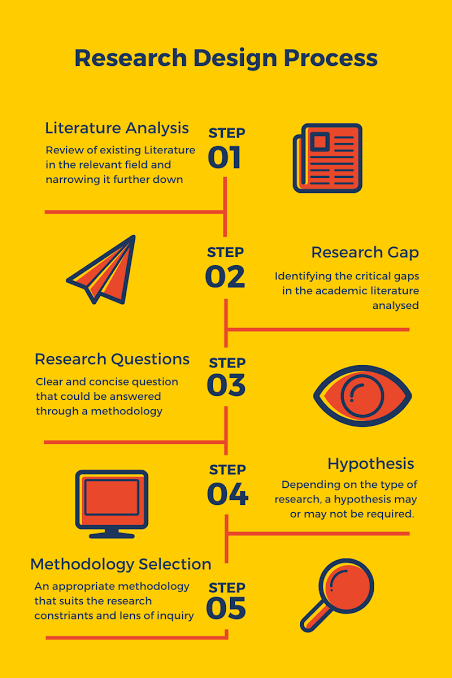
3. Research Question
A research question translates the research problem into a focused inquiry that the study seeks to answer.
For example:
- How does social media usage influence academic performance
- What factors affect employee engagement
- How effective is remote learning compared to classroom instruction
Strong research questions are clear, specific, and answerable through systematic investigation.
4. Literature Review
Before collecting data, researchers conduct a literature review to understand existing knowledge about the topic. Reviewing previous studies helps identify research gaps, refine the research question, and justify the need for the current investigation.
A high-quality literature review also assists the researcher in selecting appropriate research methods and avoiding duplication of previous work.
5. Selection of Research Methods
Choosing suitable research methods is one of the most important aspects of developing a research design. Depending on the objectives, a researcher may employ surveys, interviews, observations, experiments, focus groups, or document analysis.
The chosen method should align with the nature of the data required and the overall purpose of the investigation.
6. Data Collection
The design specifies how information will be gathered. Different studies require different approaches depending on whether they rely on quantitative research, qualitative research, or a combination of both.
Common data collection techniques include:
- Surveys
- Questionnaires
- Interviews
- Focus groups
- Direct observation
- Experiments
- Existing organizational records
Selecting appropriate techniques contributes to the overall quality of the analysis.
7. Data Analysis
Once information has been collected, it must be organized and interpreted through systematic data analysis.
For quantitative research, this often involves statistical analysis, descriptive statistics, regression models, or hypothesis testing.
In qualitative research, the researcher typically analyzes themes, patterns, meanings, and participant experiences using coding techniques and interpretation of qualitative data.
The selected analytical approach should directly support the research objectives and answer the research question.
8. Ethical Considerations
Ethics are an essential component of every research design. Researchers must ensure that participants provide informed consent, understand the purpose of the study, and have their privacy protected throughout the investigation.
Ethical research also requires transparency, honesty in reporting results, and responsible handling of collected information.
Research Design, Research Methodology, and Research Methods: Understanding the Difference
Students frequently confuse research design, research methodology, and research methods. Although closely related, these concepts serve different purposes within a research project.
| Aspect | Research Design | Research Methodology | Research Methods |
|---|---|---|---|
| Purpose | Overall blueprint of the study | The theoretical rationale behind the chosen approach | Specific techniques used to collect and analyze data |
| Focus | Planning the entire investigation | Explaining why certain approaches are appropriate | Implementing practical procedures |
| Scope | Broad | Broad and philosophical | Narrow and operational |
| Examples | Experimental, descriptive, correlational | Quantitative, qualitative, mixed approaches | Surveys, interviews, observations, experiments |
In simple terms, research methodology explains the reasoning behind the approach, research design organizes the entire investigation, while research methods describe the practical tools used to collect and analyze information.
These three elements work together to ensure that a researcher conducts a rigorous, logical, and credible study.
Laying the Foundation for a Good Research Design
Developing a good research design requires more than selecting a popular approach. The design must fit the nature of the research problem, align with the research objectives, support appropriate methods of data collection, and provide a clear path for analysis.
Researchers should begin by defining the problem, reviewing existing evidence, identifying suitable methods, considering ethical requirements, and planning how results will be interpreted. When these elements are carefully integrated, the design becomes a powerful framework that supports reliable decision-making and meaningful research outcomes.
In the next section, we will explore the major research designs used across academic and professional disciplines including descriptive research, experimental research, correlational research, exploratory research, case study research, mixed methods research, and several other approaches to help you determine the right research design for your own investigation.
Types of Research Design
Selecting the appropriate research design is one of the most important decisions a researcher makes during the research process. The design chosen influences how data is collected, the type of analysis performed, and the credibility of the final research finding. Since every research problem is unique, no single design is suitable for every study.
Broadly, research designs are classified into three categories: quantitative research, qualitative research, and mixed methods research. Within these categories are several specialized designs tailored to different objectives and research questions.
Quantitative Research Design
A quantitative research design focuses on collecting numerical data that can be measured and analyzed statistically. Researchers use this approach to test hypotheses, examine relationships between variables, measure trends, and make predictions based on objective evidence.
Because quantitative studies rely on measurable information, they often involve structured questionnaires, experiments, standardized tests, or surveys. The findings are interpreted using statistical analysis, making the results easier to compare, replicate, and generalize to larger populations.
Characteristics
- Collects numerical data
- Uses structured instruments
- Employs probability sampling where appropriate
- Supports hypothesis testing
- Produces objective findings
- Enables statistical comparisons
Example
A university wants to determine whether online learning improves students’ academic performance. The researcher surveys 500 students, compares examination scores, and performs data analysis using statistical software to determine whether significant differences exist.
Qualitative Research Design
Unlike quantitative approaches, qualitative research design seeks to understand experiences, opinions, beliefs, behaviors, and social interactions. Rather than focusing on numbers, it explores the meaning behind human actions through detailed observation and interpretation of qualitative data.
Researchers typically use interviews, focus groups, observations, and document reviews to gather rich descriptive information.
Characteristics
- Explores experiences and perceptions
- Produces non-numerical findings
- Uses flexible research procedures
- Generates in-depth insights
- Focuses on understanding rather than measurement
Example
A researcher interviews teachers to understand how digital technologies influence classroom engagement. Instead of calculating averages, the analysis identifies recurring themes, attitudes, and challenges expressed by participants.
Mixed Methods Research
Mixed methods research combines both quantitative and qualitative approaches within the same study. This design enables researchers to benefit from the strengths of both methods while minimizing their individual limitations.
For example, numerical survey results may reveal that customer satisfaction has declined, while interviews explain why customers are dissatisfied.
Advantages
- Provides comprehensive findings
- Combines numerical and descriptive evidence
- Strengthens research validity
- Improves interpretation of results
- Offers multiple perspectives on the same problem
Mixed methods are increasingly popular in healthcare, education, business, and public policy because they produce more balanced evidence.
Experimental Research Design
An experimental research design investigates cause-and-effect relationships by manipulating one variable while controlling others. It is widely regarded as one of the strongest designs for determining whether one factor directly influences another.
In experimental research, participants are often assigned to control and experimental groups. The experimental group receives a treatment or intervention, while the control group does not.
Characteristics
- Manipulates independent variables
- Measures dependent variables
- Controls external influences
- Tests causal relationships
- Often uses random assignment
Example
A pharmaceutical company evaluates a new medication by randomly assigning patients to receive either the new treatment or a placebo. After several weeks, the analysis compares health outcomes between both groups.
Quasi Experimental Design
Sometimes random assignments are impossible or unethical. In such cases, researchers use a quasi experimental design.
This design resembles experimental research but lacks full randomization. Although it cannot eliminate every source of bias, it still allows researchers to evaluate interventions under real-world conditions.
Example
A school introduces a new mathematics curriculum to one existing class while another class continues using the previous curriculum. Since students were not randomly assigned, the investigation represents a quasi-experimental rather than a true experiment.
Descriptive Research Design
A descriptive research design aims to describe characteristics, behaviors, opinions, or conditions without attempting to establish cause-and-effect relationships.
Among the various research designs, this is one of the most frequently used because it helps researchers understand “what exists” within a population.
Characteristics
- Describes existing situations
- Collects current information
- Uses surveys and observations
- Does not manipulate variables
Example
A government agency surveys citizens to determine internet access across different regions. The descriptive design summarizes demographic characteristics and usage patterns without attempting to explain why differences occur.
Correlational Research Design
A correlational research design examines relationships between variables without manipulating them.
Instead of asking whether one variable causes another, it investigates whether they move together.
Example
A researcher examines whether increased exercise is associated with reduced stress among university students.
The findings may reveal a strong relationship, but they cannot prove that exercise directly causes lower stress because other variables may also influence the outcome.
Exploratory Research
When little information exists about a topic, researchers often begin with exploratory research.
The objective is not to reach final conclusions but to understand the issue, identify possible explanations, and generate ideas for future investigation.
An exploratory design is particularly useful for emerging technologies, new social issues, or previously understudied phenomena.
Example
A startup investigates why consumers hesitate to adopt a newly developed artificial intelligence application. Interviews reveal concerns about privacy and trust, providing direction for future studies.
Case Study Research
A case study investigates a single individual, organization, event, or community in great depth.
Rather than examining a large sample, researchers focus intensively on one specific case to understand its complexity.
Characteristics
- In-depth investigation
- Rich contextual information
- Multiple data sources
- Detailed interpretation
Example
A business school analyzes the digital transformation of one multinational company over five years to understand successful innovation strategies.
Case studies are common in business, education, healthcare, psychology, and social science research.
Cross Sectional Design
A cross sectional design collects information from participants at one specific point in time.
Unlike longitudinal investigations, cross-sectional studies provide a snapshot rather than tracking changes over time.
Example
A national survey measures public attitudes toward renewable energy during a single month.
Because data is collected only once, this design is generally faster and less expensive than long-term investigations.
Cohort Study
A cohort study follows a group of individuals who share common characteristics over an extended period.
Researchers observe how exposures, experiences, or behaviors influence future outcomes.
Example
Healthcare researchers follow 2,000 adults for ten years to determine whether regular exercise reduces cardiovascular disease.
Cohort studies are especially valuable in medicine and public health because they help identify long-term trends.
Action Research
Action research is designed to solve immediate practical problems while simultaneously generating knowledge.
Instead of remaining detached observers, researchers collaborate with participants to improve existing practices.
Example
A school principal works with teachers to test new classroom management strategies, evaluates the results, implements improvements, and repeats the cycle until desired outcomes are achieved.
Action research is particularly popular in education, healthcare, and organizational development.
Sequential Design
A sequential design is commonly used within mixed-methods studies.
In this approach, one phase of the research informs the next phase.
Two common models include:
Sequential Explanatory Design
Researchers first collect quantitative data and then conduct qualitative interviews to explain the statistical findings.
Sequential Exploratory Design
Researchers first conduct qualitative interviews before designing a quantitative survey based on the emerging themes.
Sequential approaches provide richer insights than relying on a single method alone.
Comparing Major Research Designs
| Research Design | Primary Purpose | Data Type | Best Used For |
|---|---|---|---|
| Quantitative Research Design | Measure relationships and test hypotheses | Numerical | Large-scale studies |
| Qualitative Research Design | Explore experiences and meanings | Non-numerical | Human behavior and perceptions |
| Mixed Methods Research | Combine numerical and descriptive evidence | Both | Complex research problems |
| Experimental Research Design | Determine cause and effect | Numerical | Scientific experiments |
| Descriptive Research Design | Describe characteristics | Numerical or categorical | Surveys and population studies |
| Correlational Research Design | Examine relationships | Numerical | Predictive studies |
| Exploratory Research | Investigate little-known topics | Flexible | Early-stage investigations |
| Case Study | Analyze one case in depth | Multiple sources | Organizational or individual analysis |
| Cross Sectional Design | Capture a single point in time | Numerical or qualitative | Opinion surveys |
| Cohort Study | Observe changes over time | Longitudinal | Healthcare and epidemiology |
| Action Research | Improve practice | Mixed | Education and workplace improvement |
Choosing the Most Appropriate Design
Choosing among different research designs depends on several factors, including the nature of the research question, available resources, ethical considerations, and the type of evidence required.
For example:
- If the objective is to establish cause and effect, an experimental design is usually the strongest option.
- If the goal is to describe characteristics or trends, a descriptive research design is more appropriate.
- If little is known about a phenomenon, exploratory research provides a useful starting point.
- When understanding human experiences is the priority, qualitative research offers deeper insights.
- If both measurable outcomes and personal perspectives are important, mixed methods research provides a balanced approach.
Ultimately, the right research design is the one that best aligns the research question, objectives, available data, and planned analysis. Rather than selecting a design because it is popular, a skilled researcher chooses the approach that most effectively addresses the problem under investigation while producing reliable and meaningful evidence.
In the final part of this guide, you’ll learn how to select a good research design, explore practical examples across different disciplines, avoid common mistakes, and apply best practices that improve the quality and credibility of any research study.
How to Choose the Right Research Design
Selecting the right research design is one of the most important decisions a researcher makes throughout the research process. The design you choose determines how data will be collected, how the analysis will be conducted, and ultimately whether the research finding can be trusted.
Many students assume that choosing a research design simply means selecting between qualitative and quantitative approaches. In reality, it requires careful consideration of the research problem, research objective, available resources, ethical issues, and the type of evidence needed to answer the research question.
The following framework can help researchers make informed decisions.
1. Clearly Define the Research Problem
Every successful research study begins with a clearly defined research problem. If the problem is vague or poorly articulated, selecting an appropriate design becomes difficult.
For example:
- If the goal is to determine why employee productivity has declined, an exploratory or qualitative approach may be suitable.
- If the goal is to measure how much productivity has changed, a quantitative approach may be more appropriate.
- If the goal is to evaluate whether a new policy caused the decline, an experimental approach may be required.
The clearer the problem, the easier it becomes to identify the most appropriate design.
2. Align the Design with the Research Question
Your research question should always determine your design, not the other way around.
Consider these examples:
| Research Question | Appropriate Research Design |
|---|---|
| What factors influence customer satisfaction? | Descriptive Research Design |
| Does employee training improve productivity? | Experimental Research Design |
| Is there a relationship between income and education? | Correlational Research Design |
| How do patients experience telemedicine? | Qualitative Research Design |
| How can classroom participation be improved? | Action Research |
This alignment ensures that every stage of the investigation contributes to answering the central question.
3. Consider the Type of Data Required
The nature of the information you need plays a significant role in choosing a design.
If your study requires:
- Numerical measurements → Quantitative Research
- Personal opinions and experiences → Qualitative Research
- Both numerical and descriptive evidence → Mixed Methods Research
Selecting the appropriate type of data helps ensure meaningful data analysis and credible conclusions.
4. Evaluate Available Resources
Researchers should realistically assess available resources before selecting a design.
Consider:
- Budget
- Time
- Equipment
- Access to participants
- Technical expertise
- Availability of software for statistical analysis
For example, a nationwide experimental study may be ideal in theory but impractical if funding is limited.
5. Consider Ethical Requirements
Some designs are ethically inappropriate for certain investigations.
For example:
- Researchers cannot intentionally expose participants to harmful conditions simply to observe outcomes.
- Sensitive personal information must remain confidential.
- Participants should always provide informed consent.
Ethics should influence every stage of the research process, from planning through reporting.
Practical Examples of Research Design Across Different Fields
Understanding how research designs are applied in practice helps bridge the gap between theory and real-world investigations.
Education
A university wants to evaluate whether interactive learning platforms improve examination performance.
Recommended Design:
- Experimental Research Design
Students are divided into two groups. One uses the new platform, while the other follows traditional classroom instruction. Examination scores are compared through data analysis.
Business
A retail company wants to understand why customer loyalty has declined.
Recommended Design:
- Case Study
- Qualitative Research Design
Managers interview long-term customers to identify recurring themes and service challenges before implementing improvements.
Healthcare
Researchers investigate whether daily exercise reduces the risk of diabetes.
Recommended Design:
- Cohort Study
Participants are followed for several years while researchers monitor lifestyle habits and health outcomes.
Marketing
A company launches a new advertising campaign and wants to evaluate consumer responses.
Recommended Design:
- Descriptive Research
- Market Research
Surveys are distributed to customers, and responses are summarized using descriptive statistics.
Psychology
A psychologist investigates whether sleep quality is related to anxiety among university students.
Recommended Design:
- Correlational Research Design
The analysis determines whether a statistical relationship exists between sleep patterns and anxiety levels.
Social Science
A researcher explores how community members perceive renewable energy projects.
Recommended Design:
- Qualitative Research
- Interviews
- Focus groups
The collected qualitative data is coded into themes to identify common perceptions and concerns.
Common Mistakes to Avoid
Even experienced researchers occasionally make mistakes during the planning stage. Avoiding these common errors can significantly improve the quality of your research study.
Choosing a Design Before Defining the Problem
Many students decide to use a particular design simply because it is familiar.
Instead, begin with the research problem and allow it to determine the design.
Writing Broad Research Questions
Poor example:
“What is education?”
Better example:
“How does online learning influence academic performance among undergraduate students?”
Specific questions lead to stronger investigations.
Ignoring the Literature Review
Skipping the literature review may result in repeating previous work or overlooking important theories.
Reviewing existing studies helps identify research gaps and improves the quality of the proposed design.
Collecting Irrelevant Data
Every piece of information collected should contribute to answering the research question.
Collecting unnecessary data increases costs and complicates analysis.
Selecting Inappropriate Research Methods
Using interviews when numerical evidence is required or surveys when in-depth understanding is needed reduces the effectiveness of the investigation.
Always ensure the selected research methods align with the study objectives.
Overlooking Ethical Considerations
Ignoring participant privacy, informed consent, or confidentiality can invalidate a study and damage public trust.
Ethical research is good research.
Best Practices for Developing a Good Research Design
The following recommendations can help researchers develop a good research design regardless of discipline.
Define Clear Objectives
Every stage of the investigation should support the research objective.
Use Appropriate Research Methods
Select methods that directly answer the research question.
Remember that research design, research methodology, and research methods work together rather than independently.
Pilot Test Data Collection Instruments
Before collecting information from the full sample, test questionnaires or interview guides with a small group.
Pilot testing helps identify unclear questions and improves data quality.
Maintain Consistency
Use standardized procedures throughout the research process.
Consistency improves reliability and reduces bias.
Document Every Decision
Researchers should record:
- Why a particular design was selected
- Sampling decisions
- Data collection procedures
- Changes made during the study
- Limitations encountered
This transparency strengthens the credibility of the final report.
Use Appropriate Analysis Techniques
Choose analytical methods that match the collected data.
For quantitative studies, appropriate statistical analysis enhances objectivity.
For qualitative investigations, systematic coding and thematic interpretation improve rigor.
Report Findings Honestly
Researchers should present both expected and unexpected research findings without manipulating or omitting results.
Honest reporting contributes to scientific integrity and supports future investigations, including systematic review studies that synthesize evidence across multiple publications.
Frequently Asked Questions
What is research design
Research design is the overall plan or blueprint that guides how a researcher collects, analyzes, and interprets data to answer a research question systematically and accurately.
What is the difference between research design and research methodology
Research design outlines the structure of the study, while research methodology explains the theoretical reasoning behind the chosen approach. Research methods, on the other hand, are the specific techniques used to collect and analyze data.
Which research design is best
There is no universally “best” design. The most appropriate choice depends on the research objectives, research question, available resources, ethical considerations, and the nature of the phenomenon being investigated.
Why is research design important
A well-developed research design improves validity, reliability, efficiency, and the overall quality of a study. It also helps reduce bias and ensures that the findings accurately address the research problem.
Can qualitative and quantitative research be combined
Yes. Mixed methods research combines qualitative and quantitative approaches to provide a more comprehensive understanding of complex research problems.
When should exploratory research be used
Exploratory research is appropriate when little information exists about a topic or when researchers seek to generate new ideas, identify patterns, or refine future research questions.
What makes a good research design
A good research design aligns with the research problem, objectives, and questions; uses appropriate methods; considers ethical requirements; supports accurate data collection and analysis; and produces valid, reliable, and meaningful findings.
Conclusion
A well-planned research design is the foundation of every successful research study. It provides a structured framework that guides the researcher from defining the research problem and formulating the research question to selecting appropriate research methods, collecting data, performing analysis, and presenting reliable conclusions.
Throughout this guide, we’ve explored the purpose and importance of research design, its essential components, and the major types used across academic and professional disciplines including quantitative research, qualitative research, experimental research, descriptive research, correlational research, action research, case study, cross sectional design, cohort study, and mixed methods research. We’ve also examined how to choose the right design, avoid common mistakes, and apply best practices that improve the quality and credibility of research.
Ultimately, there is no one-size-fits-all approach. The right research design is the one that best aligns with your objectives, available resources, and the evidence required to answer your research question. By investing time in thoughtful planning, conducting a thorough literature review, selecting appropriate methods, and applying rigorous data analysis, researchers can produce findings that are accurate, trustworthy, and capable of informing decisions across education, healthcare, business, social science, public policy, and beyond.
Whether you are preparing a classroom assignment, developing a thesis, writing a dissertation, or leading a professional research project, mastering research design will help you conduct studies with confidence, integrity, and lasting impact.
Be the first to comment