Research plays a fundamental role in expanding knowledge, solving problems, and supporting evidence-based decision-making across various disciplines. Whether in education, healthcare, business, social science, or marketing research, selecting the appropriate research design is one of the most important decisions a researcher makes. A well-chosen research design ensures that a study addresses the research problem effectively, answers the research question accurately, and produces reliable findings that contribute meaningful insight to existing knowledge.
Among the many research methods available, descriptive research design remains one of the most widely used because it focuses on describing the characteristics, behaviors, conditions, or patterns of a population or phenomenon without manipulating variables. Instead of establishing cause-and-effect relationships like experimental research or exploring entirely new topics like exploratory research, descriptive research seeks to present an accurate picture of what currently exists. This makes it particularly valuable in descriptive studies where researchers aim to understand trends, opinions, demographic characteristics, or behaviors using systematic and objective methods.
Descriptive research is applied in numerous fields, including market research, education, healthcare, psychology, government policy, and user research. Organizations use it to understand customer preferences, educational institutions rely on it to evaluate student performance, healthcare professionals use it to monitor disease prevalence, and businesses depend on it to identify consumer buying patterns that inform strategic decisions. Because of its flexibility and practicality, descriptive research design has become a cornerstone of modern research methodology.
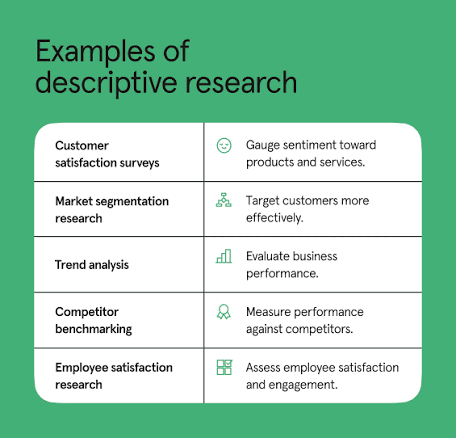
This comprehensive guide explains what descriptive research design is, its purpose, characteristics, major types, and practical applications. It also explores how researchers can effectively implement this research design while highlighting its strengths, limitations, and role in producing valuable insights for academic and professional settings.
What Is Descriptive Research Design
Academic Definition
Descriptive research design is a systematic research design that aims to describe the characteristics, behaviors, conditions, or phenomena of a population, situation, or subject without manipulating independent variables. It belongs to the family of non-experimental research methods because the researcher observes and records information as it naturally occurs rather than introducing treatments or interventions.
Unlike experimental research design, which seeks to determine cause-and-effect relationships by controlling variables, descriptive research focuses on answering questions such as “What is happening?”, “Who is involved?”, “Where does it occur?”, and “How frequently does it happen?” The primary objective is to generate an accurate and comprehensive description of the subject under investigation.
In research methodology, descriptive research serves as an essential foundation for understanding real-world situations before more complex analytical or experimental investigations are undertaken. The findings often provide baseline information that supports future research and helps organizations develop evidence-based strategies.
Plain-Language Explanation
Simply put, descriptive research design helps researchers describe a situation exactly as it exists. Imagine a school principal who wants to know how satisfied students are with online learning. Instead of changing the teaching methods or conducting experiments, the principal distributes questionnaires, collects responses, analyzes the descriptive data, and summarizes the findings. This process illustrates descriptive research because the goal is to observe and report existing conditions rather than influence them.
Similarly, a hospital administrator may conduct an observational study to determine patient satisfaction levels across different departments. A retail company may perform market research to identify customer purchasing habits. A government agency may examine employment statistics to understand demographic patterns. In each case, the researcher collects information, identifies trends, and presents findings without attempting to alter the environment being studied.
Why Descriptive Research Design Matters
Every successful study begins with a clear understanding of the problem being investigated. Descriptive research provides this understanding by supplying factual information about populations, behaviors, opinions, and conditions. Without this foundational knowledge, researchers may struggle to formulate meaningful hypotheses or design effective interventions.
The importance of descriptive research extends beyond academia. Businesses rely on descriptive studies to evaluate customer satisfaction, governments use them to inform policy decisions, healthcare providers monitor disease distribution, and educators assess student learning outcomes. By accurately describing current realities, descriptive research equips decision-makers with actionable insights that improve planning, resource allocation, and strategic decision-making.
Moreover, descriptive research often serves as the starting point for more advanced investigations. The patterns identified through descriptive studies frequently inspire experimental research, qualitative research, or mixed-methods studies that explore underlying causes or relationships in greater depth.
Purpose of Descriptive Research Design
The primary purpose of descriptive research design is to provide an accurate and objective account of existing situations without influencing the variables being observed. Rather than testing whether one variable causes another, descriptive research aims to document facts, identify trends, and explain how specific characteristics are distributed within a defined population.
One major objective is to describe populations. Researchers may examine demographic characteristics such as age, gender, education level, income, occupation, or geographic location to understand the composition of a target group. Such information is invaluable for organizations seeking to tailor products, services, or policies to specific audiences.
Another important purpose is identifying behavioral patterns. Businesses conducting marketing research often investigate consumer preferences, shopping habits, and purchasing behaviors to develop effective marketing strategies. Educational researchers may analyze attendance records, academic performance, and learning preferences to improve instructional methods.
Descriptive research also supports organizational decision-making. Government agencies use descriptive data to monitor unemployment rates, crime statistics, and public health trends. Hospitals assess patient satisfaction to improve healthcare delivery. Companies evaluate employee engagement to strengthen workplace culture. Each study contributes valuable insights that inform practical decisions.
Additionally, descriptive research provides a strong foundation for future research. Before testing hypotheses through experimental research, researchers frequently perform descriptive studies to understand the current state of knowledge and identify areas requiring further investigation.
Key Characteristics of Descriptive Research Design
Understanding the characteristics of descriptive research helps distinguish it from other research methods and ensures researchers select the most appropriate design for their objectives.
Non-Experimental Nature
One defining characteristic of descriptive research design is that it is non-experimental. Researchers observe situations without manipulating variables or assigning treatments. This distinguishes descriptive research from experimental design, where researchers intentionally alter one or more variables to examine causal effects.
Systematic Data Collection
Descriptive research follows a structured process for collecting information. Researchers carefully define the research problem, identify the target population, select appropriate research methods, design data collection instruments, and analyze findings using established procedures. This systematic approach enhances the reliability and validity of the research report.
Focus on Real-World Conditions
Descriptive research investigates phenomena in their natural settings. Whether examining classroom performance, consumer preferences, healthcare outcomes, or workplace satisfaction, researchers seek to capture authentic conditions rather than artificially controlled environments.
Objective Observation
Researchers strive to remain neutral throughout the study. Personal opinions and assumptions should not influence data collection or interpretation. Objective observation helps ensure that the findings accurately represent the population being studied.
Use of Quantitative and Qualitative Data
Although descriptive research is commonly associated with quantitative descriptive research, it may also incorporate qualitative descriptive research depending on the research objectives. Quantitative approaches involve numerical measurements such as frequencies, percentages, and descriptive statistics, while qualitative data may include interview responses, observations, or document analysis that provide richer contextual understanding.
Identification of Patterns and Trends
Another important characteristic is the identification of recurring patterns within collected data. By examining similarities, differences, and trends across a population, researchers generate meaningful insight into behaviors, opinions, and characteristics that may otherwise remain unnoticed.
Supports Evidence-Based Decisions
Because descriptive research produces factual information rather than assumptions, organizations use its findings to make informed decisions. Whether improving educational programs, developing marketing campaigns, or designing public health interventions, reliable descriptive studies contribute to more effective planning and policy development.
Types of Descriptive Research Design
Different types of descriptive research design address different research objectives. Choosing the appropriate type depends on the nature of the research problem, available resources, and the kind of information the researcher intends to collect.
Survey Research
Survey research is perhaps the most common form of descriptive research. It involves collecting information from a sample or an entire population through questionnaires, interviews, or online surveys. Survey research is widely used because it allows researchers to gather large amounts of information efficiently while maintaining standardized procedures.
For example, a university may survey students to assess satisfaction with online learning platforms. A retail company may conduct customer satisfaction surveys to improve products and services. Government agencies frequently use surveys to measure employment rates, household income, and public opinion.
Survey research is especially valuable when researchers need to summarize opinions, attitudes, or behaviors across large populations.
Observational Study
An observational study involves systematically watching and recording behaviors or events without interfering with participants. Researchers observe natural environments to understand how individuals behave under ordinary conditions.
For instance, educators may observe classroom interactions to evaluate teaching methods, while healthcare professionals monitor patient behaviors during treatment. Businesses also use observational techniques in user research to understand how customers interact with products or digital platforms.
Because observational studies capture authentic behaviors, they often complement survey findings by providing additional context.
Case Study
A case study focuses on an in-depth examination of a single individual, organization, event, or community. Unlike broader descriptive studies, the case study method seeks detailed understanding rather than broad generalization.
For example, a researcher may investigate how one hospital successfully reduced patient waiting times or how a particular school improved student academic performance. Multiple case studies can also be compared to identify recurring themes and best practices across different contexts.
Case study research provides rich information that can generate hypotheses, illustrate theoretical concepts, and inspire future research in similar settings.
Cross Sectional Study
A cross sectional study examines a population at a single point in time. Researchers collect data once to describe current conditions rather than tracking changes over extended periods. Cross sectional studies are particularly useful for measuring prevalence, opinions, and demographic characteristics.
For example, a public health organization may conduct a cross sectional study to estimate vaccination rates within a community, while a business may analyze customer preferences during a specific marketing campaign.
In contrast, longitudinal research follows participants over time to examine changes and long-term developments. Understanding this distinction helps researchers choose the research design that best aligns with their objectives.
Data Collection Methods in Descriptive Research Design
The quality of any descriptive research depends largely on the quality of the data collected. Even a well-planned descriptive research design cannot produce meaningful results if inappropriate data collection techniques are used. Therefore, selecting the right research method is essential for obtaining accurate, reliable, and relevant information that addresses the research problem and answers the research question.
Researchers should choose data collection methods based on the objectives of the study, the characteristics of the target population, the available resources, and the type of descriptive data required. In many descriptive studies, researchers combine multiple research methods to obtain a more comprehensive understanding of the phenomenon being investigated.
Questionnaires
Questionnaires are among the most popular tools used in descriptive research. They consist of carefully designed questions that allow participants to provide information about their experiences, opinions, behaviors, or demographic characteristics.
Questionnaires are widely used because they are cost-effective, can reach large populations, and provide standardized responses that simplify data analysis. In market research, companies use questionnaires to evaluate customer satisfaction, product preferences, and buying behavior. Educational researchers use them to measure students’ perceptions of teaching methods, while healthcare organizations use them to assess patient satisfaction.
A well-designed questionnaire should contain clear, unbiased, and relevant questions. It should also be tested through a pilot study before full implementation to identify ambiguous wording or technical issues that could affect data quality.
Interviews
Interviews provide researchers with an opportunity to collect more detailed information than questionnaires alone. Depending on the objectives of the study, interviews may be structured, semi-structured, or unstructured.
Structured interviews use predetermined questions that ensure consistency across participants, making them particularly useful in descriptive research. Semi-structured interviews combine prepared questions with follow-up discussions, allowing researchers to gain deeper insight into participants’ responses.
Interviews are especially valuable when conducting qualitative descriptive research because they allow participants to explain their experiences in their own words. Although interviews require more time and resources than questionnaires, they often produce richer qualitative data that helps explain observed patterns.
Observation
Observation is another important descriptive research method in which the researcher systematically watches individuals, groups, or events without interfering with their normal activities.
Observation may be direct or indirect, participant or non-participant, depending on the objectives of the study. An observational study is particularly useful when researchers want to examine behaviors that participants may not accurately report through questionnaires or interviews.
For example, a researcher studying classroom interaction may observe teachers and students during lessons rather than relying solely on self-reported information. Similarly, organizations conducting user research frequently observe customers interacting with websites or mobile applications to identify usability challenges and opportunities for improvement.
Existing Records and Document Analysis
Many descriptive studies rely on existing records instead of collecting entirely new information. School attendance records, hospital databases, census reports, financial statements, government publications, and company performance reports all represent valuable sources of descriptive data.
Document analysis allows researchers to examine historical information, identify long-term patterns, and compare trends across different periods without conducting extensive fieldwork. This approach is particularly useful when studying organizational performance, policy implementation, or demographic changes.
Secondary Data
Secondary data refers to information previously collected by other researchers or institutions for different purposes. Government surveys, international databases, published journal articles, organizational reports, and statistical yearbooks provide researchers with reliable information that can support descriptive research.
Using secondary data can significantly reduce research costs and time. However, researchers should carefully evaluate the credibility, relevance, and currency of secondary sources before incorporating them into their research report.
Sampling Techniques in Descriptive Research
Selecting an appropriate sample is one of the most important decisions in any study. Since researchers often cannot collect information from every member of a population, sampling techniques allow them to select representative participants whose responses reflect the broader population.
The choice of sampling technique directly affects the validity and reliability of research findings.
Probability Sampling
Probability sampling gives every member of the population a known chance of being selected. This approach reduces sampling bias and increases the likelihood that findings accurately represent the target population.
Common probability sampling methods include:
- Simple random sampling
- Systematic sampling
- Stratified sampling
- Cluster sampling
Stratified sampling is particularly useful when researchers want to ensure representation from different demographic groups, while cluster sampling is often preferred for geographically dispersed populations.
Non-Probability Sampling
In some descriptive studies, probability sampling may not be practical because of time, financial, or logistical constraints. In such cases, researchers may use non-probability sampling methods.
Common examples include:
- Convenience sampling
- Purposive sampling
- Snowball sampling
- Quota sampling
Although these methods may introduce bias, they remain valuable when studying hard-to-reach populations or conducting preliminary investigations.
Researchers should always justify their chosen sampling technique in the research methodology section and explain how it supports the objectives of the study.
Data Analysis in Descriptive Research Design
After data collection is complete, researchers analyze the information to identify trends, summarize findings, and answer the research question. Unlike experimental research, which often relies on inferential statistical techniques to test hypotheses, descriptive research primarily uses descriptive statistics to summarize observed characteristics.
Common descriptive statistics include:
- Frequencies
- Percentages
- Mean
- Median
- Mode
- Standard deviation
- Tables
- Charts
- Graphs
These statistical measures help researchers present complex information in a clear and understandable manner.
For example, a marketing research project examining customer satisfaction may report that 82% of respondents are satisfied with a company’s services. Similarly, a school administrator may calculate the average examination score of students to evaluate academic performance.
Modern researchers frequently use software such as Microsoft Excel, IBM SPSS Statistics, or R to organize, analyze, and visualize descriptive data efficiently. These tools improve accuracy while reducing the time required to process large datasets.
However, researchers should remember that descriptive statistics summarize information rather than explain why observed patterns exist. Any attempt to establish causation requires a different research design.
Applications of Descriptive Research Design
One reason descriptive research remains popular is its versatility. It can be applied across numerous academic disciplines and professional sectors to solve practical problems and support informed decision-making.
Education
Educational institutions frequently use descriptive research to evaluate student achievement, teaching effectiveness, curriculum implementation, classroom engagement, and learning outcomes.
For example, a university may conduct a descriptive study to determine factors influencing student attendance or assess satisfaction with online learning environments.
Healthcare and Nursing
Healthcare organizations use descriptive research to monitor disease prevalence, patient satisfaction, healthcare utilization, and service quality.
Nurses may conduct descriptive studies to examine patient experiences during hospitalization, identify common health concerns, or evaluate adherence to treatment plans. Such findings help healthcare providers improve service delivery and patient outcomes.
Business and Market Research
Businesses rely heavily on descriptive research for market research because understanding customer behavior is essential for long-term success.
Organizations investigate customer demographics, purchasing habits, product preferences, brand loyalty, and service quality to develop effective business strategies. Marketing research also helps companies identify emerging consumer patterns, evaluate advertising campaigns, and improve customer experiences.
For instance, a retail company may analyze customer feedback to determine which product features receive the highest satisfaction ratings before launching a new product line.
Social Science
Researchers in social science frequently use descriptive research to examine social behaviors, cultural practices, public opinions, and community development.
Government agencies also conduct descriptive studies to monitor unemployment, poverty, education, crime, and population growth. The resulting findings often influence public policy and national development programs.
User Research and Technology
Technology companies increasingly depend on user research to improve digital products and services.
Researchers observe how users interact with websites, mobile applications, or software systems to identify usability issues and improve customer experiences. These studies generate actionable insights that support product development and innovation.
Advantages of Descriptive Research Design
Descriptive research offers numerous benefits that explain its widespread use across academic and professional environments.
One major advantage is its simplicity. Compared with experimental research design, descriptive research is generally easier to plan and implement because researchers do not manipulate variables or create controlled experimental conditions.
Another advantage is flexibility. Researchers can collect information using questionnaires, interviews, observation, existing records, or multiple research methods simultaneously. This flexibility allows studies to address a wide variety of research problems.
Descriptive research is also cost-effective. Large populations can often be studied efficiently using online surveys or existing databases, reducing both financial costs and data collection time.
Furthermore, descriptive research provides valuable insights into real-world situations. Organizations can use these findings to improve services, develop policies, understand customer behavior, and support evidence-based decision-making.
Another significant benefit is that descriptive studies often serve as the foundation for future research. By identifying trends, relationships, and recurring patterns, researchers can develop hypotheses that are later tested using more advanced research designs.
Finally, descriptive research contributes to informed planning. Whether evaluating educational performance, healthcare delivery, or consumer behavior, reliable findings help decision-makers allocate resources more effectively.
Limitations of Descriptive Research Design
Despite its many strengths, descriptive research also has limitations that researchers must recognize.
The most important limitation is that descriptive research cannot establish cause-and-effect relationships. Although researchers may identify relationships or patterns, they cannot conclude that one variable causes another because variables are not manipulated under controlled conditions.
Another challenge involves response bias. Participants may provide inaccurate information due to misunderstanding questions, memory limitations, or social desirability. Researchers can minimize this risk by designing clear questionnaires and ensuring participant anonymity.
Sampling bias also presents a concern. If the selected sample does not accurately represent the population, the findings may not be generalizable. Careful sampling procedures help reduce this problem.
Data quality depends heavily on the reliability and validity of research instruments. Poorly designed questionnaires or inconsistent observation procedures can reduce the credibility of the study.
Additionally, descriptive research often provides only a snapshot of a phenomenon at a particular point in time. While cross sectional studies effectively describe current conditions, they may not capture changes that occur over longer periods.
Researchers should also acknowledge ethical responsibilities throughout the study. Protecting participant confidentiality, obtaining informed consent, and ensuring responsible data management are essential components of high-quality research methodology.
Although these limitations exist, careful planning, appropriate research methods, rigorous sampling, and transparent reporting enable researchers to produce trustworthy findings that contribute meaningful knowledge to their respective fields.
Descriptive Research Design vs Other Research Designs
Selecting the right research design is essential because each approach serves a different purpose. Although descriptive research design is one of the most widely used research methods, it is not suitable for every research problem. Understanding how it differs from other approaches helps a researcher make informed methodological decisions and justify the selected design in a research report.
Descriptive Research Design vs Experimental Research Design
The primary difference between descriptive research design and experimental research design lies in the purpose of the study.
Descriptive research seeks to describe existing situations, behaviors, opinions, or characteristics without manipulating variables. The researcher simply observes and records what naturally occurs. In contrast, experimental research design investigates cause-and-effect relationships by deliberately manipulating one or more independent variables while controlling other factors.
For example, a descriptive study may investigate students’ preferred online learning platforms, while an experimental research study may examine whether a new teaching strategy improves examination performance compared to traditional methods.
When the objective is to understand “what exists,” descriptive research design is appropriate. However, when the goal is to determine “what causes change,” experimental design is the better choice.
Descriptive Research Design vs Exploratory Research
Exploratory research is conducted when very little information exists about a topic. Its purpose is to generate ideas, identify possible variables, and formulate hypotheses for future investigation.
Descriptive research, on the other hand, assumes that the researcher already has a clearly defined research problem and wants to accurately describe the phenomenon.
For instance, if researchers know very little about how artificial intelligence influences classroom learning, they may begin with exploratory research. Once key issues have been identified, descriptive research can be used to measure how widespread those issues are among teachers and students.
In many research projects, exploratory research precedes descriptive research because it helps establish the foundation for more structured investigations.
Descriptive Research Design vs Qualitative Research Design
Qualitative research design focuses on understanding meanings, experiences, beliefs, and social interactions through detailed observations, interviews, and discussions.
Although descriptive research can include qualitative descriptive research, the two are not identical. Qualitative research typically seeks depth, interpretation, and contextual understanding, whereas descriptive research aims to provide an accurate description of a population or phenomenon using either qualitative data, quantitative data, or both.
For example, interviewing cancer survivors about their emotional experiences represents qualitative research. Measuring how many patients report satisfaction with treatment represents descriptive research.
Descriptive Research Design vs Quantitative Research Design
Quantitative research design emphasizes numerical measurement and statistical analysis.
Many descriptive studies adopt a quantitative descriptive research approach by collecting numerical information through questionnaires or structured surveys. However, quantitative research extends beyond description and may involve hypothesis testing, prediction, and inferential statistics.
A quantitative descriptive research project may report that 78% of employees are satisfied with workplace communication. A broader quantitative study might investigate whether workplace communication predicts employee productivity.
Understanding this distinction helps researchers choose the most appropriate research method for their objectives.
Descriptive Research Design vs Case Study Method
The case study method investigates one individual, organization, community, or event in great depth.
Descriptive research usually examines larger populations to identify common characteristics and patterns. While case studies provide detailed contextual information, descriptive research offers broader generalizations across larger samples.
For example, examining one hospital’s patient safety program represents a case study. Surveying 150 hospitals to describe patient safety practices represents descriptive research.
Both approaches contribute valuable knowledge, but they answer different types of research questions.
How to Write the Descriptive Research Design Section in Chapter Three
One of the most common challenges faced by students is explaining and justifying their chosen research design in Chapter Three of a thesis, dissertation, or research proposal. A strong methodology section demonstrates that the selected design aligns with the objectives of the study and supports the collection of reliable evidence.
Step 1: Introduce the Research Design
Begin by clearly stating the research design adopted for the study.
Example:
“This study adopted a descriptive research design because it seeks to describe the characteristics, opinions, and experiences of respondents without manipulating any variables.”
The introduction should explain why the design is appropriate for addressing the research question.
Step 2: Justify the Choice
The researcher should explain why descriptive research is the most suitable approach.
Possible justifications include:
- The study seeks to describe existing conditions.
- Variables will not be manipulated.
- The objective is to collect factual information from respondents.
- The design allows accurate representation of the target population.
A convincing justification strengthens the credibility of the research methodology.
Step 3: Describe the Population
Identify the target population clearly.
Example:
“The population comprised all registered nurses working in five public hospitals within the study area.”
Providing a precise population definition improves the transparency of the study.
Step 4: Explain the Sampling Procedure
Describe the selected sampling technique and explain why it is appropriate.
Include:
- Sampling method
- Sample size
- Selection criteria
Researchers should also explain how the chosen sample adequately represents the target population.
Step 5: Describe the Research Instruments
Specify the instruments used for collecting data.
Examples include:
- Questionnaires
- Interview guides
- Observation checklists
- Document review forms
Researchers should also discuss instrument validity and reliability where applicable.
Step 6: Explain Data Analysis
State how the collected data will be analyzed.
Example:
“The collected data were analyzed using descriptive statistics including frequencies, percentages, means, and tables.”
This section should also mention any statistical software used during analysis.
Sample Methodology Paragraph
This study adopted a descriptive research design to examine customer satisfaction with digital banking services. The design was considered appropriate because it enabled the researcher to collect factual information from respondents without manipulating any study variables. Data were collected through structured questionnaires administered to selected customers using stratified random sampling. The responses were analyzed using descriptive statistics, including frequencies, percentages, mean scores, and graphical presentations to identify customer satisfaction patterns and provide actionable insights for improving service delivery.
Common Mistakes to Avoid
Many students reduce the quality of their research report by making avoidable mistakes, including:
- Confusing descriptive research with experimental research.
- Using an inappropriate sampling technique.
- Writing vague research objectives.
- Selecting instruments that do not measure the intended variables.
- Failing to explain the rationale for choosing descriptive research design.
- Drawing causal conclusions from descriptive findings.
- Ignoring ethical considerations during data collection.
Avoiding these mistakes improves the overall quality and credibility of the study.
Practical Examples of Descriptive Research Design
Understanding descriptive research design examples makes it easier to apply theoretical concepts in real research situations.
Example 1: Education
A university wants to determine students’ satisfaction with virtual learning platforms.
Research design: Descriptive research design
Research method: Survey research
Data collection: Online questionnaire
Analysis: Frequencies, percentages, and mean scores
Example 2: Healthcare
A hospital investigates patient satisfaction with outpatient services.
Research design: Descriptive study
Data collection: Structured interviews and questionnaires
Outcome: Identification of service quality patterns and recommendations for improvement.
Example 3: Business
A retail company conducts market research to understand consumer purchasing behavior before introducing a new product.
Research methods include customer surveys, observation, and sales records. The findings help management understand buying patterns and improve marketing strategies.
Example 4: Social Science
Researchers investigate youth participation in community development programs across several districts.
Using descriptive research methods, they identify demographic characteristics, participation levels, and perceived barriers. The results assist policymakers in developing more effective youth engagement initiatives.
Frequently Asked Questions
What is descriptive research design?
Descriptive research design is a non-experimental research design used to systematically describe the characteristics, behaviors, opinions, or conditions of a population or phenomenon without manipulating variables. It focuses on answering questions about what exists rather than why it exists.
Is descriptive research qualitative or quantitative?
Descriptive research may be quantitative, qualitative, or a combination of both. Quantitative descriptive research uses numerical data and descriptive statistics, while qualitative descriptive research explores experiences, opinions, and observations using interviews, documents, or observational techniques.
Can descriptive research establish causation?
No. Descriptive research identifies characteristics, trends, and relationships but cannot establish cause-and-effect relationships because variables are not manipulated under controlled conditions.
What data collection methods are commonly used?
Researchers commonly use questionnaires, interviews, observation, document analysis, existing organizational records, and secondary data depending on the objectives of the study.
What is the difference between descriptive research and survey research?
Survey research is one of the methods used within descriptive research. While many descriptive studies use surveys, descriptive research may also involve observation, case studies, interviews, and document analysis.
What industries commonly use descriptive research?
Descriptive research is widely used in education, healthcare, business, marketing research, finance, agriculture, government, public health, psychology, engineering, and user research because it provides reliable information for evidence-based decision-making.
Why is descriptive research important?
Descriptive research provides reliable information about existing situations, supports planning and policy development, identifies trends and patterns, and generates knowledge that forms the basis for future research across numerous disciplines.
Conclusion
Descriptive research design remains one of the most valuable approaches in modern research because it enables researchers to accurately describe existing conditions, behaviors, opinions, and characteristics without manipulating variables. Its flexibility allows it to be applied across education, healthcare, business, social science, market research, and many other fields where understanding current realities is essential for effective decision-making.
Throughout this guide, we have explored the definition, purpose, characteristics, types, data collection methods, sampling techniques, applications, advantages, and limitations of descriptive research design. We have also examined how it differs from exploratory research, experimental research, qualitative research design, quantitative research design, and the case study method. Understanding these distinctions helps researchers choose the most appropriate research design for their specific objectives while avoiding methodological errors.
An effective descriptive study begins with a clearly defined research problem, appropriate research methods, reliable data collection instruments, and a systematic analysis of findings. Whether the goal is to understand customer behavior, evaluate educational outcomes, monitor public health, or improve organizational performance, descriptive research provides dependable evidence that supports informed decisions and generates valuable insights.
As research continues to evolve, descriptive research will remain an essential component of evidence-based inquiry. The patterns and findings generated through well-designed descriptive studies not only enhance current understanding but also lay the foundation for future research, helping scholars and practitioners develop better theories, policies, and solutions to real-world challenges.
Be the first to comment