Imagine a school wants to determine whether a newly introduced teaching method genuinely improves students’ academic performance. Instead of relying on opinions or assumptions, the school divides students into groups, teaches one group using the traditional approach and the other using the new method, and then compares their examination results. If every other factor is kept as similar as possible, the difference in performance can be attributed to the teaching method itself. This simple scenario demonstrates the foundation of experimental research design.
Across education, healthcare, psychology, agriculture, business, and social science, organizations constantly make decisions that require reliable evidence. Researchers need more than observations or personal opinions, they need a systematic way to determine whether one factor actually causes another. This is where experimental research design becomes invaluable.
Experimental research design is one of the most rigorous approaches in quantitative research because it enables researchers to investigate cause-and-effect relationships under carefully controlled conditions. By manipulating one or more variables while controlling other factors, researchers can determine whether an experimental treatment truly influences an outcome. This approach forms the backbone of many scientific discoveries, policy decisions, educational reforms, and medical breakthroughs.
This comprehensive guide explains everything you need to know about experimental research design, including its meaning, characteristics, importance, components, practical examples, and why it remains one of the most trusted research designs in modern research methodology.
What Is Experimental Research Design?
Experimental research design is a structured research design in which researchers deliberately manipulate one or more independent variables to determine their effect on a dependent variable while controlling other factors that could influence the results. Its primary purpose is to establish a clear cause-and-effect relationship between variables.
Unlike other forms of research that simply describe events or identify relationships, experimental research actively tests hypotheses by introducing an intervention and observing its impact. Because of this ability to determine causality, experimental research is widely regarded as one of the strongest forms of research for scientific investigations.
For example, a university lecturer may wish to determine whether interactive learning improves students’ examination scores more than traditional lectures. Instead of asking students which method they prefer, the lecturer designs an experiment, assigns participants to different learning methods, measures their academic performance, and compares the outcomes. This systematic process produces more reliable evidence than opinions alone.
Experimental research design follows the principles of the scientific method, ensuring that conclusions are based on measurable evidence rather than assumptions. Every experiment begins with a research question, followed by a hypothesis, data collection, statistical analysis, interpretation of findings, and conclusion.
Although experimental research is commonly associated with laboratories, it is equally valuable in classrooms, hospitals, farms, businesses, manufacturing industries, and government institutions where decisions must be supported by evidence.
Why Experimental Research Design Is Important
In today’s data-driven world, organizations are expected to justify their decisions using reliable evidence. Experimental research provides that evidence by allowing researchers to identify whether a specific intervention truly produces a measurable effect.
One of its greatest strengths is its ability to establish causal relationships. Many research methods can identify associations between variables, but only well-designed experiments can confidently determine whether one variable directly influences another.
Healthcare professionals rely on experimental research before approving new medicines or treatment procedures. Educational institutions use experiments to evaluate innovative teaching strategies. Businesses conduct experiments before launching products or marketing campaigns. Agricultural researchers test fertilizers, seeds, irrigation techniques, and pest-control methods before recommending them to farmers.
The importance of experimental research also extends to public policy. Governments often conduct experimental studies to determine whether social programs, educational initiatives, or healthcare interventions achieve their intended objectives before implementing them on a larger scale.
Because experimental research minimizes bias through careful planning, controlled conditions, and systematic observation, it produces findings that are generally more reliable than those obtained from many other research methods.
Characteristics of Experimental Research Design
Experimental research possesses several unique characteristics that distinguish it from descriptive research, case study research, and many other research approaches.
Manipulation of Variables
Manipulation is one of the defining features of experimental research. Researchers intentionally change or introduce an independent variable to observe its influence on a dependent variable.
For example, an education researcher may introduce a new online learning platform to determine whether it improves examination performance. The online platform represents the manipulated variable, while students’ examination scores become the measured outcome.
Without manipulation, it would be impossible to determine whether the intervention caused the observed changes.
Random Assignment
Random assignment involves allocating participants to different groups purely by chance. Every participant has an equal opportunity to join either the experimental group or the control group.
This process helps distribute individual differences evenly across groups, reducing bias and increasing the credibility of the findings.
It is important to distinguish random assignment from random sampling. Random sampling focuses on selecting participants from a population, whereas random assignment determines how selected participants are allocated to different experimental conditions.
Controlled Conditions
A defining characteristic of experimental research is the maintenance of controlled conditions.
Researchers attempt to ensure that every participant experiences similar circumstances except for the independent variable being tested. This control reduces the influence of external factors that could distort the results.
For example, when comparing two teaching methods, the same classroom environment, examination format, lesson duration, and learning materials may be maintained for both groups.
Measurement of Outcomes
Experimental research relies on measurable outcomes rather than assumptions.
Researchers collect numerical or observable data before and after an intervention to determine whether meaningful changes have occurred. These measurements provide objective evidence that supports or rejects the research hypothesis.
Replication
A quality experiment should be repeatable.
Other researchers should be able to follow the same procedures and obtain similar findings under comparable circumstances. Replication strengthens confidence in research findings and contributes to the development of scientific knowledge.
Objectivity
Experimental research emphasizes objectivity throughout the entire research process.
Researchers follow predetermined procedures, standardized measurement techniques, and systematic data analysis to minimize personal bias and ensure consistency.
Components of Experimental Research Design
Every successful experimental study consists of several interconnected components. Understanding these components enables researchers to design more reliable experiments and interpret findings correctly.
Research Question
Every experiment begins with a clearly defined research question.
The research question identifies the specific problem the study intends to investigate.
For example:
“Does the use of interactive learning software improve students’ mathematics performance?”
A well-written research question provides direction for every subsequent stage of the research process.
Research Hypothesis
The hypothesis is a testable prediction about the expected relationship between variables.
For example:
“Students taught using interactive learning software will perform significantly better than students taught using conventional classroom methods.”
The hypothesis serves as the foundation upon which the entire experiment is built.
Independent Variable
The independent variable is the factor intentionally manipulated by researchers.
Examples include:
- Teaching method
- Fertilizer type
- Medication dosage
- Marketing strategy
- Exercise program
Only one primary independent variable is typically manipulated at a time unless the study uses more advanced designs such as factorial design.
Dependent Variable
The dependent variable represents the outcome researchers measure after manipulating the independent variable.
Examples include:
- Examination scores
- Crop yield
- Blood pressure
- Customer satisfaction
- Product sales
Changes observed in the dependent variable help determine whether the intervention produced the intended effect.
Experimental Group
The experimental group receives the intervention or experimental treatment.
For example, if researchers are testing a new teaching strategy, students in the experimental group receive the new instructional approach.
Their results are later compared with those of another group that does not receive the intervention.
Control Group
The control group does not receive the new intervention or receives the standard practice instead.
This group provides a benchmark for comparison, making it easier to determine whether observed differences result from the experimental treatment rather than other factors.
Participants
Participants are the individuals who take part in the experiment.
Depending on the study, research participants may include students, patients, employees, customers, farmers, or community members.
Researchers must carefully select participants according to clearly defined inclusion and exclusion criteria to ensure the study addresses the intended research problem.
Experimental Unit
The experimental unit refers to the smallest entity that independently receives an experimental treatment.
In educational research, individual students may serve as the experimental unit. In agricultural research, individual plots of land may become experimental units. In medical research, each patient may represent a separate experimental unit.
Correctly identifying the experimental unit is essential for accurate statistical analysis and interpretation.
Data Collection
Reliable experiments require systematic data collection.
Researchers collect information using instruments such as tests, questionnaires, observation schedules, laboratory measurements, digital sensors, interviews, or performance assessments.
The selected data collection method should align with the research question and produce valid, reliable evidence.
Statistical Analysis
After collecting data, researchers perform statistical analysis to determine whether observed differences between groups are statistically meaningful rather than occurring by chance.
Depending on the research objectives, statistical techniques such as t-tests, analysis of variance (ANOVA), regression analysis, or chi-square tests may be used to evaluate the effectiveness of the experimental treatment.
Careful statistical analysis enables researchers to draw objective conclusions supported by empirical evidence rather than personal opinion.
Experimental research design combines these components into a structured process that helps researchers produce dependable findings capable of informing education, healthcare, business, agriculture, psychology, and numerous other disciplines. Understanding each component lays the foundation for exploring the different types of experimental research design and the practical steps involved in conducting a successful experiment, which will be covered in the next part of this guide.
Types of Experimental Research Design
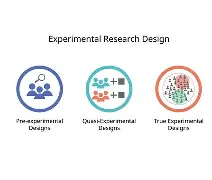
Not all experiments are conducted in the same way. Depending on the research objective, available resources, ethical considerations, and level of control over participants, researchers may choose different experimental research designs. The three major types are true experimental design, quasi experimental design, and pre experimental design. Each has its own strengths, limitations, and suitable applications.
Understanding these experimental research designs helps researchers select the most appropriate design for answering their research question while ensuring the validity and reliability of their findings.
True Experimental Design
A true experimental design is considered the gold standard in experimental research because it provides the strongest evidence for establishing cause-and-effect relationships.
In a true experimental design, researchers manipulate the independent variable, use one or more control groups, and randomly assign participants to different groups. These features help minimize bias and reduce the influence of external variables.
For example, suppose a researcher wants to determine whether a new mathematics teaching strategy improves students’ academic performance. Students are randomly assigned into two groups. The experimental group receives the new teaching strategy, while the control group continues with the traditional method. At the end of the study, both groups complete the same examination. If the experimental group performs significantly better under similar conditions, the researcher has stronger evidence that the teaching strategy influenced the outcome.
Because random assignment distributes participants fairly across groups, a true experiment provides high internal validity. This makes it one of the most trusted approaches in education, healthcare, psychology, and other scientific disciplines.
Advantages of true experimental design include:
- Strong evidence of cause-and-effect relationships.
- Reduced selection bias.
- High internal validity.
- Better control over external variables.
- Reliable and repeatable findings.
However, true experimental research design also has limitations. It can be expensive, time-consuming, and sometimes impractical or unethical. For instance, researchers cannot randomly assign people to smoke cigarettes simply to study the long-term health effects.
Quasi Experimental Design
A quasi experimental design resembles a true experiment but lacks random assignment. Instead of randomly allocating participants, researchers work with existing groups such as classrooms, hospitals, departments, or communities.
This type of design is particularly useful when random assignment is impossible, impractical, or unethical.
Imagine a researcher comparing the academic performance of students from two different schools after introducing a new teaching approach in one school. Since students are already enrolled in their respective schools, random assignment cannot occur. Nevertheless, the researcher can still compare the outcomes to determine whether the intervention produced a meaningful effect.
Although quasi experimental research provides valuable insights, the absence of random assignment increases the possibility that differences between groups existed before the intervention. Researchers must therefore use careful statistical analysis and sound research procedures to reduce potential bias.
Quasi experimental design is widely used in:
- Educational research.
- Public health studies.
- Organizational research.
- Community development projects.
- Government policy evaluations.
Pre Experimental Design
A pre experimental design is the simplest form of experimental research. It involves manipulating an independent variable but provides little or no control over external factors.
One common example is a one-group pre-test and post-test design. Researchers measure participants before an intervention, introduce the experimental treatment, and measure them again afterward.
Suppose a company organizes cybersecurity awareness training for its employees. Before the training, employees complete a knowledge assessment. After the training, they take the same assessment again. Any improvement suggests that the programme may have been effective.
Although this approach is easy to conduct, it cannot confidently establish causality because factors other than the intervention may have influenced the results.
Pre experimental research is commonly used for:
- Pilot studies.
- Preliminary investigations.
- Classroom demonstrations.
- Small-scale educational projects.
- Feasibility studies.
Because of its limited control, pre experimental research design is generally considered weaker than both true experimental design and quasi experimental design.
Comparison of the Three Major Experimental Research Designs
The differences between these research designs become clearer when compared side by side.
| Feature | True Experimental Design | Quasi Experimental Design | Pre Experimental Design |
|---|---|---|---|
| Random assignment | Yes | No | No |
| Control group | Usually present | Sometimes present | Often absent |
| Manipulation | Yes | Yes | Yes |
| Ability to establish causality | Very high | Moderate | Low |
| Internal validity | High | Moderate | Low |
| Common applications | Clinical trials, education, psychology | Schools, communities, hospitals | Pilot studies, classroom projects |
This comparison helps researchers choose the most suitable design based on their objectives and practical constraints.
Other Experimental Designs
In addition to the three major categories, several specialized experimental designs are used to address more complex research questions.
Factorial Design
A factorial design allows researchers to study the effects of two or more independent variables within a single experiment.
For example, an education researcher may investigate how both teaching methods and study duration influence students’ examination performance. Instead of conducting two separate experiments, both variables are examined simultaneously.
This approach helps researchers understand not only the individual effect of each variable but also how the variables interact with one another.
Factorial design is widely used in psychology, healthcare, education, and business research because it provides comprehensive information without requiring multiple independent studies.
Randomized Block Design
A randomized block design is used when researchers expect participants to differ in ways that could influence the outcome.
Participants are first grouped into blocks based on similar characteristics, such as age, gender, experience, or ability level. Random assignment then occurs within each block rather than across the entire sample.
For instance, a researcher evaluating two teaching methods may first classify students according to their previous academic performance before assigning them randomly to different teaching methods.
This design reduces variation within groups and improves the accuracy of the findings.
Block Design
A block design follows a similar principle by grouping comparable experimental units before applying treatments.
In agricultural research, plots with similar soil conditions may be grouped together before different fertilizers are tested. This minimizes environmental differences and allows researchers to observe the actual effect of each treatment more accurately.
Block design is particularly valuable when external conditions are expected to influence the results.
Repeated Measures Design
Repeated measures involve observing the same participants under different experimental conditions or at different times.
For example, researchers may measure employees’ productivity before training, immediately after training, and six months later. Because the same participants are measured repeatedly, individual differences are minimized.
Repeated measures are common in psychology, healthcare, education, and behavioural sciences.
However, researchers must carefully manage order effects, where participants’ performance changes simply because they become familiar with the task after repeated exposure.
Various techniques, including counterbalancing, can reduce these order effects and improve the quality of the findings.
Steps in Conducting Experimental Research
Conducting a successful experimental study requires careful planning and systematic execution. Although specific procedures vary across disciplines, most experiments follow a similar sequence.
Step 1: Identify the Research Problem
Every experiment begins with identifying a meaningful problem that requires investigation.
The problem should be specific, measurable, and capable of being investigated scientifically.
Step 2: Develop a Research Question
The research question guides the entire study.
For example:
“Does online collaborative learning improve students’ critical thinking skills more effectively than traditional classroom instruction?”
A clear research question provides direction for every subsequent stage of the research process.
Step 3: Review Existing Literature
Before designing the experiment, researchers conduct a thorough literature review.
Reviewing previous studies helps identify existing knowledge, research gaps, suitable methodologies, and potential limitations.
A well-conducted literature review also prevents unnecessary duplication of previous work.
Step 4: Formulate the Hypothesis
The hypothesis predicts the expected relationship between variables.
For example:
“There is a significant difference in academic performance between students taught using collaborative learning and those taught using traditional lectures.”
The hypothesis provides a clear statement that the experiment will test.
Step 5: Select Participants
Researchers identify suitable research participants according to predetermined selection criteria.
Participants should adequately represent the target population while meeting ethical requirements for voluntary participation and informed consent.
Step 6: Assign Participants to Groups
Whenever possible, participants should undergo random assignment into the experimental group and the control group.
Random assignment helps ensure fairness and minimizes selection bias, thereby strengthening the credibility of the study.
Step 7: Conduct the Experiment
The experimental treatment is administered according to the research plan while maintaining consistent experimental conditions.
Researchers carefully monitor every stage of the experiment to ensure procedures remain standardized.
Step 8: Collect Data
Relevant information is collected using appropriate instruments such as achievement tests, observation checklists, questionnaires, laboratory equipment, or digital monitoring systems.
High-quality data collection is essential for producing reliable findings.
Step 9: Perform Statistical Analysis
After collecting the data, researchers analyze the results using appropriate statistical techniques.
Statistical analysis determines whether observed differences between groups are significant and whether the hypothesis should be accepted or rejected.
Step 10: Interpret and Report Findings
Finally, researchers interpret the results objectively, discuss their implications, identify study limitations, and make recommendations for future research.
A well-written research paper presents these findings transparently, allowing other researchers to evaluate and replicate the study where appropriate.
Applications of Experimental Research Design
Experimental research design is widely applied across different disciplines because it enables researchers to evaluate whether an intervention produces a measurable effect. Its flexibility and scientific rigor make it one of the most valuable research designs for solving practical problems.
Education
In education, experimental research is used to evaluate teaching methods, learning technologies, classroom strategies, curriculum changes, and assessment techniques.
For example, a researcher may compare students taught through traditional classroom instruction with those taught using interactive digital learning tools. By measuring students’ performance before and after the intervention, researchers can determine whether the new teaching method significantly improves learning outcomes.
Educational experiments also help schools and universities make evidence-based decisions about instructional practices.
Psychology
Psychology relies heavily on experimental research because many psychological theories require controlled testing.
Researchers may investigate how sleep deprivation affects memory, whether stress influences decision-making, or how different learning environments affect concentration. Laboratory experiment settings are often used because they provide greater control over environmental factors.
Psychologists also use repeated measures designs to observe changes in participants over time while carefully managing order effects that could influence the results.
Healthcare
Healthcare professionals depend on experimental research before introducing new treatments, medications, or medical procedures.
Clinical trials are among the most recognized examples of experimental research. Patients receive different treatments under carefully controlled conditions, allowing researchers to evaluate safety, effectiveness, and potential side effects before recommending widespread use.
These studies have contributed significantly to advances in disease prevention, surgery, vaccination, and patient care.
Agriculture
Agricultural researchers frequently conduct experiments to determine the effectiveness of fertilizers, irrigation systems, crop varieties, and pest-control methods.
For example, researchers may divide farmland into several plots, apply different fertilizers to each plot, and compare crop yields after harvest. Because environmental conditions are carefully controlled, the findings provide valuable insights that farmers can confidently apply.
Business and Market Research
Businesses often conduct experiments before introducing new products, pricing strategies, advertising campaigns, or customer service improvements.
A company may test two versions of an online advertisement to determine which generates more sales or customer engagement. This allows decision-makers to invest in strategies supported by evidence rather than assumptions.
Market research increasingly incorporates experimental methods because they help organizations identify consumer preferences and improve business performance.
Social Science
Experimental research also contributes significantly to social science by evaluating policies, behavioural interventions, and community development programmes.
Researchers may examine whether financial literacy workshops improve household budgeting, whether youth empowerment initiatives reduce unemployment, or whether public awareness campaigns increase voter participation.
Such studies provide policymakers with reliable evidence for designing effective social programmes.
Advantages of Experimental Research Design
Experimental research design offers several advantages that explain why it is widely regarded as one of the strongest approaches in research methodology.
One of its greatest strengths is its ability to establish cause-and-effect relationships. Because researchers manipulate variables while maintaining controlled conditions, they can determine whether an intervention actually influences an outcome.
Another important advantage is the high level of control over external variables. This reduces bias and increases confidence in the results.
Experimental research also produces objective findings because conclusions are based on measurable evidence rather than opinions or personal observations.
The use of random assignment, where appropriate, further improves the reliability of findings by ensuring that participants have an equal chance of joining different groups.
Additionally, experiments are often repeatable. Other researchers can follow the same procedures to verify findings, strengthening the credibility of scientific knowledge.
Experimental research is also highly valuable for testing theories, evaluating innovations, improving products, and supporting evidence-based decision-making across various disciplines.
Disadvantages of Experimental Research Design
Despite its strengths, experimental research design is not without limitations.
Conducting experiments can be expensive, particularly when specialized equipment, laboratory facilities, or large numbers of participants are required.
Many experiments also require considerable time for planning, implementation, data collection, and statistical analysis.
Ethical concerns may limit what researchers can investigate. For example, it would be unethical to expose participants intentionally to harmful conditions simply to observe their effects.
Another challenge is that highly controlled environments may not always reflect real-world situations. As a result, findings from laboratory experiments may not always be directly applicable to everyday settings.
Participant behaviour may also change because individuals know they are being observed, potentially affecting the accuracy of the results.
Finally, not every research problem can be investigated experimentally. Some questions are better answered using descriptive research, qualitative approaches, surveys, or case study methods.
Experimental Research Design Versus Other Research Designs
Choosing the appropriate research design depends largely on the research question and study objectives.
Experimental research design focuses on determining cause-and-effect relationships through manipulation and control.
Descriptive research aims to describe characteristics, behaviours, or situations without manipulating variables.
A case study provides an in-depth investigation of a single individual, organization, event, or phenomenon rather than testing an intervention.
Correlational studies examine relationships between variables but cannot establish causality because no variable is deliberately manipulated.
Understanding these differences enables researchers to select the most appropriate methodology for their studies.
Common Mistakes to Avoid
Many beginners encounter avoidable problems when conducting an experimental study.
One common mistake is writing a vague research question that lacks clarity and focus.
Another is failing to identify the independent and dependent variables correctly.
Some researchers neglect proper random assignment when it is feasible, increasing the likelihood of biased results.
Others fail to control external variables, making it difficult to determine whether the observed effect resulted from the intervention or another factor.
Using unreliable measuring instruments, selecting an inappropriate sample, or applying incorrect statistical analysis can also compromise the quality of the findings.
Researchers should also avoid drawing conclusions that extend beyond the evidence collected during the experiment.
Best Practices for Conducting Experimental Research
Successful experiments require careful planning and disciplined execution.
Researchers should begin with a clearly defined research problem and a well-formulated hypothesis.
Variables should be identified accurately, and appropriate procedures should be established before data collection begins.
Whenever possible, random assignment should be used to improve fairness and reduce bias.
Experimental conditions should remain consistent throughout the study, ensuring that only the intended variable changes.
Reliable instruments should be used to collect data, and appropriate statistical methods should be selected before analysis.
Researchers should also document every stage of the experiment carefully to improve transparency and facilitate replication by other researchers.
Finally, ethical principles should guide every decision throughout the research process, including obtaining informed consent, protecting participant confidentiality, and minimizing potential risks.
Frequently Asked Questions
What is experimental research design?
Experimental research design is a research approach in which researchers manipulate one or more independent variables under controlled conditions to determine their effect on a dependent variable and establish cause-and-effect relationships.
What are the three main types of experimental research design?
The three major types are true experimental design, quasi experimental design, and pre experimental design.
Why is random assignment important?
Random assignment helps distribute participants fairly across different groups, reducing bias and increasing the credibility of research findings.
What is the difference between experimental research and descriptive research?
Experimental research investigates cause-and-effect relationships through manipulation, whereas descriptive research simply describes existing situations without changing any variables.
Where is experimental research commonly used?
Experimental research is widely used in education, psychology, healthcare, agriculture, engineering, business, market research, and social science.
Can experimental research be conducted outside a laboratory?
Yes. Although laboratory experiment settings provide excellent control, many experiments are successfully conducted in classrooms, hospitals, workplaces, farms, and communities.
What makes a good experiment?
A good experiment has a clear research question, a testable hypothesis, appropriate participants, careful manipulation of variables, controlled conditions, reliable data collection, and accurate statistical analysis.
Conclusion
Experimental research design remains one of the most powerful and reliable approaches for investigating cause-and-effect relationships. Through the careful manipulation of variables, the use of controlled conditions, and systematic observation, researchers can generate evidence that supports informed decision-making across numerous disciplines.
Whether improving classroom instruction, evaluating medical treatments, testing agricultural innovations, or assessing business strategies, experimental research provides dependable evidence that goes beyond assumptions and opinions. While every research design has its own strengths and limitations, experimental research is particularly valuable when the objective is to determine whether a specific intervention truly produces a measurable effect.
Selecting the appropriate experimental research design ultimately depends on the nature of the research question, available resources, ethical considerations, and the level of control that can realistically be achieved. By understanding the principles, components, applications, advantages, and limitations discussed in this guide, students, researchers, and professionals can confidently design stronger studies and produce findings that contribute meaningfully to knowledge and practice.
As you continue learning about research methodology, you may also find it helpful to explore related topics such as quantitative research, sampling techniques, research variables, validity and reliability, hypothesis testing, data collection methods, and statistical analysis. Building a solid understanding of these concepts will strengthen your ability to design, conduct, and evaluate high-quality research.
Be the first to comment