Sampling plays a fundamental role in research because it enables researchers to draw meaningful conclusions about a large population without collecting data from every individual. Whether you are conducting an academic study, preparing a dissertation, carrying out market research, or analyzing customer behavior in data science, selecting the right sampling method is essential for obtaining reliable and accurate results.
Imagine trying to study the academic performance of every university student in a country or surveying every customer who has purchased a product from a multinational company. Such an approach would require enormous amounts of time, money, and resources. Instead, researchers collect information from a carefully selected sample that represents the larger population. When the appropriate sampling techniques are used, the findings from the sample can often be generalized to the entire population with a reasonable degree of confidence.
Choosing the wrong sampling technique, however, can introduce sampling bias, increase sampling error, and reduce the validity of the research findings. For this reason, understanding the different sampling methods is one of the most important aspects of research methodology. Each method has its strengths, limitations, and ideal applications depending on the research objectives, population characteristics, available resources, and required level of accuracy.
Sampling is not limited to academic research alone. Businesses use data sampling to understand customer preferences, healthcare organizations use sampling to evaluate public health programs, governments rely on sampling for national surveys and censuses, while professionals working in data science analyze samples of large datasets to build predictive models and identify trends. Regardless of the field, selecting a representative sample is the foundation of credible research.
This comprehensive guide explains the types of sampling techniques in a simple and practical manner. You will learn the differences between probability sampling and non probability sampling, understand when each sampling method should be used, discover the advantages and disadvantages of every approach, and explore practical examples that will help you make informed decisions in your own research projects.
What Is Sampling in Research?
Sampling is the process of selecting a subset of individuals, objects, events, or observations from a larger population for the purpose of conducting research. Instead of collecting data from every member of the population, researchers gather information from a carefully chosen sample and use the findings to make conclusions about the entire group.
For example, suppose a researcher wants to investigate the study habits of 100,000 university students. Interviewing every student would require significant financial resources and considerable time. A more practical solution is to select a smaller sample, such as 1,000 students, using an appropriate sampling technique. If the sample accurately reflects the characteristics of the population, the conclusions drawn from the study are likely to be reliable.
The success of any research project depends not only on the quality of the data collected but also on how participants are selected. A poorly selected sample may produce misleading conclusions, regardless of how sophisticated the analysis is. This is why researchers devote considerable attention to choosing the most appropriate sampling methods before beginning data collection.
Sampling is widely used across various fields, including education, medicine, business, economics, psychology, agriculture, engineering, public administration, and social sciences. It provides researchers with a practical way to investigate complex questions while minimizing costs and improving efficiency.
Population vs Sample
One of the first concepts every researcher should understand is the distinction between a population and a sample.
A population refers to the complete group of individuals, items, organizations, or events that share specific characteristics relevant to a study. Depending on the research objectives, the population may consist of millions of people or only a few hundred.
A sample is a smaller portion of that population selected for detailed investigation. The goal is to ensure that the sample represents the larger population as accurately as possible.
Consider the following examples:
| Population | Sample |
|---|---|
| All undergraduate students in a university | 500 selected students |
| Every registered voter in a state | 2,000 randomly selected voters |
| All customers of an online store | 800 surveyed customers |
| Every patient admitted to a hospital during a year | 300 selected patient records |
When researchers select a representative sample, they increase the likelihood that their findings will accurately describe the entire population.
What Is a Sampling Frame?
A sampling frame is the complete list or source from which a sample is selected. It serves as the foundation for many probability sampling methods because it identifies every member of the target population who has the potential to be included in the study.
Examples of sampling frames include:
- A university’s official student register.
- A company’s employee database.
- A voter registration list.
- A customer membership database.
- A hospital patient registry.
An incomplete or outdated sampling frame can result in sampling bias because certain members of the population may be unintentionally excluded.
Sample Size and Why It Matters
Sample size refers to the number of participants or observations included in a research study. Determining the appropriate sample size is an important step because it directly affects the reliability and accuracy of the findings.
A sample that is too small may not adequately represent the population and can produce unreliable results. On the other hand, selecting an unnecessarily large sample may increase costs and extend the duration of the research without providing significant improvements in accuracy.
Several factors influence sample size, including:
- The total size of the population.
- The objectives of the research.
- The desired level of confidence.
- The acceptable margin of error.
- Available time and financial resources.
- The chosen sampling method.
Researchers should justify their sample size based on the goals and design of the study rather than selecting an arbitrary number.
Why Is Sampling Important?
Sampling offers numerous benefits that make research practical, efficient, and scientifically sound.
It Saves Time
Studying every member of a large population is often unrealistic. Sampling allows researchers to complete studies within reasonable timeframes while still obtaining meaningful insights.
It Reduces Research Costs
Collecting data from thousands or millions of individuals requires significant financial investment. Sampling minimizes expenses related to travel, staffing, equipment, questionnaires, interviews, and data processing.
It Makes Research More Manageable
Working with a carefully selected sample enables researchers to organize, monitor, and analyze data more effectively than attempting to investigate an entire population.
It Supports Better Data Quality
A smaller but well-selected sample allows researchers to devote greater attention to each participant, improving the accuracy and completeness of the collected data.
It Enables Statistical Analysis
Many statistical techniques are specifically designed for sample data. When probability sampling methods are applied correctly, researchers can estimate population characteristics and quantify sampling error with greater confidence.
It Improves Decision-Making
Organizations rely on sampling to make informed decisions without waiting for information from every individual. Businesses evaluate customer satisfaction, governments conduct labor force surveys, healthcare professionals monitor disease prevalence, and educational institutions assess learning outcomes using carefully selected samples.
Key Terms Every Researcher Should Know
Before exploring the different sampling techniques, it is helpful to understand several important concepts that frequently appear in research methodology.
Representative Sample
A representative sample closely reflects the characteristics of the population from which it is drawn. The more representative the sample, the more likely the research findings can be generalized to the broader population.
Random Selection
Random selection is the process of choosing participants so that every member of the population has an equal or known chance of being selected. This principle forms the foundation of most probability sampling techniques and helps reduce the risk of bias.
Sampling Bias
Sampling bias occurs when certain members of the population are more likely to be selected than others, causing the sample to differ systematically from the population. This can lead to inaccurate conclusions and limit the credibility of the research.
Sampling Error
Sampling error is the natural difference between the characteristics of a sample and those of the entire population. Some degree of sampling error is expected whenever researchers study a sample instead of the whole population. While it cannot be eliminated completely, appropriate sampling methods and adequate sample sizes can reduce its impact.
Selection Bias
Selection bias arises when the process used to choose participants systematically favors particular individuals or groups. Unlike random variation, selection bias can significantly distort research findings if not properly controlled.
Classification of Sampling Techniques
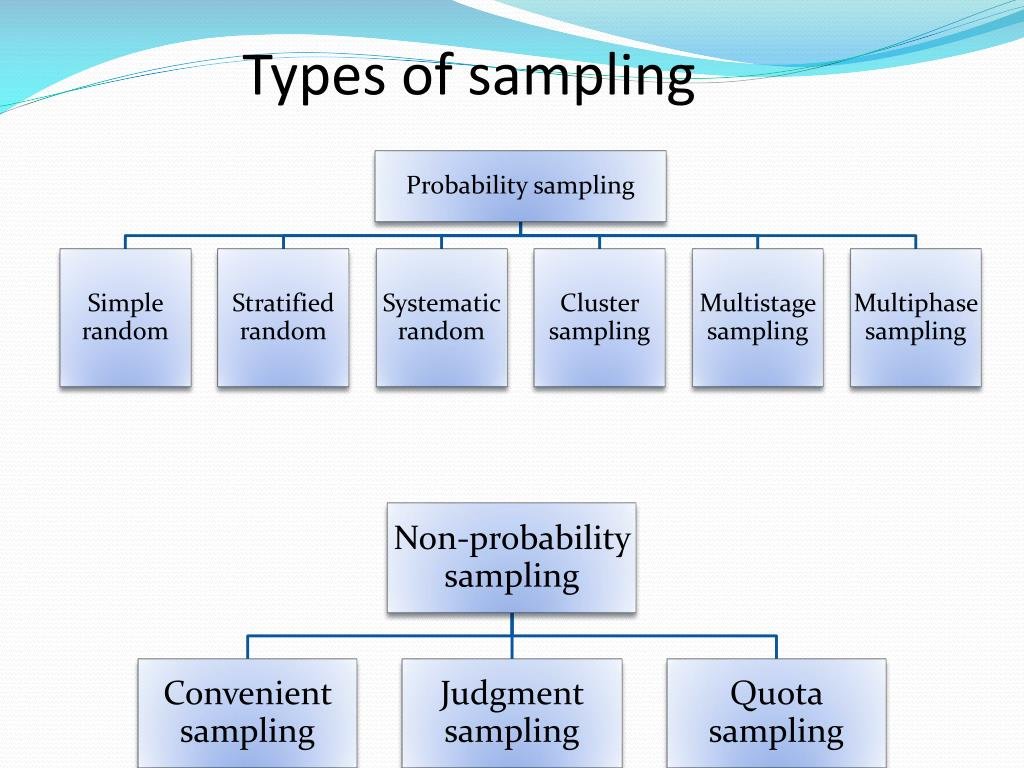
Before selecting participants for a research study, it is essential to understand that all sampling methods fall into two major categories: probability sampling and non probability sampling. This classification is based on how participants are selected from the target population and whether every member has a known chance of being included in the study.
Understanding these two categories makes it much easier to choose the most appropriate sampling technique for a particular research project. While one category emphasizes fairness and statistical accuracy, the other focuses on practicality and accessibility.
The table below highlights the major differences between the two categories.
| Feature | Probability Sampling | Non Probability Sampling |
|---|---|---|
| Selection process | Random selection | Non-random selection |
| Chance of selection | Known and measurable | Unknown |
| Risk of bias | Lower | Higher |
| Representative sample | More likely | Less likely |
| Statistical analysis | Stronger | More limited |
| Cost | Usually higher | Usually lower |
| Time required | More time-consuming | Faster |
| Common use | Quantitative research | Qualitative research and exploratory studies |
Probability sampling techniques are generally preferred when researchers want to make conclusions about an entire population because they produce a probability sample that is more likely to represent the target population accurately. In contrast, a non probability sampling method is often used when researchers are exploring a topic, working with hard-to-reach populations, or operating under limited time and financial constraints.
Probability Sampling
Probability sampling refers to a group of sampling methods in which every member of the population has a known probability of being selected. The selection process relies on random selection rather than personal judgment or convenience.
Because each individual has a measurable chance of inclusion, probability sampling techniques generally produce more reliable and unbiased results. These methods are widely used in survey research, government censuses, public opinion polls, clinical research, educational studies, and many other forms of quantitative research.
The major advantages of probability sampling include:
- Reduced sampling bias.
- Improved representativeness.
- Better statistical reliability.
- Greater confidence in research findings.
- Ability to estimate sampling error.
Despite these advantages, probability sampling methods often require a complete sampling frame, larger budgets, and more planning than non-random approaches.
The most common probability sampling methods include:
- Simple random sampling
- Systematic sampling
- Stratified sampling
- Cluster sampling
- Multistage sampling
Each method serves a different purpose depending on the nature of the research and the characteristics of the population.
Simple Random Sampling
Simple random sampling is one of the most widely recognized probability sampling techniques. In this approach, every member of the population has an equal chance of being selected, making it one of the fairest sampling methods available.
Researchers typically assign numbers to every individual in the sampling frame and then use a random number generator, computer software, or lottery method to select participants. The resulting group is known as a simple random sample.
For example, suppose a university has 5,000 registered students and a researcher needs 500 participants. Every student is assigned a unique identification number, and computer software randomly selects 500 students. Since every student had an equal opportunity to be chosen, the process qualifies as simple random sampling.
Advantages include:
- Easy to understand.
- Minimizes personal influence during participant selection.
- Produces highly reliable results.
- Reduces selection bias.
- Supports valid statistical analysis.
Limitations include:
- Requires a complete sampling frame.
- Can become expensive for very large populations.
- May be difficult to implement across multiple geographical locations.
Simple random sampling is commonly used in educational research, employee satisfaction surveys, customer experience studies, and public opinion polling.
Systematic Sampling
Systematic sampling is another probability sampling method that selects participants at regular intervals rather than randomly selecting every individual independently.
The researcher first determines the sampling interval by dividing the total population by the desired sample size. After selecting a random starting point, every nth individual is included in the study.
For instance, imagine a population of 10,000 customers where the researcher needs a sample size of 500.
The sampling interval would be:
10,000 ÷ 500 = 20
If the randomly selected starting point is customer number 8, the researcher would select customer 8, 28, 48, 68, and continue until the desired sample size is reached.
Advantages include:
- Easier to implement than simple random sampling.
- Saves time during participant selection.
- Produces an evenly distributed sample.
- Suitable for large databases.
Limitations include:
- Hidden patterns within the population list may influence results.
- Requires an accurate sampling frame.
- Less effective if records follow a repeating sequence.
Systematic sampling is widely applied in quality control, manufacturing inspections, educational assessments, and customer databases.
Stratified Sampling
Stratified sampling is a probability sampling technique used when a population contains distinct groups that differ in important ways.
Instead of selecting participants from the entire population at once, researchers first divide the population into smaller groups called strata. These strata may be based on age, gender, educational level, income, occupation, geographical location, or any characteristic relevant to the study.
After creating the strata, researchers perform random sampling within each group. This process is often referred to as stratified random sampling.
For example, a university has:
- 45% male students
- 55% female students
If the researcher intends to select 400 participants, the sample should maintain approximately the same proportions.
This would result in:
- 180 male students
- 220 female students
Maintaining these proportions helps create a more representative sample.
Advantages include:
- Increases research accuracy.
- Ensures every important subgroup is represented.
- Reduces sampling error.
- Improves comparison between groups.
Limitations include:
- Requires detailed information about the population.
- Can be time-consuming to organize.
- More complex than simple random sampling.
Stratified sampling is particularly useful in national education surveys, healthcare studies, political polling, and organizational research.
Cluster Sampling
Cluster sampling is designed for populations that are naturally divided into groups, known as clusters.
Instead of randomly selecting individuals, researchers randomly select entire clusters and collect data from all or some members within those selected clusters.
For example, imagine a study involving secondary schools across a country. Rather than selecting individual students from every school, researchers may randomly choose 20 schools and survey students within those schools.
This approach significantly reduces travel costs and simplifies data collection.
Advantages include:
- Cost-effective.
- Suitable for geographically dispersed populations.
- Simplifies fieldwork.
- Reduces logistical challenges.
Limitations include:
- May produce less precise estimates than other probability sampling techniques.
- Different clusters may vary considerably from one another.
- Larger sample sizes are often needed to improve accuracy.
Clustered sampling is commonly used in national household surveys, educational assessments, and public health research.
Multistage Sampling
Multistage sampling combines two or more probability sampling methods into a sequence of selection stages. It is particularly useful when studying very large or geographically dispersed populations.
For example, a nationwide educational survey might proceed as follows:
Stage 1:
Randomly select states.
Stage 2:
Randomly select local government areas within those states.
Stage 3:
Randomly select schools within each local government area.
Stage 4:
Randomly select students within each school.
By narrowing the population step by step, researchers reduce costs while maintaining many of the strengths of probability sampling methods.
Advantages include:
- Highly practical for large-scale research.
- Reduces travel and administrative costs.
- Flexible enough for complex populations.
- Efficient for nationwide studies.
Limitations include:
- More complicated to design.
- Errors at one stage can affect later stages.
- Requires careful planning and documentation.
Multistage sampling is frequently used in demographic surveys, government statistics, international development research, and large-scale educational assessments.
Why Probability Sampling Is Often Preferred
Researchers generally prefer probability sampling techniques when the objective is to make reliable conclusions about an entire population. Because every participant has a known chance of selection, these methods reduce bias and increase the likelihood of obtaining a representative sample.
However, no sampling method is perfect. Even with careful planning, some sampling error is unavoidable because conclusions are based on a sample rather than the entire population. Researchers should therefore choose the probability sampling method that best matches their research objectives, available resources, and study design.
Non Probability Sampling
Unlike probability sampling, non probability sampling refers to a group of sampling methods in which participants are selected using non-random procedures. The researcher does not know the exact probability that each member of the population will be included in the study.
Although these methods are more susceptible to bias, they remain valuable in many research situations. Researchers often choose a non probability sampling method when time, budget, or access to participants is limited. These techniques are especially common in qualitative research, pilot studies, exploratory research, and studies involving difficult-to-reach populations.
The main advantages of non probability sampling include:
- Faster participant selection.
- Lower research costs.
- Easier implementation.
- Useful for exploratory studies.
- Suitable when no complete sampling frame exists.
However, researchers should recognize that these methods generally have a higher risk of sampling bias and selection bias, making it more difficult to generalize findings to the entire population.
The most common non probability sampling techniques include:
- Convenience sampling
- Purposive sampling
- Quota sampling
- Judgment sampling
- Volunteer sampling (also known as voluntary sampling)
Each technique serves a different purpose depending on the objectives and practical limitations of the research.
Convenience Sampling
Convenience sampling is one of the simplest and most frequently used sampling methods. Participants are selected because they are readily available and easy to access.
Rather than using random selection, researchers collect data from individuals who are willing and conveniently located.
For example, a university lecturer who wants to evaluate a new teaching strategy may distribute questionnaires only to students attending a particular class because they are immediately available.
Similarly, a researcher studying consumer preferences might survey shoppers entering a nearby shopping mall instead of randomly selecting customers across an entire city.
Advantages include:
- Very easy to conduct.
- Requires minimal planning.
- Low cost.
- Saves time.
- Suitable for pilot studies.
Limitations include:
- High risk of sampling bias.
- Participants may not represent the wider population.
- Results have limited generalizability.
Convenience sampling is best used for preliminary investigations rather than studies intended to represent an entire population.
Purposive Sampling
Purposive sampling, sometimes called judgmental or expert sampling, involves deliberately selecting participants who possess specific characteristics relevant to the research objectives.
Instead of selecting participants randomly, the researcher intentionally identifies individuals with the knowledge, experience, or qualifications needed for the study.
For example, if a researcher wants to understand how cybersecurity professionals respond to ransomware attacks, interviewing experienced security analysts would provide more useful insights than surveying the general public.
Likewise, a study on university financial management might specifically target bursars, auditors, and finance directors because they possess specialized knowledge.
Advantages include:
- Produces rich, detailed information.
- Suitable for qualitative research.
- Focuses on knowledgeable participants.
- Efficient for specialized topics.
Limitations include:
- Researcher judgment may introduce bias.
- Difficult to generalize findings.
- Participant selection may become subjective.
Purposive sampling is widely used in case studies, interviews, phenomenological research, and expert opinion studies.
Quota Sampling
Quota sampling resembles stratified sampling in that the population is divided into groups based on selected characteristics. The major difference is that participants within each group are selected non-randomly.
The researcher first determines quotas for different categories and then selects participants until each quota has been filled.
Suppose a market research company wants opinions from 400 consumers consisting of:
- 200 males
- 200 females
Rather than selecting participants randomly, interviewers approach available individuals until each quota is completed.
Advantages include:
- Faster than probability sampling.
- Ensures representation of important categories.
- Relatively inexpensive.
- Suitable for opinion surveys.
Limitations include:
- Participant selection remains subjective.
- Increased risk of selection bias.
- Results may not represent the entire population accurately.
Quota sampling is commonly used in political polling, customer satisfaction surveys, and marketing research.
Judgment Sampling
Judgment sampling is closely related to purposive sampling. In this technique, the researcher relies on professional knowledge and experience to determine who should participate in the study.
The success of this approach depends largely on the researcher’s expertise.
For instance, a public health researcher investigating infectious disease control may intentionally interview experienced epidemiologists because they possess the most relevant knowledge.
Advantages include:
- Useful for expert-based research.
- Efficient when specialists are required.
- Provides in-depth insights.
Limitations include:
- Strong possibility of personal bias.
- Results depend heavily on researcher judgment.
- Limited statistical generalization.
Judgment sampling is often used in policy analysis, expert panels, and organizational research.
Volunteer Sampling
Volunteer sampling, also known as voluntary sampling, involves participants who willingly choose to participate after seeing an invitation or advertisement.
Examples include:
- Online surveys shared on social media.
- Research participation advertisements.
- Volunteer registration forms.
- Public opinion polls.
Advantages include:
- Easy participant recruitment.
- Low administrative costs.
- Useful for online studies.
Limitations include:
- Volunteers may differ significantly from non-volunteers.
- Greater possibility of bias.
- Results may overrepresent highly motivated individuals.
Volunteer sampling has become increasingly common due to the widespread use of online questionnaires and digital research platforms.
Probability Sampling vs Non Probability Sampling
Choosing between probability sampling and non probability sampling depends on the purpose of the study, available resources, and the desired level of accuracy.
The following comparison highlights the major differences.
| Feature | Probability Sampling | Non Probability Sampling |
|---|---|---|
| Participant selection | Random selection | Non-random selection |
| Probability of selection | Known | Unknown |
| Representative sample | More likely | Less likely |
| Sampling bias | Lower | Higher |
| Sampling error estimation | Possible | Difficult |
| Cost | Higher | Lower |
| Time | Longer | Faster |
| Statistical inference | Strong | Limited |
| Best suited for | Quantitative research | Qualitative and exploratory research |
In general, probability sampling techniques are preferred when researchers want to make conclusions about an entire population, while non probability sampling is more appropriate for exploratory studies, interviews, focus groups, and situations where random selection is not practical.
How to Choose the Right Sampling Technique
Selecting the most appropriate sampling technique is one of the most important decisions in any research project. A poor choice can compromise the quality of the data and reduce the credibility of the findings.
Several factors should guide this decision.
Define Your Research Objectives
The first step is understanding what your study aims to achieve.
If the goal is to estimate characteristics of an entire population, probability sampling methods are generally more appropriate.
If the objective is to gain detailed insights from specific individuals, purposive sampling or another non probability sampling method may be more suitable.
Consider the Population
The size, diversity, and accessibility of the population influence the choice of sampling methods.
A geographically dispersed population may require cluster sampling or multistage sampling, while a relatively small and accessible population may allow the use of simple random sampling.
Evaluate Available Resources
Research budgets often determine what is practical.
Probability sampling usually requires greater financial investment because researchers need comprehensive sampling frames, larger teams, and more extensive planning.
When resources are limited, convenience sampling or quota sampling may be more feasible.
Determine the Required Sample Size
The required sample size depends on factors such as population size, desired confidence level, acceptable margin of error, and research objectives.
Selecting an appropriate sample size helps improve the reliability of the results while minimizing unnecessary costs.
Assess the Risk of Bias
Researchers should always consider potential sources of bias before selecting participants.
Questions to ask include:
- Could certain groups be excluded?
- Is participant selection influenced by personal preferences?
- Does the sampling frame accurately represent the population?
- Are volunteers likely to differ from non-volunteers?
Identifying these issues early helps reduce sampling bias and improve the overall quality of the research.
Common Mistakes Researchers Should Avoid
Even experienced researchers can make mistakes when selecting participants. Understanding these common errors helps improve research quality and credibility.
Using an Inappropriate Sampling Method
Every research project has unique objectives. Selecting a sampling method simply because it is convenient may produce unreliable findings.
Always match the sampling technique to the research design and objectives.
Ignoring the Sampling Frame
An incomplete sampling frame may exclude important segments of the population, reducing representativeness and increasing bias.
Researchers should ensure that the sampling frame is accurate, current, and comprehensive before participant selection begins.
Selecting an Inadequate Sample Size
Very small samples may not capture the diversity of the population, while excessively large samples may waste resources without significantly improving accuracy.
Sample size should be determined using appropriate statistical and methodological considerations.
Overlooking Sampling Bias
Bias can occur during participant selection, questionnaire distribution, or data collection.
Researchers should evaluate every stage of the study to identify and minimize potential sources of bias.
Confusing Sampling Error with Research Mistakes
Sampling error is a natural consequence of studying a sample rather than the entire population.
It differs from methodological errors such as poor questionnaire design, inaccurate measurements, or data entry mistakes.
Understanding this distinction helps researchers interpret their findings more accurately.
Practical Applications of Sampling Techniques
Sampling techniques are applied across virtually every field that relies on data-driven decision-making.
In education, researchers evaluate teaching methods, student performance, and curriculum effectiveness using carefully selected samples.
Healthcare professionals rely on sampling to monitor disease outbreaks, assess treatment outcomes, and evaluate public health interventions.
Businesses use sampling methods to understand customer preferences, measure satisfaction, test new products, and improve marketing strategies.
Government agencies conduct household surveys, employment studies, agricultural assessments, and national demographic surveys using probability sampling techniques to produce representative statistics.
In data science, data sampling helps analysts work efficiently with massive datasets by selecting smaller subsets that preserve the characteristics of the original data. This improves processing speed while supporting reliable model development and analysis.
Regardless of the field, the choice of sampling technique directly influences the quality, reliability, and usefulness of the research findings.
Frequently Asked Questions
What are the main types of sampling techniques?
The two main categories are probability sampling and non probability sampling. Probability sampling includes simple random, systematic, stratified, cluster, and multistage sampling, while non probability sampling includes convenience, purposive, quota, judgment, and volunteer sampling.
Which sampling technique is the most accurate?
Probability sampling techniques generally produce more accurate and representative results because every member of the population has a known chance of selection. However, the most appropriate technique depends on the objectives and practical constraints of the research.
When should convenience sampling be used?
Convenience sampling is most suitable for pilot studies, exploratory research, classroom projects, and situations where time, budget, or access to participants is limited.
Why is sampling bias a problem?
Sampling bias occurs when certain members of the population are more likely to be selected than others. This reduces the representativeness of the sample and can lead to misleading conclusions.
What is the difference between sampling error and sampling bias?
Sampling error is the natural difference between a sample and the population that occurs because only a subset is studied. Sampling bias, on the other hand, results from flaws in the participant selection process that systematically distort the sample.
Conclusion
Sampling is one of the most important foundations of scientific research. The quality of any study depends not only on how data are analyzed but also on how participants are selected. Understanding the different sampling methods enables researchers to design studies that are practical, reliable, and capable of producing meaningful conclusions.
Probability sampling techniques provide stronger statistical confidence and are generally preferred for quantitative studies that seek to generalize findings to larger populations. In contrast, non probability sampling offers flexibility and practicality for exploratory and qualitative research where random selection may not be feasible.
Whether you are conducting survey research, preparing an academic dissertation, analyzing customer behavior, or working with data science applications, selecting the appropriate sampling technique is essential. By carefully considering your research objectives, population characteristics, available resources, and potential sources of bias, you can choose the method that best supports credible and trustworthy results.
With a clear understanding of these techniques, researchers are better equipped to collect high-quality data, reduce errors, and produce findings that contribute meaningfully to knowledge and informed decision-making.
Be the first to comment