Understanding the types of validity is one of the most important aspects of research methodology. Whether you are conducting educational research, healthcare research, business research, psychology studies, or any form of empirical research, ensuring the validity of your research determines whether your findings accurately represent the concept you intended to measure. Without proper validity, even a well-designed study with sophisticated statistical analysis may produce misleading conclusions, resulting in poor decision-making and unreliable research findings.
Validity in research goes beyond simply collecting data. It focuses on measurement accuracy, the appropriateness of research instruments, and the degree to which conclusions drawn from a study reflect reality. Researchers invest considerable effort in questionnaire design, instrument validation, pilot testing, sampling techniques, and data collection methods because each of these contributes significantly to the validity of research.
For students writing undergraduate projects, postgraduate theses, dissertations, or journal articles, understanding research validity is essential. Likewise, lecturers, researchers, data analysts, and professionals rely on various validity assessment techniques to ensure their studies meet academic and professional standards. From educational assessment and psychological measurement to market research and clinical research, validity testing remains a cornerstone of quality research.
This comprehensive guide explains the different types of validity in research, their importance, practical examples, advantages, limitations, common threats, and best practices for improving validity. You will also learn the relationship between validity and reliability, understand how measurement validity affects data quality, and discover practical strategies for developing reliable research instruments that produce trustworthy results.
What Is Validity in Research?
Validity refers to the extent to which a research instrument, assessment tool, experiment, questionnaire, or measurement scale accurately measures what it is intended to measure. In simple terms, validity answers one important question: “Does this research instrument truly measure the intended concept?”
For example, imagine a researcher wants to measure students’ mathematical ability but designs a questionnaire that mainly tests reading comprehension. Even if the questionnaire consistently produces the same results, it lacks validity because it measures a different construct from the one originally intended.
Research validity is therefore concerned with measurement accuracy rather than consistency. A valid research instrument captures the true characteristics of the variables being investigated while minimizing measurement error and bias.
Validity plays a central role in research methodology because every conclusion depends on the quality of the measurements collected. Poor validity affects data accuracy, weakens statistical significance, introduces measurement error, and reduces confidence in the research findings.
In modern scientific research, validity is evaluated throughout the research process—from research design and instrument development to data collection, statistical analysis, interpretation of results, and reporting.
Characteristics of Validity
A valid research study generally possesses several important characteristics.
It Measures the Intended Construct
The primary objective of validity is ensuring that the research instrument measures exactly what it claims to measure.
For instance, an intelligence assessment should evaluate intelligence rather than memory, vocabulary, or personality traits. Similarly, a customer satisfaction survey should accurately assess customer experiences rather than employee performance.
It Produces Accurate Results
Validity focuses on accuracy rather than repetition. A highly valid questionnaire reflects the actual opinions, attitudes, knowledge, or behaviors of respondents.
It Supports Meaningful Conclusions
Research conclusions become meaningful only when based on valid measurements. Invalid measurements often produce misleading interpretations that affect policy decisions, educational reforms, healthcare interventions, or business strategies.
It Reduces Bias
A valid research design minimizes researcher bias, sampling bias, instrumentation effects, and confounding variables that may distort the findings.
It Enhances Research Quality
Validity contributes directly to research quality by improving the credibility, trustworthiness, and usefulness of research outcomes.
Why Validity Is Important in Research
Validity serves as the foundation of credible scientific investigation. Regardless of whether the study involves quantitative research, qualitative research, mixed methods research, experimental research, or survey research, validity determines the value of the conclusions.
Some of the major reasons validity is important include:
Accurate Measurement
Accurate measurement allows researchers to evaluate variables correctly without introducing unnecessary measurement error. High measurement validity increases confidence that the results genuinely reflect reality.
Better Decision-Making
Government agencies, educational institutions, healthcare organizations, and businesses frequently use research findings to make important decisions. Decisions based on invalid research may lead to ineffective policies or costly mistakes.
Improved Research Instrument Quality
Research instrument validity ensures that questionnaires, observation checklists, interview guides, tests, and assessment tools measure the intended concepts effectively.
Instrument validation often involves expert review, pilot study findings, psychometric analysis, and validity evidence before actual data collection begins.
Stronger Statistical Analysis
Reliable statistical analysis depends heavily on valid data. Invalid measurements reduce the accuracy of correlation analysis, regression analysis, hypothesis testing, confidence intervals, and other statistical procedures.
Higher Academic Credibility
Universities, academic journals, and research institutions expect studies to demonstrate strong validity assessment procedures. Proper validation increases the acceptance and credibility of dissertations, theses, and journal publications.
Ethical Research Practice
Collecting inaccurate or misleading data wastes participants’ time and may produce false conclusions. Maintaining validity reflects ethical responsibility and professional research standards.
Validity in Research Methodology
Validity is deeply integrated into every stage of research methodology. It is not merely a statistical concept applied after data collection but an ongoing consideration from the initial planning stage to the final interpretation of results.
Researchers must consider validity when selecting an appropriate research design, defining research variables, developing measurement instruments, choosing sampling techniques, conducting pilot testing, collecting data, and performing statistical analysis.
For example, in quantitative research, researchers often use structured questionnaires, standardized tests, and numerical measurement scales. These instruments require careful validation to ensure measurement accuracy.
In qualitative research, validity may involve strategies such as prolonged engagement, triangulation, participant verification, peer debriefing, and detailed documentation to strengthen the credibility of findings.
Mixed methods research combines both quantitative and qualitative approaches, making validity assessment even more important because researchers must maintain consistency across multiple data collection methods.
Relationship Between Validity and Research Design
Research design influences the overall validity of a study. Different research designs face different validity challenges.
Experimental research generally emphasizes internal validity by controlling extraneous variables through random assignment and standardized procedures.
Observational studies often prioritize ecological validity because they examine behavior within natural environments.
Survey research focuses heavily on questionnaire validity, sampling techniques, and measurement accuracy.
Empirical research across education, healthcare, psychology, engineering, finance, and business analytics all require careful consideration of research validity before conclusions can be trusted.
Types of Validity in Research
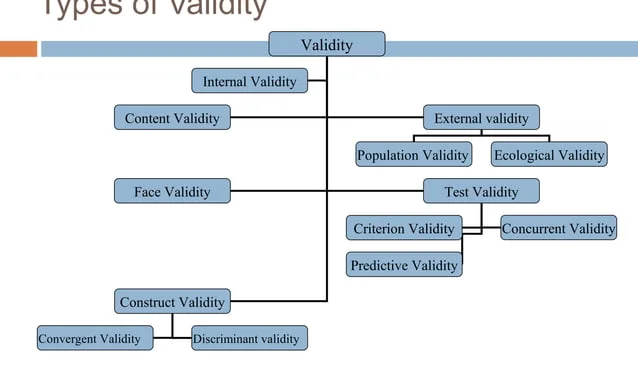
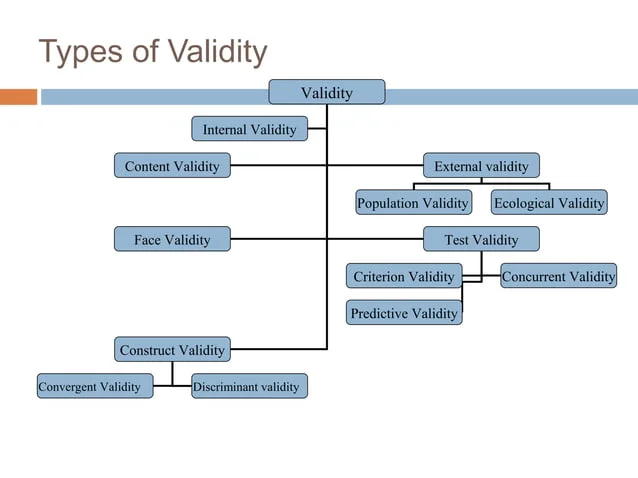
Researchers classify validity into several categories depending on what aspect of the study is being evaluated. Each type of validity addresses a unique component of research measurement and contributes to the overall quality of the investigation.
The major types of validity include:
- Content validity
- Construct validity
- Criterion validity
- Face validity
- Internal validity
- External validity
- Ecological validity
- Statistical conclusion validity
- Predictive validity
- Concurrent validity
Each validity type serves a different purpose, yet they complement one another in producing dependable and meaningful research findings.
Content Validity
Content validity refers to the degree to which a research instrument adequately covers all aspects of the concept being measured.
In other words, content validity evaluates whether every important component of a construct is represented within the questionnaire, assessment, or measurement instrument.
Suppose a lecturer designs a final examination intended to assess students’ understanding of accounting. If the examination focuses only on financial accounting while ignoring auditing, taxation, management accounting, and public sector accounting, the examination lacks sufficient content validity because it does not represent the entire course content.
Researchers usually establish content validity through expert review. Subject matter experts evaluate each questionnaire item, assessment question, or measurement scale to determine whether it adequately reflects the research objectives.
Content validity is particularly important in educational research, classroom assessment, psychological measurement, certification examinations, healthcare research, and employee performance assessment.
Advantages of Content Validity
Content validity offers several benefits:
- Ensures comprehensive coverage of research variables.
- Improves questionnaire validity.
- Strengthens educational evaluation.
- Enhances assessment validity.
- Reduces omission of important concepts.
- Supports accurate instrument development.
Limitations of Content Validity
Despite its usefulness, content validity also has limitations.
It relies heavily on expert judgment, meaning different experts may hold different opinions regarding whether certain questionnaire items should be included. Furthermore, content validity alone does not guarantee that respondents interpret questions as intended during data collection.
Practical Example of Content Validity
A university researcher develops a questionnaire measuring students’ academic engagement.
Instead of asking only about classroom attendance, the questionnaire includes questions covering class participation, assignment completion, study habits, interaction with lecturers, use of learning resources, collaborative learning, motivation, and independent reading.
Because all important dimensions of academic engagement are represented, the instrument demonstrates stronger content validity.
Construct Validity
Construct validity refers to the extent to which a research instrument accurately measures an abstract concept or theoretical construct.
Unlike physical characteristics such as height or weight, constructs cannot be observed directly. Examples include intelligence, anxiety, motivation, customer satisfaction, leadership ability, organizational commitment, emotional intelligence, and academic achievement.
Researchers must develop measurement instruments capable of representing these invisible concepts accurately.
Construct validity is particularly important in psychology, educational psychology, behavioral research, social science research, consumer behavior research, organizational research, and personality assessment.
For example, a researcher measuring job satisfaction should include items related to work environment, salary satisfaction, career development, leadership support, work-life balance, and recognition rather than focusing exclusively on employee income.
A narrow measurement approach weakens construct assessment and reduces overall research validity.
Researchers often evaluate construct validity using statistical techniques such as correlation analysis, factor analysis, regression analysis, and other psychometric procedures that examine whether questionnaire items behave consistently with theoretical expectations.
Advantages of Construct Validity
Strong construct validity provides several important benefits.
It improves psychological validity by ensuring that abstract concepts are measured accurately. It also strengthens scale development, supports theory testing, enhances instrument validation, and increases confidence in empirical research findings.
Furthermore, construct validity contributes to the development of standardized measurement instruments that can be applied across different populations and research settings.
Example of Construct Validity
Imagine a researcher studying employee motivation within a multinational company.
Instead of asking a single question such as “Are you motivated at work?”, the researcher develops a comprehensive measurement scale that evaluates intrinsic motivation, recognition, career advancement opportunities, organizational commitment, job satisfaction, workplace relationships, and personal achievement.
Because these multiple dimensions collectively represent the broader concept of employee motivation, the research instrument demonstrates stronger construct validity.
Criterion Validity
Criterion validity refers to the extent to which the results of a research instrument correspond with another established measure or criterion that is widely accepted as accurate. In simple terms, it determines whether the scores obtained from a new measurement instrument agree with an external standard that measures the same concept.
Researchers commonly use criterion validity when developing new questionnaires, psychological tests, educational assessments, healthcare screening tools, and employee performance assessments. If a newly developed instrument produces results similar to those of a recognized standard, it demonstrates good criterion validity.
Criterion validity is especially valuable in psychometrics, educational research, healthcare research, market research, organizational research, and behavioral research because it helps verify that a new instrument can replace or complement an existing one without compromising measurement accuracy.
Criterion validity is generally divided into two important categories: predictive validity and concurrent validity.
Predictive Validity
Predictive validity refers to the extent to which a research instrument accurately predicts future outcomes or behavior.
A measurement instrument has strong predictive validity when its results can reliably forecast future performance or events.
For example, a university entrance examination is expected to predict students’ future academic achievement. If students who score highly on the entrance examination consistently perform well during their university studies, the examination demonstrates strong predictive validity.
Similarly, aptitude tests used during employee recruitment are expected to predict future job performance. Financial institutions may use credit scores to predict the likelihood of loan repayment, while healthcare professionals may use clinical screening tools to predict the risk of developing certain diseases.
Advantages of predictive validity include improving long-term decision-making, supporting effective selection processes, reducing uncertainty, and helping organizations allocate resources more efficiently.
However, predictive validity may be influenced by unexpected life events, environmental changes, technological developments, or personal circumstances that occur after the initial assessment.
Concurrent Validity
Concurrent validity evaluates whether a new research instrument produces results similar to those obtained from an established instrument when both are administered at approximately the same time.
Unlike predictive validity, concurrent validity focuses on present performance rather than future outcomes.
For example, a researcher develops a new depression assessment questionnaire and administers it alongside an internationally recognized psychological assessment. If both instruments produce similar scores for participants, the new questionnaire demonstrates strong concurrent validity.
Educational researchers frequently compare newly developed examinations with standardized academic assessments to evaluate concurrent validity. Healthcare researchers may compare a new diagnostic tool with an existing gold-standard medical test to determine whether both identify patients consistently.
Concurrent validity is valuable because it allows researchers to validate new instruments quickly without waiting months or years to observe future outcomes.
Face Validity
Face validity refers to the extent to which a research instrument appears, at face value, to measure what it is intended to measure.
Unlike other forms of validity, face validity is based primarily on appearance and common sense rather than statistical analysis. It asks whether respondents, experts, or reviewers believe that the questionnaire, assessment, or test looks appropriate for its intended purpose.
For instance, if a questionnaire designed to measure customer satisfaction contains questions about service quality, product reliability, pricing, customer support, and overall experience, respondents are likely to perceive it as a suitable instrument. This gives the questionnaire good face validity.
Although face validity is the weakest form of validity from a scientific perspective, it remains important because it influences respondents’ confidence in the research instrument. Participants who believe questions are relevant are generally more willing to provide honest and thoughtful responses.
However, researchers should never rely solely on face validity because an instrument may appear appropriate while failing to measure the intended construct accurately.
Internal Validity
Internal validity refers to the extent to which observed changes in the dependent variable are genuinely caused by the independent variable rather than by external or confounding variables.
Internal validity is particularly important in experimental research because researchers seek to establish cause-and-effect relationships.
For example, suppose a researcher wants to determine whether a new teaching method improves students’ academic performance. If students achieve better results after the intervention, the researcher must determine whether the improvement resulted from the teaching method itself or from other factors such as additional tutoring, increased study time, improved learning resources, or prior knowledge.
Strong internal validity means the researcher has successfully controlled alternative explanations for the observed outcomes.
Researchers strengthen internal validity by using random assignment, control groups, standardized procedures, blinding where appropriate, statistical controls, and careful experimental design.
Common Threats to Internal Validity
Several factors may reduce internal validity, including:
Selection Bias
Selection bias occurs when participants in different groups possess significant differences before the study begins.
History Effect
Unexpected external events occurring during the study may influence participants’ behavior or outcomes.
Maturation Effect
Participants naturally change over time because of growth, aging, learning, or fatigue.
Testing Effect
Participants may perform differently simply because they have previously completed the same assessment.
Instrumentation Effect
Changes in research instruments, observers, measurement procedures, or data collection methods during the study may affect results.
Experimental Mortality
Participants who withdraw from the study before completion may influence the final findings.
Regression to the Mean
Extremely high or low scores often move closer to the average during subsequent measurements.
Researcher Bias
Researchers’ expectations or behaviors may unintentionally influence participants or data interpretation.
Understanding these threats helps researchers improve validity and produce more trustworthy research findings.
External Validity
External validity refers to the extent to which research findings can be generalized beyond the specific participants, setting, or conditions of the original study.
A study with high external validity produces results that remain applicable to other populations, locations, organizations, or periods.
For example, if a researcher investigates customer satisfaction using only university students, it may be inappropriate to generalize the findings to elderly consumers or working professionals. Similarly, conclusions drawn from one hospital may not necessarily apply to all healthcare facilities.
Researchers improve external validity through representative sampling techniques, larger sample sizes, realistic research environments, and replication across different populations.
High external validity is particularly valuable in public health studies, educational research, organizational research, business analytics, consumer behavior research, and policy evaluation because decision-makers often require findings that apply to broader populations.
Ecological Validity
Ecological validity refers to the extent to which research findings reflect real-life situations.
Studies conducted under highly controlled laboratory conditions sometimes fail to represent how individuals behave in everyday environments.
For example, participants completing psychological tasks inside a laboratory may respond differently from how they would behave at home, in school, or at work. Similarly, customers observed during a formal experiment may not exhibit the same purchasing behavior they display in a supermarket.
Observational studies generally achieve stronger ecological validity because they examine behavior within natural settings.
Researchers should balance experimental control with realistic environments to ensure that research findings remain meaningful and applicable.
Statistical Conclusion Validity
Statistical conclusion validity concerns whether the statistical analysis correctly supports the conclusions drawn from the data.
Even when research design and measurement validity are strong, inappropriate statistical analysis can produce misleading conclusions.
Several factors influence statistical conclusion validity, including sample size, measurement error, statistical significance, confidence intervals, statistical power, assumption testing, and the selection of appropriate analytical techniques.
For example, using regression analysis when the assumptions of regression are violated may produce inaccurate findings. Likewise, conducting hypothesis testing with an extremely small sample size may reduce statistical power and increase the risk of incorrect conclusions.
Researchers strengthen statistical conclusion validity by selecting appropriate statistical procedures, checking assumptions carefully, minimizing measurement error, and ensuring sufficient sample sizes.
Comparison of the Major Types of Validity
Each type of validity addresses a different aspect of research quality, and understanding their distinctions helps researchers design stronger studies.
Content validity focuses on whether a research instrument adequately covers all dimensions of the concept being measured.
Construct validity examines whether an instrument accurately measures an abstract theoretical construct.
Criterion validity determines whether a new instrument agrees with an established standard and includes predictive validity and concurrent validity.
Face validity considers whether the instrument appears appropriate to respondents and experts.
Internal validity evaluates whether changes in the dependent variable result from the independent variable rather than external influences.
External validity assesses whether findings can be generalized to other settings and populations.
Ecological validity examines whether findings reflect real-world behavior.
Statistical conclusion validity evaluates whether statistical analysis supports the research conclusions appropriately.
No single type of validity is more important than the others. Instead, they work together to strengthen overall research quality.
Validity Versus Reliability
Students often confuse validity and reliability because both are essential components of research methodology. Although closely related, they measure different aspects of research quality.
Reliability refers to the consistency of measurement. A reliable research instrument produces similar results whenever it is administered under similar conditions.
Examples of reliability include test-retest reliability, internal consistency, inter-rater reliability, and measures such as Cronbach’s alpha, which assess the consistency of questionnaire items.
Validity, on the other hand, focuses on accuracy. A valid instrument measures the intended construct correctly.
A bathroom weighing scale that consistently adds five kilograms to every measurement demonstrates high reliability because it produces consistent results. However, it lacks validity because the measurements are inaccurate.
Conversely, an instrument cannot truly be considered valid unless it also demonstrates an acceptable level of reliability. Consistent measurements provide the foundation upon which accurate measurements can be established.
Researchers should therefore evaluate both validity and reliability during instrument validation to ensure dependable and meaningful research findings.
Practical Examples of Validity Across Different Fields
Validity principles apply across virtually every discipline.
In educational research, lecturers validate examinations to ensure that questions represent the learning objectives and accurately assess students’ knowledge and skills.
In psychology, researchers evaluate whether personality assessments, intelligence tests, and emotional intelligence scales accurately measure the intended psychological constructs.
Healthcare research depends on valid diagnostic tools, clinical screening instruments, and patient satisfaction surveys to support effective medical decision-making and improve patient care.
Business researchers use customer satisfaction surveys, employee engagement assessments, and market research questionnaires to understand consumer behavior, organizational commitment, and workplace performance.
Finance researchers validate instruments used to measure financial literacy, investment behavior, risk tolerance, and organizational performance before drawing conclusions from empirical research.
Social science research relies on carefully developed measurement scales to study attitudes, beliefs, cultural values, voting behavior, and social interactions.
Regardless of the field, the objective remains the same: ensuring that research instruments accurately measure the concepts they were designed to investigate.
How to Improve Validity in Research
Improving validity is one of the most important responsibilities of every researcher. A study that lacks validity may produce inaccurate findings, regardless of how advanced the statistical analysis or how large the sample size may be. Fortunately, researchers can strengthen research validity by adopting appropriate planning, research design, and data collection procedures from the beginning of a study.
Clearly Define the Research Problem
The first step in improving validity is defining the research problem, objectives, research questions, and hypotheses clearly. A poorly defined research problem often leads to selecting inappropriate variables and measurement instruments.
Researchers should identify exactly what they intend to measure before developing questionnaires, interviews, observations, or experiments.
Select an Appropriate Research Design
Different research questions require different research designs. Choosing an unsuitable design may reduce both internal validity and external validity.
For example, experimental research is ideal for establishing cause-and-effect relationships, while survey research is more suitable for collecting opinions, attitudes, and perceptions. Qualitative research provides detailed explanations of experiences, whereas quantitative research focuses on numerical measurement and hypothesis testing. Mixed methods research combines both approaches to provide a more comprehensive understanding of research problems.
Selecting the correct research design strengthens measurement validity and improves the credibility of research findings.
Develop High-Quality Research Instruments
The quality of a research instrument directly influences the quality of collected data. Researchers should ensure that every questionnaire, interview guide, observation checklist, or assessment tool aligns with the study objectives.
Good questionnaire design includes:
- Simple and clear wording.
- Logical sequence of questions.
- Neutral language that avoids leading respondents.
- Questions that measure one concept at a time.
- Appropriate response scales.
- Elimination of ambiguous or double-barreled questions.
Carefully developed instruments reduce measurement error and improve both questionnaire validity and assessment validity.
Conduct a Pilot Study
A pilot study is one of the most effective ways to improve validity before full-scale data collection.
Pilot testing allows researchers to:
- Identify confusing questions.
- Detect technical problems.
- Estimate completion time.
- Evaluate respondent understanding.
- Assess measurement accuracy.
- Improve data quality.
- Refine the research instrument.
Feedback obtained during the pilot study should be used to revise the instrument before administering it to the main study population.
Seek Expert Review
Expert review plays a critical role in establishing content validity. Subject matter experts evaluate whether questionnaire items adequately represent the variables under investigation.
Experts may recommend:
- Removing irrelevant questions.
- Adding missing dimensions.
- Improving question wording.
- Reorganizing sections.
- Clarifying technical terminology.
This process strengthens instrument validation and increases confidence in the final research instrument.
Use Appropriate Sampling Techniques
Sampling techniques significantly influence external validity.
Researchers should choose sampling methods that accurately represent the target population whenever possible.
Examples include:
- Simple random sampling.
- Stratified sampling.
- Systematic sampling.
- Cluster sampling.
- Multistage sampling.
Using representative samples increases the likelihood that research findings can be generalized to broader populations.
Increase Sample Size
Very small sample sizes reduce statistical power and may produce unstable estimates.
A larger sample size generally:
- Improves precision.
- Reduces sampling error.
- Strengthens statistical conclusion validity.
- Increases confidence in hypothesis testing.
- Produces more reliable regression analysis and correlation analysis results.
However, researchers should prioritize sample quality as well as quantity. A large but poorly selected sample may still produce biased findings.
Standardize Data Collection Procedures
Every participant should experience the same research conditions as much as possible.
Standardized procedures include:
- Using identical instructions.
- Administering questionnaires consistently.
- Training research assistants.
- Maintaining similar environmental conditions.
- Following ethical guidelines throughout data collection.
Standardization minimizes variability unrelated to the variables being studied.
Control Confounding Variables
Confounding variables may distort the relationship between independent and dependent variables.
Researchers can reduce their effects through:
- Random assignment.
- Statistical controls.
- Matching participants.
- Restricting participant characteristics.
- Using control groups where appropriate.
Controlling confounding variables strengthens internal validity and improves causal interpretation.
Reduce Researcher Bias
Researchers should remain objective throughout the study.
Ways to minimize researcher bias include:
- Following standardized protocols.
- Using multiple data collectors where appropriate.
- Applying blind or double-blind procedures in experimental research.
- Maintaining accurate documentation.
- Allowing independent review of research procedures.
Objectivity improves both measurement accuracy and the credibility of research findings.
Common Mistakes Researchers Make
Many research projects suffer from avoidable mistakes that reduce validity.
One common mistake is confusing validity with reliability. Although both concepts are related, consistency alone does not guarantee accurate measurement.
Another frequent error is skipping pilot testing. Without pilot testing, researchers may overlook ambiguous questions, technical issues, or respondent misunderstandings that could have been corrected before full-scale data collection.
Poor questionnaire design also weakens validity. Leading questions, vague wording, double negatives, and overlapping response options often produce inaccurate responses.
Some researchers fail to define research variables clearly, making it difficult to determine whether the instrument measures the intended construct.
Inadequate sampling techniques represent another common problem. Selecting participants based solely on convenience may introduce sampling bias and reduce the generalizability of research findings.
Ignoring threats to validity such as maturation effects, history effects, testing effects, instrumentation changes, and researcher bias may also compromise research quality.
Finally, applying inappropriate statistical analysis can undermine statistical conclusion validity even when the research instrument itself is well designed.
Best Practices for Establishing Validity
Researchers should adopt several best practices to improve research quality.
Begin by conducting a thorough literature review to understand how previous studies measured similar variables.
Use validated measurement scales whenever appropriate instead of creating entirely new instruments without justification.
If a new instrument must be developed, perform comprehensive instrument validation through expert review, pilot testing, and psychometric evaluation.
Document every stage of the validation process so that readers understand how validity evidence was established.
Maintain transparency regarding research limitations and acknowledge any factors that may affect the interpretation of results.
Replicate studies across different populations, settings, and time periods whenever possible. Replication strengthens external validity and increases confidence in empirical research findings.
Finally, combine strong validity with appropriate reliability testing, sound statistical analysis, and ethical research practices to produce dependable and meaningful conclusions.
Practical Checklist for Evaluating Validity
Before collecting data, researchers should confirm that they can answer “Yes” to the following questions:
- Is the research problem clearly defined?
- Are the research objectives aligned with the variables?
- Does the research instrument measure the intended construct?
- Have subject matter experts reviewed the instrument?
- Has a pilot study been conducted?
- Are the questionnaire items clear and unbiased?
- Have appropriate sampling techniques been selected?
- Is the sample representative of the target population?
- Have potential threats to validity been identified and controlled?
- Are standardized data collection procedures in place?
- Will appropriate statistical analysis be used?
- Has reliability been evaluated alongside validity?
- Have ethical considerations been addressed?
If the answer to most of these questions is yes, the study is more likely to produce accurate and trustworthy findings.
Frequently Asked Questions
What are the main types of validity?
The major types of validity include content validity, construct validity, criterion validity, face validity, internal validity, external validity, ecological validity, statistical conclusion validity, predictive validity, and concurrent validity. Each evaluates a different aspect of research quality and measurement accuracy.
Why is validity important in research?
Validity ensures that a research instrument accurately measures the concept it was designed to measure. It improves data quality, strengthens research findings, supports better decision-making, and increases the credibility of academic and professional studies.
What is the difference between validity and reliability?
Validity refers to measurement accuracy, while reliability refers to measurement consistency. An instrument can be reliable without being valid, but it cannot be truly valid unless it also demonstrates an acceptable level of reliability.
Can a study have high reliability but low validity?
Yes. A measuring instrument may consistently produce the same results while measuring the wrong concept. In this situation, it is reliable but not valid.
Which type of validity is the most important?
No single type of validity is universally the most important. The relevance of each depends on the research objectives, methodology, and research design. High-quality studies often demonstrate multiple forms of validity simultaneously.
How is content validity established?
Content validity is usually established through expert review, where specialists evaluate whether the research instrument adequately covers all aspects of the concept being measured.
What is construct validity?
Construct validity determines whether a research instrument accurately measures an abstract concept such as intelligence, motivation, job satisfaction, or organizational commitment.
What is criterion validity?
Criterion validity evaluates how closely a research instrument agrees with an established standard. It includes predictive validity and concurrent validity.
How can researchers improve validity?
Researchers can improve validity by selecting an appropriate research design, developing high-quality research instruments, conducting pilot testing, obtaining expert review, choosing suitable sampling techniques, controlling confounding variables, reducing bias, and applying appropriate statistical analysis.
Why is pilot testing important?
Pilot testing helps identify weaknesses in research instruments before the main study begins. It improves questionnaire design, increases measurement accuracy, and strengthens overall research validity.
What are common threats to validity?
Common threats include selection bias, sampling bias, maturation effect, history effect, testing effect, instrumentation changes, experimental mortality, regression to the mean, researcher bias, and confounding variables.
Does validity apply only to quantitative research?
No. Validity is important in quantitative research, qualitative research, and mixed methods research. Although the techniques for establishing validity differ across methodologies, all researchers aim to ensure that their findings accurately represent reality.
Conclusion
Understanding the types of validity is fundamental to conducting credible and meaningful research. Whether a study is carried out in education, psychology, healthcare, business, finance, engineering, or the social sciences, validity determines whether the conclusions drawn from the research truly reflect the concepts being investigated.
Throughout this guide, we explored content validity, construct validity, criterion validity, predictive validity, concurrent validity, face validity, internal validity, external validity, ecological validity, and statistical conclusion validity. Each type addresses a specific dimension of research quality, and together they provide a comprehensive framework for evaluating the accuracy and trustworthiness of research instruments and findings.
Effective research does not rely on sophisticated statistical techniques alone. It begins with a clearly defined research problem, an appropriate research design, carefully developed measurement instruments, sound questionnaire design, representative sampling techniques, thorough pilot testing, expert review, rigorous instrument validation, and objective data collection methods. When these elements are combined with appropriate statistical analysis and careful interpretation of results, researchers produce findings that are both reliable and valid.
Researchers should also recognize that validity is not a one-time procedure but a continuous process that extends throughout the entire research lifecycle. From planning and instrument development to data analysis and reporting, every decision influences the quality of the evidence generated.
By applying the principles, strategies, and best practices discussed in this article, students, lecturers, researchers, and professionals can improve the validity of their studies, strengthen the credibility of their research findings, and contribute valuable evidence that supports informed decision-making and advances knowledge across disciplines. Whether you are preparing a university project, a postgraduate dissertation, a journal publication, or a professional research report, prioritizing validity will help ensure that your work stands up to academic scrutiny and provides meaningful, trustworthy insights for your intended audience.
Be the first to comment