Knowing how to write a research proposal is one of the most valuable academic skills every student and researcher should master. Whether you are preparing an undergraduate project, master’s thesis, doctoral dissertation, grant application, or university research project, a well-written research proposal serves as the blueprint that guides your entire research study. It communicates what you intend to investigate, why the topic is important, how you plan to conduct the study, and what contribution your research will make to existing knowledge.
Unfortunately, many students approach proposal writing as a formality rather than a strategic planning process. They often focus on completing required sections without demonstrating the originality, feasibility, and academic significance of their proposed research project. As a result, many research proposals are rejected or require substantial revisions before approval.
A successful research proposal does much more than describe an idea. It convinces supervisors, review committees, funding organizations, or academic institutions that the proposed research is worthwhile, achievable, and capable of producing reliable findings. Every section of the proposal should work together to build a logical and persuasive argument supported by existing literature, credible evidence, and an appropriate research methodology.
This comprehensive guide explains every stage of proposal writing in a practical and easy-to-follow manner. You will learn how to select a research topic, identify a research gap, formulate a strong research question, write research objectives, develop a convincing problem statement, conduct a literature review, choose suitable research methods, address ethical considerations, prepare a realistic research timeline, and present a professional proposal format. By the end of this guide, you will understand exactly how to write a research proposal that meets university standards and increases the likelihood of approval.
What Is a Research Proposal?
A research proposal is a formal academic document that outlines the plan for conducting a research study. It explains what the researcher intends to investigate, why the study is necessary, how the research will be carried out, and what outcomes are expected.
Unlike a research paper, which reports completed findings, a research proposal focuses on planned research. It serves as a roadmap that guides every stage of the research process, from defining the research problem to collecting and analyzing data.
Universities require students to submit a research proposal before beginning major academic projects because it allows supervisors to evaluate the feasibility, originality, and academic quality of the proposed research. Funding organizations also require detailed proposals before awarding research grants, ensuring that available resources support worthwhile and well-designed projects.
A well-prepared proposal demonstrates that the researcher has thoroughly examined the existing literature, identified a meaningful research gap, selected an appropriate research design, and developed a realistic plan for completing the study.
Why Is a Research Proposal Important?
Many first-time researchers underestimate the importance of writing a strong proposal. However, it plays several critical roles throughout the research process.
First, it provides direction. A carefully planned proposal helps researchers remain focused on their research objectives and prevents unnecessary deviations from the original study.
Second, it demonstrates academic preparedness. By reviewing scholarly articles and previous studies before beginning the research project, researchers gain a deeper understanding of their topic and avoid duplicating existing work.
Third, it justifies the significance of the study. Every research proposal should explain why the proposed investigation deserves attention and how it contributes to academic knowledge or practical problem-solving.
Another important function is evaluating feasibility. Before investing months in a research project, supervisors assess whether the proposed methodology, timeline, resources, and sample size are realistic.
Research proposals also assist in obtaining ethical approval. Studies involving human participants often require institutional approval before data collection begins. The proposal allows ethics committees to evaluate participant safety, confidentiality, and informed consent procedures.
Finally, a high-quality proposal improves the overall quality of the completed research paper or dissertation because every stage has been carefully planned in advance.
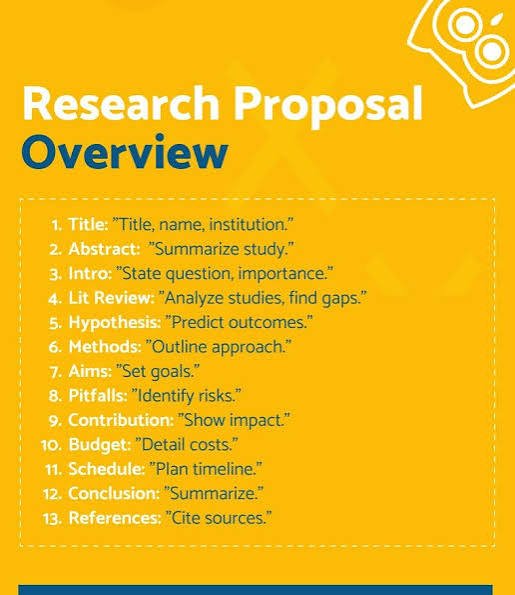
Key Components of a Research Proposal
Although proposal requirements differ across universities and disciplines, most academic institutions expect researchers to include several essential sections.
These typically include:
- Title
- Introduction
- Background of the study
- Problem statement
- Research aim
- Research objectives
- Research question
- Hypothesis (where applicable)
- Literature review
- Theoretical framework or conceptual framework
- Research methodology
- Research design
- Data collection methods
- Sampling technique
- Sample size
- Data analysis methods
- Ethical considerations
- Significance of the study
- Scope of the study
- Limitations of the study
- Research timeline
- Research budget (if required)
- Reference list or bibliography
Each section contributes to building a logical and persuasive proposal.
Step 1: Choose a Strong Research Topic
Every successful proposal begins with selecting the right research topic.
Your topic should be interesting, relevant, researchable, and sufficiently focused. Choosing an overly broad topic often makes the research project difficult to manage, while an extremely narrow topic may limit the availability of scholarly articles and existing literature.
A good research topic should satisfy several criteria.
It should address a genuine academic or practical problem.
It should contribute something new to existing knowledge.
Adequate peer-reviewed sources should be available to support the literature review.
The topic should be feasible within the available time, resources, and research skills.
Finally, the topic should genuinely interest the researcher because motivation plays an important role throughout lengthy academic research projects.
Instead of selecting a vague topic like “Technology in Education,” narrow it to a more specific issue such as “The Impact of Artificial Intelligence on Undergraduate Academic Writing in Nigerian Universities.”
A focused topic leads to a clearer research question and a stronger proposal.
Step 2: Identify the Research Problem
After selecting a topic, clearly define the problem your research intends to solve.
The research problem explains what is currently unknown, misunderstood, or inadequately addressed within existing literature.
A strong research problem does not simply describe a general issue. Instead, it demonstrates a specific gap that requires further investigation.
For example, previous studies may have focused on developed countries while neglecting developing nations. Alternatively, existing research may produce conflicting findings, use outdated methodologies, or ignore important populations.
Clearly identifying the research problem provides the foundation for the entire proposal and justifies why the proposed research study is necessary.
Step 3: Write an Effective Problem Statement
The problem statement expands upon the research problem by explaining why it deserves investigation.
A strong problem statement typically answers four questions:
What is happening?
Why is it a problem?
What evidence demonstrates the existence of the problem?
Why should researchers address it?
Support your problem statement with recent evidence from scholarly articles, government reports, or reputable organizational publications.
Avoid making unsupported claims. Every statement should be backed by credible sources whenever possible.
The problem statement should naturally lead readers toward the research aim and research objectives.
Step 4: Develop the Research Aim and Research Objectives
The research aim describes the overall purpose of the proposed study.
It provides a broad statement explaining what the research intends to accomplish.
For example:
“The aim of this research is to examine the impact of artificial intelligence on undergraduate academic writing.”
Research objectives divide this overall aim into smaller, measurable tasks.
Effective objectives usually begin with action verbs such as identify, examine, evaluate, determine, assess, compare, analyze, investigate, or explore.
For example:
- To examine how students use artificial intelligence during academic writing.
- To evaluate the influence of AI tools on writing quality.
- To identify challenges associated with AI-assisted writing.
- To recommend strategies for the ethical use of AI in higher education.
Clear objectives guide the research methodology and ensure that every stage of the study contributes directly to achieving the research aim.
Step 5: Formulate the Research Question
The research question is one of the most important elements of any research proposal because it directs the entire investigation.
A good research question should be clear, focused, specific, answerable, and aligned with the research objectives.
Weak research questions are often vague or too broad.
For example:
“How does technology affect education?”
A stronger version would be:
“How does the use of artificial intelligence influence academic writing quality among undergraduate students in public universities?”
This version identifies the independent variable, dependent variable, target population, and research context.
Every subsequent section of the proposal—including the literature review, research methodology, data collection, and data analysis—should directly address the research question.
Step 6: Develop a Testable Hypothesis (When Applicable)
Not every research proposal requires a hypothesis. Qualitative research often focuses on exploration rather than prediction, making hypotheses unnecessary. However, quantitative research frequently includes one or more hypotheses that can be tested statistically.
A hypothesis is a clear, testable statement predicting the relationship between variables.
For example:
“There is a significant positive relationship between the use of artificial intelligence writing tools and undergraduate academic writing performance.”
Researchers commonly formulate both a null hypothesis and an alternative hypothesis to support statistical testing during data analysis.
A well-developed hypothesis aligns closely with the research objectives, research question, and chosen research design, ensuring consistency throughout the proposed study.
Step 7: Conduct a Comprehensive Literature Review
The literature review is one of the most important sections of a research proposal because it demonstrates your understanding of existing literature related to your research topic. It also shows supervisors and reviewers that your proposed research study is grounded in scholarly evidence rather than personal opinion.
A high-quality literature review does more than summarize previous studies. It critically evaluates scholarly articles, compares findings, identifies recurring themes, discusses conflicting evidence, and highlights the research gap your study intends to address.
Begin by conducting a systematic literature search using reputable academic databases such as Google Scholar, Scopus, Web of Science, JSTOR, ScienceDirect, ERIC, or discipline-specific databases. Prioritize peer-reviewed sources because they have undergone expert evaluation before publication.
As you review existing literature, pay attention to the research methods used, sample characteristics, major findings, strengths, limitations, and recommendations for future research.
Instead of discussing each article individually, organize the literature according to themes, theoretical perspectives, methodologies, or chronological developments. This approach creates a coherent discussion rather than a collection of isolated summaries.
Conclude the literature review by identifying the research gap. Explain what previous studies have overlooked and demonstrate how your proposed research project will contribute new knowledge or practical solutions.
Step 8: Develop the Theoretical Framework or Conceptual Framework
Many academic proposals include either a theoretical framework, a conceptual framework, or both.
A theoretical framework is based on established theories that explain the phenomenon being studied. It provides the academic foundation upon which the research study is built.
For example, research investigating technology adoption may rely on the Technology Acceptance Model (TAM), while educational studies may use Constructivist Learning Theory.
A conceptual framework, on the other hand, illustrates the expected relationships among variables in your specific study. It is often presented as a diagram showing independent variables, dependent variables, and moderating or mediating variables.
Both frameworks help readers understand the intellectual basis of your study and ensure consistency throughout the research design, data collection, and data analysis.
Step 9: Choose an Appropriate Research Methodology
The research methodology explains the overall approach you will use to answer your research question. It should clearly justify why your chosen methods are appropriate for achieving the research objectives.
Your methodology should align with the nature of your research problem rather than personal preference.
Qualitative research is appropriate when exploring experiences, opinions, beliefs, behaviors, or complex social phenomena. Researchers typically collect data through interviews, focus groups, observations, or document analysis.
Quantitative research focuses on numerical data and statistical analysis. Surveys, experiments, structured questionnaires, and standardized tests are common quantitative research methods.
Mixed methods research combines qualitative and quantitative approaches, allowing researchers to benefit from the strengths of both methodologies.
Whichever approach you select, explain why it is the most suitable for your proposed research study.
Step 10: Select the Most Suitable Research Design
The research design serves as the blueprint for conducting your study. It determines how data will be collected, measured, and analyzed.
Different research questions require different research designs.
Descriptive research design is appropriate for describing characteristics or trends within a population.
Correlational research design examines relationships between variables without establishing causation.
Experimental research investigates cause-and-effect relationships through controlled manipulation of variables.
Cross-sectional studies collect data from participants at a single point in time.
Cohort studies follow groups over an extended period to observe changes or outcomes.
Case study research provides an in-depth investigation of a specific individual, organization, event, or phenomenon.
Action research emphasizes solving practical problems through continuous improvement and collaboration.
Clearly justify your selected research design by explaining how it supports your research objectives and research methodology.
Step 11: Describe Your Data Collection Methods
Data collection refers to the procedures used to gather information required for answering the research question.
Common data collection methods include questionnaires, interviews, observations, focus group discussions, experiments, document analysis, and existing datasets.
If using questionnaires, explain whether they are structured, semi-structured, or open-ended.
If conducting interviews, specify whether they will be structured, semi-structured, or unstructured.
For observational studies, describe the observation procedures and recording methods.
When using secondary data, explain where the data will be obtained and why it is suitable for the study.
Providing detailed explanations demonstrates careful planning and increases confidence in the proposed methodology.
Step 12: Explain the Sampling Technique and Sample Size
The sampling technique explains how participants or research units will be selected.
Probability sampling methods include simple random sampling, stratified sampling, systematic sampling, and cluster sampling. These approaches improve representativeness and support statistical generalization.
Non-probability sampling methods include purposive sampling, convenience sampling, quota sampling, and snowball sampling. These techniques are common in qualitative research where in-depth understanding is more important than statistical representation.
After explaining the sampling technique, justify the sample size.
Rather than selecting an arbitrary number, explain how the sample size was determined using previous studies, statistical calculations, or practical considerations.
A well-justified sample increases the credibility of the proposed research.
Step 13: Describe Your Data Analysis Plan
A strong proposal clearly explains how collected data will be analyzed.
For quantitative research, data analysis may involve descriptive statistics, correlation analysis, regression analysis, hypothesis testing, analysis of variance (ANOVA), or other statistical techniques.
Researchers often use software such as SPSS, R, Stata, SAS, or Microsoft Excel for statistical analysis.
For qualitative research, analysis may involve thematic analysis, content analysis, narrative analysis, grounded theory analysis, or discourse analysis.
Explain why the selected analytical approach is appropriate for answering your research question.
Including this information assures reviewers that meaningful conclusions can be drawn from the collected evidence.
Step 14: Address Ethical Considerations
Every research proposal involving human participants should discuss ethical considerations.
Researchers have a responsibility to protect participants throughout the research process.
Explain how informed consent will be obtained before participation.
Describe measures taken to maintain confidentiality and anonymity.
Discuss how participant privacy will be protected during data collection, storage, analysis, and publication.
Indicate whether ethical approval will be obtained from the relevant institutional review board or ethics committee before beginning the study.
Researchers should also explain how they will minimize potential risks while maximizing benefits to participants.
Demonstrating ethical responsibility strengthens the credibility of the proposal and increases the likelihood of institutional approval.
Step 15: Explain the Significance of the Study
The significance of the study explains why the proposed research matters.
This section should identify the individuals, organizations, industries, policymakers, educators, researchers, or communities that may benefit from the findings.
Discuss both academic and practical contributions.
Academic contributions may include filling a research gap, extending existing theories, or improving current knowledge.
Practical contributions may involve informing policy decisions, improving professional practice, supporting organizational decision-making, or addressing societal challenges.
A convincing explanation of significance helps reviewers understand the value of investing time and resources in the proposed research project.
Step 16: Define the Scope and Limitations of the Study
Every research proposal should clearly define its boundaries.
The scope of the study specifies exactly what will and will not be included.
For example, the scope may be limited to undergraduate students in public universities within a particular country during a specific academic year.
Clearly defining the scope helps readers understand the context and applicability of the findings.
Researchers should also acknowledge potential limitations.
Common limitations include time constraints, financial resources, access to participants, geographical restrictions, limited sample sizes, and reliance on self-reported data.
Acknowledging limitations demonstrates honesty and realistic planning rather than weakening the proposal.
Step 17: Create a Realistic Research Timeline
A research proposal should demonstrate that the project can be completed within the available timeframe. Including a realistic research timeline reassures supervisors and funding organizations that the study has been carefully planned and that each phase of the research project has been allocated sufficient time.
Your timeline should cover every major stage of the research process, including selecting the research topic, conducting the literature review, developing research instruments, obtaining ethical approval, collecting data, analyzing data, interpreting findings, writing the research paper, revising the manuscript, and submitting the final report.
The timeline should be practical rather than overly ambitious. Allow extra time for unexpected delays, participant recruitment, supervisor feedback, and revisions. A well-structured schedule demonstrates strong project management skills and increases the credibility of your research proposal.
Step 18: Prepare a Research Budget (If Required)
Not every research proposal requires a budget. However, proposals submitted for grants, sponsored research, or institutional funding usually include a detailed estimate of anticipated expenses.
Typical research costs may include transportation, accommodation for fieldwork, printing and photocopying, internet subscriptions, software licenses, research equipment, participant incentives, transcription services, and publication fees.
Each expense should be clearly justified. Avoid including unnecessary or inflated costs, as reviewers carefully assess whether the proposed budget represents good value for the expected outcomes.
A transparent and realistic budget demonstrates professionalism and financial responsibility.
Step 19: Compile an Accurate Reference List
The reference list is often one of the last sections completed, but it should never be treated as an afterthought.
Every source cited throughout the proposal must appear in the bibliography or reference list using the citation style required by your institution. Common referencing styles include APA Style, MLA Style, Harvard Referencing, and Chicago Style.
Maintain consistency in formatting throughout the document. Incorrect citations, incomplete references, or inconsistent formatting can reduce the overall quality of an otherwise excellent proposal.
Using citation management software such as Zotero, Mendeley, or EndNote can simplify reference management, reduce errors, and save considerable time during revisions.
Always cite peer-reviewed sources, books, government publications, and other credible evidence accurately to maintain academic integrity and avoid plagiarism.
Formatting a Research Proposal
Presentation matters almost as much as content. A professionally formatted proposal reflects attention to detail and creates a positive impression on reviewers.
Although formatting requirements differ among universities, most institutions expect proposals to include a title page, table of contents, clearly organized headings, consistent font style and size, appropriate margins, page numbering, and accurate citations.
Use concise academic language throughout the proposal. Avoid unnecessary jargon, lengthy sentences, and vague expressions.
Each section should flow logically into the next, creating a coherent argument that guides readers from the research problem to the proposed methodology.
Before submission, carefully proofread the document to eliminate grammatical errors, spelling mistakes, formatting inconsistencies, and citation errors.
Common Mistakes to Avoid When Writing a Research Proposal
Even well-prepared students sometimes make mistakes that weaken their proposals. Recognizing these common problems can help you produce a stronger document.
One common mistake is selecting a research topic that is too broad or too narrow. Broad topics often become difficult to investigate thoroughly, while extremely narrow topics may lack sufficient scholarly articles.
Another frequent problem is writing an unclear problem statement. If reviewers cannot identify the specific issue your study intends to address, they are unlikely to appreciate its significance.
Many proposals also contain poorly defined research objectives that do not align with the research question. Every objective should contribute directly to answering the central research question.
A weak literature review is another common issue. Simply summarizing previous studies without comparing, evaluating, or synthesizing them fails to demonstrate critical thinking.
Researchers sometimes choose inappropriate research methods that cannot adequately answer their research question. The methodology should always match the objectives of the study.
Ignoring ethical considerations may also delay proposal approval, particularly when human participants are involved.
Another mistake is presenting an unrealistic research timeline or budget. Reviewers expect practical planning based on available resources and time.
Many proposals also suffer from poor organization, inconsistent formatting, grammatical errors, and inadequate proofreading.
Finally, plagiarism remains one of the most serious academic offenses. Every borrowed idea, quotation, and paraphrased statement must be properly cited using the required referencing style.
Useful Tools for Writing a Research Proposal
Modern technology offers numerous tools that make proposal writing more efficient.
Google Scholar remains one of the best resources for locating scholarly articles and existing literature.
Scopus and Web of Science provide comprehensive citation databases for identifying influential research.
Reference management software such as Zotero, Mendeley, and EndNote simplifies citation management and bibliography creation.
Grammarly can improve grammar, punctuation, clarity, and writing style, while Microsoft Word Editor provides additional proofreading support.
Turnitin helps researchers verify originality and detect unintentional plagiarism before submission.
Research Rabbit and Connected Papers assist researchers in discovering related studies and visualizing citation networks.
AI research tools, including ChatGPT and Microsoft Copilot, can support brainstorming, outlining, explaining complex concepts, and improving clarity. However, researchers should always verify AI-generated information against original scholarly sources and institutional guidelines.
These tools enhance productivity but should never replace critical thinking, independent analysis, or careful evaluation of evidence.
Practical Tips for Writing an Outstanding Research Proposal
Writing an excellent research proposal requires more than following a template. It requires thoughtful planning, critical analysis, and clear communication.
Start planning early rather than rushing to meet submission deadlines.
Choose a research topic that genuinely interests you because sustained motivation improves the quality of your work.
Read extensively before writing so your proposal is grounded in current scholarly evidence.
Develop a clear and focused research question that guides every section of the proposal.
Ensure that your research aim, objectives, methodology, and expected outcomes remain logically connected.
Write clearly and concisely, avoiding unnecessary repetition and overly complex language.
Support every major claim with credible evidence from peer-reviewed sources.
Revise your proposal multiple times. Strong proposals are refined through careful editing rather than written perfectly in a single draft.
Seek constructive feedback from your supervisor or experienced researchers before submission. External perspectives often identify weaknesses that are difficult to recognize independently.
Finally, remember that a research proposal is not merely an academic requirement. It is the strategic foundation of your entire research project. Investing time in developing a strong proposal will make every subsequent stage of the research process more organized, efficient, and successful.
Frequently Asked Questions
How long should a research proposal be?
The required length depends on your institution and the type of research project. Undergraduate proposals are often between 1,500 and 3,000 words, while master’s and doctoral proposals may range from 3,000 to 10,000 words or more. Always follow your department’s guidelines.
Can I change my research topic after submitting the proposal?
Yes, minor adjustments are common as researchers gain a deeper understanding of the topic. However, significant changes may require approval from your supervisor or research committee, particularly after the proposal has been formally accepted.
How many references should a research proposal include?
There is no universal number. The reference list should include enough high-quality and relevant sources to demonstrate a thorough understanding of the topic. Most proposals rely primarily on recent peer-reviewed scholarly articles, complemented by authoritative books and reputable reports where appropriate.
Do all research proposals require a hypothesis?
No. Hypotheses are typically associated with quantitative research that tests relationships or differences between variables. Qualitative research often focuses on exploring experiences or phenomena and may not require a formal hypothesis.
What is the difference between a research proposal and a research paper?
A research proposal explains what you plan to study, why it is important, and how the research will be conducted. A research paper presents the completed study, including the collected data, analysis, findings, discussion, and conclusions.
Conclusion
Learning how to write research proposal is an essential step toward becoming a successful researcher. A well-prepared proposal serves as the foundation for every research project by clearly defining the research problem, establishing meaningful research objectives, reviewing existing literature, selecting an appropriate research methodology, and outlining a realistic plan for completing the study. It demonstrates to supervisors, funding bodies, and academic institutions that the proposed research is original, feasible, ethically sound, and capable of making a valuable contribution to knowledge.
The strongest research proposals are built on careful planning rather than rushed writing. They begin with a focused research topic, identify a genuine research gap, support arguments with credible scholarly evidence, and maintain consistency across every section. By investing time in conducting a thorough literature review, choosing appropriate research methods, organizing ideas logically, and revising the document carefully, researchers can significantly improve the quality of their proposal and increase the likelihood of approval.
Ultimately, writing a research proposal is more than fulfilling an academic requirement. It is an opportunity to transform an initial research idea into a structured, achievable, and impactful study. Mastering this skill not only strengthens your academic writing but also lays the groundwork for producing reliable, meaningful, and influential research throughout your academic and professional career.
Be the first to comment