Action research has become one of the most practical and influential approaches to solving real-world problems across education, healthcare, business, community development, and organizational management. Unlike traditional research that primarily aims to generate theoretical knowledge, action research focuses on improving practice through continuous learning, collaboration, and evidence-based decision-making. It enables researchers and practitioners to identify problems, implement solutions, evaluate outcomes, and refine strategies through an ongoing cycle of planning, action, observation, and reflection.
As organizations face increasingly complex challenges, the demand for research methods that deliver immediate and measurable improvements continues to grow. This is where action research stands out. Rather than separating research from practice, it combines both into a single process that encourages continuous improvement while producing reliable knowledge. Researchers work closely with participants and stakeholders to address issues within their natural settings, making the findings highly relevant and applicable.
Whether a teacher wants to improve student learning, a healthcare professional aims to enhance patient care, or a business leader seeks to increase employee productivity, action research provides a structured framework for identifying problems and implementing effective interventions. Because it emphasizes collaboration and practical solutions, it has become an essential research methodology for professionals seeking meaningful change.
This comprehensive guide explains what action research is, why it matters, its defining characteristics, the different types of action research, the complete action research process, practical examples, advantages, limitations, and best practices. By the end of this guide, you will understand how action research contributes to evidence based practice, supports professional growth, and helps researchers develop sustainable solutions to real-world challenges.
What Is Action Research?
Action research is a systematic research methodology that combines investigation with practical action to solve problems and improve existing practices. It is a cyclical process in which researchers identify a problem, develop an intervention, collect and analyze data, evaluate the results, and use the findings to improve future practice.
Unlike many traditional research methods that primarily seek to generate generalizable theories, action research emphasizes practical application. The goal is not simply to understand a problem but to create measurable improvements within a specific environment. This makes it particularly valuable for professionals who want to improve teaching, healthcare delivery, workplace performance, community programs, or organizational processes.
The action research method is built on collaboration between researchers, practitioners, participants, and stakeholders. Instead of viewing participants merely as subjects, they actively contribute to identifying challenges, implementing solutions, and evaluating outcomes. This collaborative approach often leads to stronger engagement and more sustainable improvements.
For example, a school principal notices declining student engagement in science classes. Rather than relying solely on existing literature, the principal collaborates with teachers to introduce interactive teaching strategies, collects data on classroom participation and academic performance, analyzes the results, and modifies instructional methods based on the evidence gathered. This entire process represents an action research project because it combines research with immediate practical improvement.
Because action research addresses actual challenges within natural environments, it is widely regarded as one of the most effective forms of applied research.
Why Action Research Is Important
Organizations and institutions constantly seek better ways to improve performance, solve problems, and make informed decisions. While many research methods generate valuable theoretical knowledge, action research directly connects research findings with practical implementation.
One of the greatest strengths of action research is its ability to produce immediate improvements while simultaneously generating valuable insights. Rather than waiting for long-term academic studies to influence practice, organizations can implement interventions, monitor results, and make adjustments throughout the research process.
Action research is especially valuable because it:
- Improves decision making through evidence based practice.
- Encourages collaboration among researchers, practitioners, and participants.
- Supports continuous improvement within organizations.
- Solves real world problems using systematic investigation.
- Promotes professional growth and reflective practice.
- Produces findings that are immediately applicable.
- Strengthens organizational learning through ongoing evaluation.
These benefits explain why action research has become increasingly popular across multiple disciplines.
It is commonly used in:
- Education
- Healthcare
- Nursing research
- Business management
- Organizational development
- Community development
- Public health
- Social work
- Government programs
- Nonprofit organizations
Because the research process occurs within real-life settings, organizations often gain practical solutions that can be implemented quickly while continuously improving existing systems.
Why Research Design Matters in Action Research
Every successful study begins with selecting an appropriate research design. A well-structured research design serves as the blueprint that guides every stage of the investigation, from identifying the research question to interpreting findings and implementing recommendations.
Within action research, the research design is especially important because it determines how the intervention will be planned, how participants will be involved, how data collection will occur, and how improvements will be evaluated.
A strong research design helps researchers:
- Define a clear research question.
- Select appropriate research methods.
- Identify relevant participants.
- Establish reliable data collection procedures.
- Conduct meaningful data analysis.
- Evaluate intervention outcomes objectively.
- Improve validity and reliability.
- Generate trustworthy findings.
Unlike experimental research, which often seeks to isolate variables under controlled conditions, action research focuses on improving practice within naturally occurring environments. This practical orientation makes flexibility an essential characteristic of the research design.
Researchers often combine qualitative research, quantitative research, or mixed methods research depending on the objectives of the study. Interviews, surveys, classroom observations, focus groups, performance records, and organizational reports may all contribute valuable evidence during the investigation.
Key Characteristics of Action Research
Although every action research project addresses different problems, several defining characteristics distinguish this research methodology from other research methods.
Problem-Oriented Approach
Every action research project begins by identifying a specific problem that requires improvement.
Rather than investigating abstract theories, researchers focus on practical challenges affecting individuals, organizations, or communities.
Examples include:
- Improving classroom instruction.
- Reducing hospital infection rates.
- Increasing employee productivity.
- Enhancing customer satisfaction.
- Strengthening community participation.
The entire study is designed around solving the identified problem through systematic inquiry.
Collaborative Participation
One defining characteristic of action research is collaboration.
Researchers rarely work alone. Instead, participants, practitioners, managers, teachers, healthcare professionals, and community members actively contribute throughout the research process.
This collaborative environment improves communication, increases commitment to change, and encourages shared ownership of the intervention.
Participatory action research, for example, places even greater emphasis on involving participants in planning, implementation, and evaluation.
Systematic Inquiry
Although action research addresses practical problems, it remains a rigorous research methodology.
Researchers follow a structured process that includes:
- Planning.
- Data collection.
- Observation.
- Statistical analysis where appropriate.
- Reflection.
- Evaluation.
- Implementation of improvements.
This systematic approach ensures that decisions are based on evidence rather than assumptions.
Continuous Improvement
Unlike one-time investigations, action research follows an iterative process.
Each cycle generates new findings that inform future improvements.
Researchers continuously evaluate interventions, identify remaining challenges, and implement revised strategies.
This commitment to continuous improvement makes action research particularly valuable for organizations committed to long-term excellence.
Evidence Based Practice
Action research emphasizes evidence based practice rather than intuition or tradition.
Every decision is supported by carefully collected data.
Researchers gather evidence through:
- Interviews.
- Surveys.
- Observation.
- Qualitative data.
- Quantitative data.
- Organizational records.
- Performance indicators.
These multiple data sources strengthen the credibility of the findings and support informed decisions.
Reflective Practice
Reflection is central to every action research cycle.
Rather than ending the study after collecting results, researchers carefully examine what worked, what failed, and what modifications should be introduced.
Reflective practice enables practitioners to improve professional competence while continuously refining organizational processes.
This reflective approach transforms action research from a single project into an ongoing culture of learning.
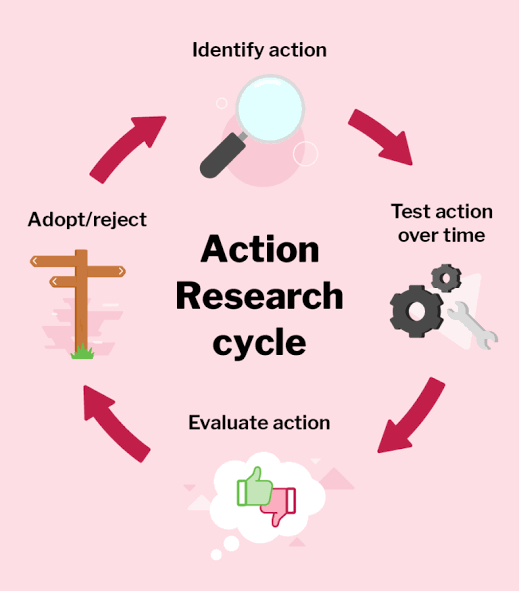
The Action Research Cycle
The defining feature of action research is its cyclical nature. Instead of following a linear path, the action research cycle allows researchers to revisit each stage as new evidence emerges.
Although several action research models exist, most follow a similar sequence that emphasizes planning, implementation, observation, and reflection.
Planning
The first stage begins by identifying the problem and developing a clear research question.
Researchers conduct a literature review, examine existing evidence, identify stakeholders, and determine appropriate research methods.
During planning, objectives are clearly defined, resources are identified, ethical considerations are addressed, and data collection procedures are established.
Taking Action
After planning, the proposed intervention is implemented.
This may involve introducing new teaching strategies, workplace policies, healthcare procedures, or community programs designed to address the identified issue.
The intervention should be carefully documented so that researchers can evaluate its effectiveness later.
Observation
Observation involves monitoring the implementation and collecting relevant data throughout the study.
Researchers gather both qualitative and quantitative evidence to evaluate whether meaningful improvements are occurring.
Observation may include classroom visits, interviews, surveys, performance metrics, focus groups, organizational reports, or other appropriate data sources.
Reflection
Reflection is the final stage of each cycle.
Researchers analyze the findings, assess whether objectives were achieved, identify strengths and weaknesses, and determine what modifications should be made.
Rather than ending the investigation, reflection often leads directly into another planning phase, creating a continuous cycle of improvement.
This iterative process allows organizations to adapt their strategies based on evidence rather than assumptions.
Types of Action Research
Although all forms of action research share common principles, several types have emerged to address different organizational and research needs.
Participatory Action Research
Participatory action research emphasizes active collaboration between researchers and participants throughout every stage of the study.
Community members help identify problems, develop interventions, interpret findings, and implement recommendations.
This approach is particularly effective in community development, public health, and social work because it empowers participants while producing locally relevant solutions.
Classroom Action Research
Classroom action research is widely used by teachers seeking to improve instructional methods, classroom management, curriculum delivery, and student learning outcomes.
Rather than waiting for external evaluations, educators investigate their own teaching practices using systematic data collection and reflection to improve educational practice continuously.
Collaborative Action Research
Collaborative action research involves multiple researchers, practitioners, or organizations working together to solve a common problem. Instead of one individual leading the entire study, a team contributes ideas, shares responsibilities, collects data, and evaluates the effectiveness of interventions collectively.
For example, a group of teachers within the same school may work together to improve students’ reading comprehension. Each teacher implements similar instructional methods in their classroom, collects data on student performance, and meets regularly to discuss findings. This collaborative approach allows researchers to compare experiences, refine teaching strategies, and develop solutions that benefit the entire institution.
Because diverse perspectives are included throughout the research process, collaborative action research often produces more comprehensive findings and stronger organizational learning.
Practical Action Research
Practical action research focuses on solving immediate workplace or organizational problems. It is typically conducted by professionals who wish to improve their own practices rather than generate broad academic theories.
For instance, a hospital administrator may investigate ways to reduce patient waiting times by introducing a new appointment scheduling system. After implementing the intervention, the administrator collects data on patient satisfaction, appointment delays, and staff efficiency before making further improvements based on the findings.
This type of action research is highly valued because it produces practical solutions that directly improve organizational performance.
Educational Action Research
Educational action research extends beyond individual classrooms to address broader issues affecting schools, colleges, and universities. Researchers may investigate curriculum development, teacher professional development, instructional methods, student engagement, or school improvement initiatives.
Suppose a university introduces blended learning across several departments. Researchers evaluate how the new instructional approach affects academic performance, student participation, and learning outcomes through continuous observation and reflection. The findings help administrators refine teaching practices while supporting evidence based decisions.
Educational action research contributes significantly to improving educational practice because it allows institutions to evaluate innovations under authentic learning conditions.
Action Research vs. Traditional Research
Many students confuse action research with traditional research because both involve systematic investigation and data collection. However, their objectives, processes, and outcomes differ considerably.
Traditional research primarily seeks to expand theoretical knowledge and develop generalizable conclusions. Researchers usually maintain a degree of separation from participants to reduce bias and improve objectivity. In many cases, findings are intended to contribute to academic literature rather than solve an immediate problem.
In contrast, action research emphasizes practical improvement within a specific setting. Researchers actively participate in implementing interventions, evaluating results, and refining practices. The primary goal is to create positive change while simultaneously generating useful knowledge.
Some of the key differences include:
- Action research focuses on solving practical problems, while traditional research often emphasizes theory development.
- Action research encourages collaboration between researchers and participants, whereas traditional research typically maintains greater researcher independence.
- Action research follows an iterative process of planning, acting, observing, and reflecting, while traditional research generally follows a linear process.
- Action research aims to improve practice immediately, whereas traditional research often contributes to long-term academic understanding.
Although these approaches differ, both play valuable roles in advancing knowledge and improving professional practice.
Action Research vs. Experimental Research
Action research and experimental research both seek to improve understanding and support informed decisions, but they differ significantly in their design and objectives.
Experimental research attempts to establish causal relationships by manipulating independent variables while controlling external influences. Researchers frequently use random assignment, control groups, and standardized procedures to improve validity and determine whether an intervention directly causes observed outcomes.
Action research, however, rarely involves strict experimental control. Instead, researchers work within naturally occurring environments where flexibility and collaboration are prioritized over rigid control. The objective is not simply to establish causation but to improve practice through continuous evaluation and refinement.
Experimental research is particularly valuable when testing scientific hypotheses under controlled conditions, while action research is better suited for improving real-world practices within organizations, schools, hospitals, and communities.
The Role of Researchers and Participants
One defining characteristic of action research is the close partnership between researchers and participants.
Rather than viewing participants solely as subjects from whom data are collected, action research encourages active involvement throughout the study. Participants contribute to identifying problems, developing interventions, implementing changes, interpreting findings, and evaluating outcomes.
Researchers facilitate the investigation by providing methodological expertise, coordinating data collection, conducting statistical analysis where appropriate, and ensuring that ethical standards are maintained.
This collaborative relationship offers several advantages:
- Greater commitment to implementing change.
- Improved quality of data collection.
- Better understanding of local challenges.
- Stronger acceptance of recommendations.
- Increased sustainability of improvements.
By involving participants throughout the research process, organizations often develop solutions that are more practical, realistic, and effective.
Data Collection in Action Research
Reliable data collection is essential for producing credible findings. Since action research aims to improve practice, researchers must gather sufficient evidence before, during, and after implementing an intervention.
Depending on the research question, data collection may involve one or several methods.
Common approaches include:
- Surveys that measure participant opinions or satisfaction.
- Interviews that provide detailed qualitative data.
- Classroom or workplace observations.
- Focus group discussions.
- Organizational reports.
- Performance records.
- Assessment scores.
- Attendance records.
- Reflective journals.
- Observation checklists.
Combining multiple data sources strengthens the validity of the findings by allowing researchers to compare evidence from different perspectives.
Many action research projects adopt a mixed methods research approach by integrating qualitative research and quantitative research. While qualitative data help explain participant experiences, quantitative data provide measurable evidence of improvement.
Data Analysis and Interpretation
After completing data collection, researchers analyze the information to determine whether the intervention achieved its objectives.
The choice of analytical techniques depends on the research design and the type of data collected.
Qualitative data may be analyzed using thematic analysis, coding procedures, or content analysis to identify recurring themes and participant experiences.
Quantitative data may involve descriptive statistics, statistical analysis, or other statistical methods that measure changes in performance, satisfaction, or outcomes.
Researchers carefully compare findings before and after the intervention to determine whether measurable improvements occurred.
Data interpretation goes beyond identifying numerical changes. Researchers examine whether improvements align with the original research question, consider alternative explanations, acknowledge study limitations, and assess how the findings contribute to evidence based practice.
Accurate analysis helps organizations make informed decisions while ensuring that recommendations are supported by reliable evidence rather than assumptions.
Validity, Reliability, and Ethical Considerations
Although action research emphasizes flexibility, maintaining scientific quality remains essential.
Researchers improve validity by ensuring that the intervention directly addresses the identified problem, collecting data from multiple sources, involving participants throughout the research process, and carefully documenting each stage of the investigation.
Reliability is strengthened by using consistent data collection procedures, standardized instruments where appropriate, and transparent documentation of research methods.
Ethical considerations should guide every stage of the study. Researchers must obtain informed consent when necessary, protect participant confidentiality, minimize potential harm, and ensure that participation remains voluntary throughout the project.
Maintaining high ethical standards strengthens trust between researchers and participants while improving the credibility of the research findings.
Advantages of Action Research
Action research has gained widespread recognition because it enables organizations and professionals to solve problems while continuously improving practice. Unlike many research methods that focus primarily on theory, action research produces immediate, measurable outcomes that benefit both researchers and participants.
Promotes Continuous Improvement
One of the greatest strengths of action research is its emphasis on continuous improvement. Rather than treating research as a one-time activity, the action research cycle encourages researchers to evaluate results, reflect on outcomes, and refine interventions through repeated cycles.
This ongoing process allows organizations to respond effectively to changing circumstances while maintaining long-term progress.
Provides Practical Solutions
Action research is designed to address real-world problems. Instead of producing findings that remain within academic journals, researchers generate practical solutions that can be implemented immediately.
Whether the objective is improving classroom instruction, enhancing healthcare services, or increasing workplace productivity, the research findings directly support decision making and organizational improvement.
Encourages Collaboration
Collaboration is one of the defining strengths of action research.
Researchers, participants, managers, teachers, healthcare professionals, and community members work together throughout the investigation. This shared responsibility often leads to stronger commitment, better communication, and greater acceptance of recommended changes.
Collaborative decision making also increases the likelihood that interventions will remain effective after the study concludes.
Supports Evidence Based Practice
Action research promotes evidence based practice by ensuring that decisions are supported by carefully collected data rather than assumptions or personal opinions.
Researchers collect information through observation, interviews, surveys, organizational records, performance indicators, and other reliable data sources before making recommendations.
This systematic approach improves organizational learning and reduces the risk of ineffective decision making.
Enhances Professional Growth
Professionals who conduct action research often develop stronger analytical, problem-solving, and reflective skills.
Teachers improve instructional methods.
Healthcare professionals enhance patient care.
Business managers strengthen organizational performance.
Community leaders improve program effectiveness.
The continuous cycle of reflection encourages lifelong learning and professional development.
Highly Flexible
Another important advantage is flexibility.
Action research can be adapted to different research questions, organizational settings, participant groups, and available resources.
Researchers may use qualitative research, quantitative research, or mixed methods research depending on the objectives of the study.
This adaptability makes action research suitable across numerous disciplines.
Limitations of Action Research
Although action research offers many advantages, researchers should also recognize its limitations.
Understanding these challenges helps ensure realistic expectations and stronger research design.
Limited Generalizability
Most action research projects investigate a specific problem within one organization, school, hospital, or community.
As a result, findings may not always apply to other settings with different participants or environmental conditions.
Researchers should therefore avoid making overly broad conclusions based on a single study.
Potential Researcher Bias
Because researchers often participate directly in implementing interventions, maintaining complete objectivity can be difficult.
Personal expectations may unintentionally influence observation, interpretation, or evaluation.
Researchers reduce bias by documenting procedures carefully, collecting evidence from multiple sources, and encouraging participant feedback throughout the investigation.
Time-Intensive Process
Action research requires substantial time and commitment.
Planning, implementing interventions, collecting data, analyzing findings, conducting reflection, and repeating the action research cycle often require several months.
Organizations must therefore allocate adequate resources to support the research process.
Organizational Constraints
Limited funding, staffing shortages, administrative changes, or competing organizational priorities may affect implementation.
Researchers should identify these challenges during the planning stage and develop strategies for minimizing their impact.
Complex Data Management
Action research frequently combines qualitative data and quantitative data from multiple sources.
Managing interviews, surveys, observations, organizational records, and performance indicators requires careful organization and systematic data analysis.
Without effective planning, valuable information may become difficult to interpret.
Real-World Applications of Action Research
The flexibility of action research allows it to be applied across numerous disciplines where continuous improvement is essential.
Education
Education remains one of the largest areas where action research is conducted.
Teachers regularly investigate ways to improve student learning, classroom practice, curriculum development, instructional methods, and academic performance.
For example, a mathematics teacher introduces project-based learning to improve student engagement. After collecting assessment scores, classroom observations, and student feedback, the teacher analyzes the findings and adjusts instructional strategies accordingly.
This systematic process improves educational practice while generating valuable insights for future teaching.
Healthcare
Healthcare professionals use action research to improve patient safety, treatment quality, communication, and clinical procedures.
A nursing department may introduce a new patient monitoring system to reduce medication errors.
Researchers collect performance data, observe nursing practice, interview staff members, and evaluate patient outcomes before recommending further improvements.
Nursing research frequently relies on action research because it supports quality improvement while maintaining patient-centered care.
Business and Organizational Development
Businesses continually seek ways to improve productivity, employee satisfaction, customer service, and operational efficiency.
Managers may conduct action research to evaluate new leadership strategies, employee training programs, or workplace policies.
Data collection may include employee surveys, productivity reports, interviews, customer feedback, and performance indicators.
The findings support informed decisions that contribute to organizational development and sustainable improvement.
Community Development
Community organizations often face complex social challenges requiring collaborative solutions.
Action research enables community members, researchers, and local leaders to work together to improve housing, education, healthcare access, environmental sustainability, and public services.
Participatory action research is particularly valuable because it empowers community members to become active contributors rather than passive participants.
Public Health
Public health agencies frequently use action research to evaluate vaccination campaigns, health education programs, disease prevention initiatives, and community wellness projects.
Continuous monitoring allows researchers to identify successful interventions, improve implementation strategies, and maximize public health outcomes.
How to Conduct an Effective Action Research Project
Although every action research project differs, successful investigations generally follow a structured process.
Step 1: Identify the Problem
Begin by clearly defining the issue requiring improvement.
The problem should be specific, measurable, and relevant to the organization or community.
A well-defined research question provides direction for the entire investigation.
Step 2: Conduct a Literature Review
A thorough literature review helps researchers understand existing knowledge, identify research gaps, evaluate previous interventions, and select appropriate research methods.
Reviewing earlier studies also strengthens the theoretical foundation of the project.
Step 3: Develop an Action Plan
Researchers design an intervention that addresses the identified problem.
The action plan should specify objectives, participant responsibilities, timelines, required resources, ethical considerations, and methods of evaluation.
Step 4: Implement the Intervention
The proposed solution is introduced within the natural environment.
Researchers carefully document implementation while monitoring participant responses and organizational conditions.
Step 5: Collect Data
Systematic data collection occurs before, during, and after implementation.
Researchers may gather qualitative data through interviews, observations, and focus groups while collecting quantitative data from surveys, performance indicators, organizational records, or assessment scores.
Using multiple data sources improves the validity of the findings.
Step 6: Analyze the Data
Researchers perform data analysis to determine whether the intervention produced measurable improvements.
Statistical analysis, thematic analysis, and other appropriate analytical techniques help identify meaningful patterns within the data.
The findings should directly address the original research question.
Step 7: Reflect and Improve
Reflection is the final stage of each action research cycle.
Researchers evaluate successes, identify remaining challenges, consider participant feedback, and determine how future interventions can be improved.
This reflection initiates the next cycle of planning and continuous improvement.
Common Mistakes to Avoid
Even well-planned action research projects can encounter problems if researchers overlook important methodological principles.
Some common mistakes include:
- Defining a research question that is too broad or unclear.
- Collecting insufficient or low-quality data.
- Ignoring participant feedback during implementation.
- Failing to conduct a comprehensive literature review.
- Overlooking ethical considerations.
- Drawing conclusions that are not supported by evidence.
- Neglecting reflection after implementation.
- Failing to document each stage of the action research process.
- Allowing researcher bias to influence findings.
- Attempting to solve multiple unrelated problems within a single study.
Avoiding these mistakes strengthens the credibility and usefulness of the research.
Best Practices for Conducting Action Research
Experienced researchers consistently follow several best practices that improve research quality.
- Clearly define the research question before beginning the investigation.
- Involve participants throughout every stage of the research process.
- Collect evidence from multiple data sources.
- Combine qualitative and quantitative approaches where appropriate.
- Maintain detailed documentation of every intervention.
- Apply suitable data analysis techniques.
- Reflect honestly on both successes and limitations.
- Follow ethical guidelines throughout the study.
- Base recommendations on evidence rather than assumptions.
- Use each completed cycle as the foundation for future improvement.
These practices strengthen both the reliability of the findings and the long-term impact of the project.
Frequently Asked Questions
Is action research qualitative or quantitative?
Action research is not limited to a single methodology. Researchers may use qualitative research, quantitative research, or mixed methods research depending on the research question, objectives, and available data.
Who can conduct action research?
Action research can be conducted by teachers, healthcare professionals, business managers, community leaders, government agencies, nonprofit organizations, and academic researchers. Anyone seeking to improve practice through systematic inquiry can apply the action research methodology.
How is action research different from traditional research?
Traditional research often focuses on developing theory and producing generalizable knowledge. Action research emphasizes solving practical problems through collaboration, implementation, observation, reflection, and continuous improvement.
Why is reflection important in action research?
Reflection allows researchers to evaluate findings, identify strengths and weaknesses, improve future interventions, and promote continuous learning. Without reflection, the action research cycle remains incomplete.
Can action research improve organizational performance?
Yes. Because action research combines systematic investigation with practical implementation, organizations frequently use it to improve productivity, service quality, employee engagement, customer satisfaction, and operational effectiveness.
Conclusion
Action research is one of the most valuable research methodologies for professionals seeking practical solutions to real-world challenges. By combining systematic inquiry with direct action, it enables researchers, practitioners, and participants to work collaboratively toward continuous improvement while generating reliable evidence for decision making.
Throughout this guide, we explored the meaning of action research, its defining characteristics, the action research cycle, major types, practical applications, advantages, limitations, and the steps required to conduct a successful action research project. We also examined how evidence based practice, reflective practice, collaboration, and rigorous data collection contribute to stronger findings and more sustainable outcomes.
Unlike many traditional research methods, action research bridges the gap between theory and practice by encouraging organizations to learn from experience, refine interventions, and adapt continuously to changing conditions. Whether applied in education, healthcare, business, community development, public health, or organizational development, it empowers researchers to create meaningful change while contributing valuable insights to professional practice.
Ultimately, the effectiveness of action research depends on thoughtful planning, active participant involvement, ethical research practices, systematic data analysis, and a genuine commitment to continuous improvement. When these principles are followed, action research becomes far more than a research method—it becomes a powerful framework for innovation, organizational learning, and lasting positive change.
Be the first to comment