Writing a literature review is one of the most important stages of the research process, yet it is also one of the most misunderstood. Many students believe a literature review is simply a summary of books, journal articles, and previous studies. In reality, an effective literature review does much more. It evaluates, compares, synthesizes, and interprets existing literature to demonstrate what is already known about a topic, identify research gaps, and establish the foundation for new research.
Whether you are preparing a research paper, undergraduate project, master’s thesis, doctoral dissertation, or journal article, learning how to write literature review effectively is a skill that will improve the quality of your academic writing and strengthen your research. A well-written literature review not only shows that you understand the work of other researchers but also demonstrates your ability to think critically, organize ideas logically, and contribute meaningful insights to your field.
The challenge for many students is knowing where to begin. Questions such as “How many sources should I use?”, “How do I organize the body?”, “How do I compare different studies?”, and “What is the difference between summarizing and synthesizing?” are common. Without proper guidance, it is easy to produce a review that merely lists previous studies instead of building a coherent academic argument.
Fortunately, writing a high-quality literature review is a skill that can be learned. By understanding the purpose of a literature review, conducting a systematic literature search, evaluating scholarly sources critically, organizing evidence effectively, and following a clear writing structure, you can produce a review that meets academic standards and supports your research objectives.
This comprehensive guide explains every stage of the process. You’ll learn what a literature review is, why it matters, the different types of literature reviews, how to search academic databases, evaluate evidence, identify a research gap, synthesize findings, structure your review, avoid common mistakes, and write with confidence. Whether you’re writing your first assignment or preparing an advanced dissertation, this guide will help you produce a literature review that is clear, persuasive, and academically rigorous.
What Is a Literature Review?
A literature review is a critical evaluation and synthesis of published research related to a specific topic or research question. Rather than simply describing previous studies, it examines how different researchers have approached a problem, compares their findings, identifies areas of agreement and disagreement, and highlights gaps that require further investigation.
In academic writing, a literature review serves as the bridge between existing knowledge and new research. It demonstrates that the researcher understands the scholarly conversation surrounding a topic and can position their own study within that conversation.
Unlike a simple annotated bibliography, where each source is discussed independently, a literature review integrates multiple scholarly sources into a unified discussion. The emphasis is on relationships between studies, recurring themes, methodological differences, theoretical perspectives, and the overall development of knowledge in a particular field.
For example, if your research paper investigates the impact of online learning on academic performance, your literature review should not merely summarize individual articles. Instead, it should compare findings across empirical studies, discuss differences in research methodology, evaluate conflicting evidence, identify patterns, and explain where additional research is needed.
Because a literature review focuses on analysis rather than description, it is considered one of the most intellectually demanding sections of academic research.
Why Is a Literature Review Important
A literature review performs several important functions throughout the research process. Without it, researchers risk duplicating existing work, overlooking important evidence, or failing to justify the significance of their study.
One of its primary purposes is to establish context. Every research study builds upon previous knowledge. Reviewing existing literature allows researchers to understand how ideas have evolved over time and how their work contributes to the broader academic discussion.
A literature review also helps identify a research gap. By carefully examining scholarly articles, researchers can discover unanswered questions, inconsistent findings, underrepresented populations, or methodological limitations that deserve further investigation. These gaps often become the basis for new research questions and research objectives.
Another important function is strengthening the theoretical and conceptual foundation of a study. Existing literature introduces relevant theories, conceptual frameworks, and research methodology that can guide the design of new research.
Literature reviews also improve the quality of academic writing. Reading high-quality scholarly sources exposes students to appropriate academic vocabulary, evidence-based argumentation, and effective citation practices.
Beyond academic requirements, literature reviews support evidence-based decision-making. Professionals in healthcare, education, business, public policy, and market research frequently review published evidence before implementing new policies or interventions.
Ultimately, a strong literature review demonstrates that a researcher understands the existing body of knowledge and can produce meaningful conclusions supported by credible evidence.
Objectives of a Literature Review
Every literature review should accomplish several interconnected objectives.
First, it summarizes existing literature relevant to the research topic while avoiding unnecessary repetition. The goal is not simply to list previous studies but to explain what they collectively reveal.
Second, it evaluates the quality of existing evidence. Not all research studies are equally reliable. Researchers must critically assess research design, methodology, sample size, data collection procedures, statistical analysis, and potential bias before accepting conclusions.
Third, it identifies patterns and relationships across multiple studies. Recognizing similarities and differences between investigations helps explain how knowledge has developed over time.
Fourth, it identifies research gaps. These may include theoretical gaps, methodological gaps, geographical limitations, inconsistent findings, or populations that have received little scholarly attention.
Finally, it provides the foundation for the current study by explaining how the proposed research contributes something new to existing knowledge.
Types of Literature Reviews
Not all literature reviews follow the same approach. The appropriate type depends on the purpose of the study, the research methodology, and the scope of the project.
Narrative Literature Review
A narrative review provides a broad overview of existing literature related to a particular topic. It summarizes and interprets previous studies without following the highly structured procedures required in systematic reviews.
Narrative reviews are particularly useful when researchers want to explain the historical development of an idea, compare theoretical perspectives, or introduce readers to a broad research area.
Because narrative reviews rely heavily on the researcher’s interpretation, transparency regarding source selection is especially important.
Systematic Review
A systematic review follows a rigorous and transparent methodology for identifying, selecting, evaluating, and synthesizing research evidence.
Researchers establish inclusion criteria and exclusion criteria before searching academic databases. Every stage of the literature search is documented to minimize bias and improve reproducibility.
Systematic reviews are widely used in medicine, psychology, education, and evidence-based policy because they provide highly reliable summaries of available evidence.
Scoping Review
A scoping review explores the breadth of research available on a topic rather than answering a narrowly defined research question.
This type of review is especially valuable when a field is emerging or rapidly evolving. It helps researchers understand the volume, characteristics, and distribution of existing literature while identifying areas requiring further investigation.
Critical Review
A critical review moves beyond summarizing published work by carefully evaluating the strengths, weaknesses, assumptions, and limitations of previous research.
Instead of simply reporting findings, researchers assess the credibility of evidence, compare competing viewpoints, and explain why certain conclusions may be more convincing than others.
Critical reviews require strong analytical skills and are common in graduate-level academic writing.
Theoretical Review
A theoretical review examines theories, conceptual models, and frameworks related to a research topic.
Rather than focusing primarily on empirical studies, it analyzes how different theories explain a phenomenon and evaluates their strengths and limitations.
Researchers often conduct theoretical reviews when developing new conceptual frameworks or refining existing theories.
Integrative Review
An integrative review combines evidence from both empirical studies and theoretical literature to provide a comprehensive understanding of a research problem.
Because it draws upon multiple forms of evidence, this type of literature review often offers broader perspectives than reviews limited to one research methodology.
Literature Review vs. Annotated Bibliography
Many students mistakenly assume that a literature review and an annotated bibliography are interchangeable. Although both involve reviewing scholarly sources, they serve different purposes.
An annotated bibliography discusses each source independently. Every article, book, or report receives its own summary and evaluation.
A literature review, by contrast, organizes evidence around themes, concepts, methodologies, or chronological developments. Instead of discussing one article at a time, it compares multiple studies simultaneously and explains the relationships between them.
For example, three different studies examining online education may all be discussed together under a theme such as “student engagement in virtual classrooms.” This integrated approach produces a stronger academic argument than isolated summaries.
Literature Review vs. Research Paper
Another common misconception involves confusing a literature review with a complete research paper.
A research paper presents original findings obtained through data collection, statistical analysis, experimentation, or other research methods.
A literature review does not collect new data. Instead, it analyzes and synthesizes existing literature to explain what previous researchers have already discovered.
However, the literature review remains one of the most important sections of a research paper because it provides the theoretical and empirical foundation upon which the new study is built.
Before You Start Writing a Literature Review
Successful literature reviews begin long before the first paragraph is written. Careful preparation improves efficiency, strengthens academic quality, and prevents unnecessary revisions later.
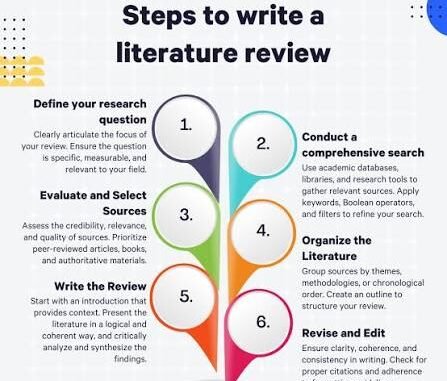
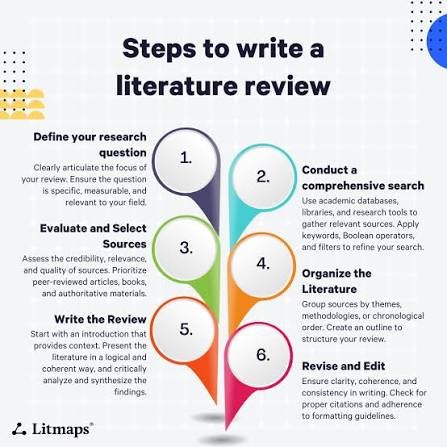
The first step is clearly defining the research topic. A topic that is too broad can produce thousands of irrelevant search results, while one that is too narrow may yield insufficient scholarly sources.
After selecting the topic, develop a focused research question that guides the entire review. A clearly defined research question determines which studies should be included, what evidence is relevant, and how the review should be organized.
Next, identify important keywords related to your topic. Consider synonyms, broader concepts, narrower terms, and discipline-specific terminology. Using multiple search terms improves the effectiveness of your literature search and helps locate relevant scholarly articles across different academic databases.
Finally, establish clear inclusion criteria and exclusion criteria before beginning the literature search. These criteria may relate to publication dates, language, study design, population, geographical location, or methodological quality. Defining these standards in advance promotes consistency and reduces selection bias.
How to Search for Relevant Literature
Finding credible and relevant sources is one of the most important stages of writing a literature review. Even the strongest writing cannot compensate for weak or outdated references. An effective literature search should be systematic, comprehensive, and focused on scholarly evidence that directly addresses your research question.
Begin by identifying keywords related to your topic. Besides your primary topic, think of alternative spellings, synonyms, broader concepts, and narrower concepts. For example, if your topic is online education, related keywords may include e-learning, distance education, virtual learning, digital learning, and blended learning.
Using Boolean operators can significantly improve search accuracy. Combining keywords with AND narrows search results, OR expands them, and NOT excludes unwanted topics. Quotation marks are useful when searching for exact phrases, while truncation symbols can capture different forms of a word.
Searching across multiple academic databases improves the comprehensiveness of your review. Different databases index different journals, meaning that relying on only one platform may cause you to miss valuable studies.
Popular academic databases include Google Scholar, Scopus, Web of Science, PubMed, JSTOR, ScienceDirect, ERIC, PsycINFO, and ProQuest. Depending on your discipline, specialized databases may also contain highly relevant literature.
Rather than downloading every article you find, first read the title and abstract. If the study appears relevant, examine the methodology, findings, and conclusion before deciding whether to include it in your review.
It is equally important to prioritize peer-reviewed publications because they have undergone expert evaluation before publication. Although books, conference proceedings, government reports, and reputable organizational publications may also provide useful information, peer-reviewed journal articles generally carry greater academic credibility.
Evaluating Sources Critically
Not every published source deserves equal attention. One of the defining characteristics of a strong literature review is the ability to evaluate literature critically rather than accepting every finding at face value.
When reading each source, consider several important questions.
Who conducted the study? Researchers with recognized expertise and publications in the field often produce more reliable work.
Where was the research published? Articles appearing in reputable peer-reviewed journals usually provide stronger evidence than unpublished manuscripts or non-scholarly websites.
Is the research current? In rapidly evolving disciplines such as medicine, technology, and artificial intelligence, more recent studies often provide more accurate evidence. However, classic theoretical works should not be ignored simply because they are older.
Was the sample size appropriate? Small samples may reduce the generalizability of findings, while larger and more representative samples often increase confidence in the results.
Was the research methodology suitable for answering the research question? The chosen research design should align with the objectives of the study.
Were limitations acknowledged? High-quality researchers openly discuss weaknesses in their studies instead of presenting conclusions as absolute facts.
Can the findings be generalized to other populations or settings? Context matters when interpreting research outcomes.
Carefully evaluating each source improves the overall quality of your literature review and prevents weak evidence from influencing your conclusions.
How to Read Research Articles Efficiently
Many students attempt to read every research article from beginning to end. While this may seem thorough, it is often inefficient, especially when reviewing dozens or even hundreds of publications.
Instead, adopt a strategic reading approach.
Start with the abstract to determine whether the article addresses your research question.
Next, read the introduction to understand the background and objectives of the study.
Move to the methodology section to examine the research design, participants, instruments, and data collection procedures.
Review the results to understand the major findings.
Then read the discussion and conclusion to see how the researchers interpreted their results and connected them to previous studies.
Finally, examine the reference list. References often lead to additional high-quality studies that may be valuable for your literature review.
Taking organized notes while reading saves considerable time during the writing stage. Record key findings, theoretical frameworks, methodology, strengths, limitations, and direct relevance to your research question.
Organizing Your Literature Before Writing
One of the biggest mistakes researchers make is beginning to write before organizing their sources.
Instead of arranging studies in the order they were found, group them according to meaningful patterns. This makes the literature review easier to write and easier for readers to follow.
There are several effective organizational approaches.
Chronological Organization
This approach presents literature according to historical development.
Researchers discuss how understanding of a topic has evolved over time, highlighting important discoveries and major shifts in thinking.
Chronological organization works particularly well for topics that have experienced substantial theoretical or technological development.
Thematic Organization
Thematic organization is the most common approach used in academic literature reviews.
Instead of discussing individual studies separately, related research is grouped under common themes.
For example, a literature review on employee motivation might include themes such as leadership style, workplace environment, financial incentives, organizational culture, and employee engagement.
This structure helps readers understand broader patterns rather than isolated findings.
Methodological Organization
Sometimes researchers organize literature according to research methodology.
Studies using qualitative methods may be discussed separately from quantitative studies, mixed-methods research, experimental designs, or observational studies.
This approach allows researchers to compare methodological strengths and weaknesses across the literature.
Theoretical Organization
If multiple theories explain a phenomenon, organizing the literature according to theoretical perspectives may be the most appropriate option.
Each section explains how a particular theory has been applied, compares competing viewpoints, and evaluates their explanatory power.
How to Develop a Strong Literature Review Structure
Although literature reviews vary across disciplines, most follow a consistent structure consisting of an introduction, body, and conclusion.
The introduction introduces the research topic, explains its importance, defines the scope of the review, and presents the research question or objectives.
The body forms the largest section. Here, researchers synthesize evidence, compare findings, identify agreements and disagreements, evaluate methodologies, discuss theoretical perspectives, and highlight research gaps.
The conclusion summarizes major findings from the literature without introducing new evidence. It explains how the reviewed literature supports the current study and identifies opportunities for future research.
Throughout the review, paragraphs should flow logically from one idea to the next. Clear transitions help readers understand how different themes connect.
How to Synthesize Literature Instead of Summarizing
One of the most common weaknesses in student writing is excessive summarization.
Summarizing means describing individual studies one after another.
For example:
“Smith (2022) found that online learning improves academic performance. Johnson (2023) found similar results. Brown (2024) also reported positive outcomes.”
Although factually correct, this writing does not demonstrate critical thinking.
Synthesis takes analysis much further.
A synthesized discussion compares multiple studies, explains similarities and differences, evaluates methodological quality, identifies recurring themes, and offers interpretation.
For example:
“Most studies report a positive association between online learning and academic performance. However, improvements appear strongest among self-directed learners, suggesting that learner autonomy may moderate educational outcomes. Differences in sample characteristics and instructional design partly explain conflicting findings across studies.”
Notice that synthesis creates a coherent academic discussion instead of isolated summaries.
Strong synthesis is what separates an excellent literature review from an average one.
Identifying Research Gaps
Every literature review should demonstrate why additional research is needed.
Research gaps represent unanswered questions or areas where existing knowledge remains incomplete.
Several types of gaps commonly appear in scholarly literature.
Empirical gaps occur when few studies investigate a particular population, location, or context.
Methodological gaps arise when researchers consistently use similar methods while neglecting alternative research designs.
Theoretical gaps appear when existing theories fail to explain observed findings adequately.
Practical gaps occur when research findings have limited real-world application.
Population gaps exist when important demographic groups remain underrepresented.
Contradictory evidence may also indicate a research gap. When different studies produce conflicting findings, further investigation is often necessary.
Rather than simply stating that a gap exists, explain why addressing it will contribute meaningful knowledge to the field.
Using Evidence Effectively
Academic writing depends on evidence rather than opinion.
Every major claim in your literature review should be supported by credible scholarly sources.
Instead of relying heavily on direct quotations, paraphrase information using your own words while maintaining accurate citation. Paraphrasing demonstrates understanding and creates a smoother reading experience.
Balance evidence from multiple sources rather than depending excessively on one author. If several high-quality studies support the same conclusion, presenting them together strengthens your argument.
At the same time, acknowledge contradictory evidence. Ignoring conflicting findings weakens academic credibility. Instead, explain possible reasons for disagreement, such as differences in methodology, sample characteristics, geographic context, or analytical techniques.
Effective literature reviews present evidence objectively while demonstrating thoughtful interpretation.
Maintaining Academic Voice
A literature review should maintain a formal, objective, and scholarly tone throughout.
Avoid conversational expressions, unsupported personal opinions, emotional language, and exaggerated claims.
Instead of writing, “I think this study is excellent,” explain why it is methodologically strong.
For example:
“The study employed a large nationally representative sample, increasing the generalizability of its findings.”
Objective language strengthens academic credibility and allows evidence—not opinion—to persuade the reader.
Consistent use of precise terminology, logical transitions, and balanced analysis contributes to a professional literature review that meets university and journal standards.
How to Write the Introduction of a Literature Review
The introduction sets the direction for the entire literature review. It should provide readers with sufficient background information to understand the topic while clearly defining the scope of the review.
An effective literature review introduction should briefly introduce the research topic, explain why it is important, identify the research question or research objectives, define the boundaries of the review, and explain how the review is organized.
Avoid discussing individual studies in detail within the introduction. Instead, focus on preparing readers for the critical discussion that follows.
For example, if your topic examines the relationship between artificial intelligence and higher education, your introduction should explain the growing use of AI in education, why reviewing existing literature is necessary, and the specific aspects that the review will examine.
A concise yet informative introduction immediately establishes credibility and gives readers a clear understanding of what to expect.
How to Write the Body of a Literature Review
The body is the core of every literature review. This is where you critically evaluate, compare, and synthesize previous studies rather than merely describing them.
Each section should focus on a single theme, concept, theory, methodology, or chronological development. Begin each paragraph with a clear topic sentence that introduces the main idea, followed by evidence from multiple scholarly sources.
Rather than discussing one article at a time, integrate several studies into a unified discussion.
For example, instead of writing:
“Smith (2021) found that online learning improves student engagement. Johnson (2022) reached a similar conclusion. Brown (2023) also reported positive findings.”
A stronger approach would be:
“Several empirical studies consistently report that online learning improves student engagement, although the magnitude of improvement varies according to instructional design, learner motivation, and technological accessibility. These findings suggest that educational outcomes depend not only on digital platforms but also on broader pedagogical factors.”
This approach demonstrates synthesis instead of simple summarization.
When comparing studies, discuss similarities, differences, methodological strengths, weaknesses, limitations, and implications. Explain why conflicting findings may have occurred instead of simply listing them.
Throughout the body, maintain logical transitions between paragraphs so that readers can easily follow the development of your argument.
How to Write the Conclusion of a Literature Review
The conclusion should bring the literature review together by summarizing the major themes without introducing new evidence.
Rather than repeating every point discussed earlier, emphasize the overall patterns emerging from the literature.
Discuss the major findings that consistently appear across previous studies.
Highlight the most significant research gaps identified during your review.
Explain how the reviewed literature supports your own research study.
Finally, indicate why further investigation is necessary and how your research contributes to the existing body of knowledge.
A strong conclusion reinforces the significance of the literature review while naturally leading readers toward the next stage of the research process.
Common Mistakes to Avoid When Writing a Literature Review
Even experienced researchers occasionally make mistakes that reduce the quality of a literature review. Recognizing these common problems helps you produce stronger academic writing.
One frequent mistake is summarizing sources without analyzing them. Simply describing previous studies does not demonstrate critical thinking or scholarly synthesis.
Another mistake is relying on outdated literature. While foundational theories remain valuable, researchers should incorporate recent peer-reviewed articles whenever possible to ensure the review reflects current knowledge.
Many students also use too few scholarly sources. A comprehensive literature review requires sufficient evidence to support meaningful conclusions.
Poor organization is another common weakness. Randomly presenting studies without a clear thematic or methodological structure makes the review difficult to follow.
Ignoring contradictory findings can also weaken credibility. High-quality researchers acknowledge disagreements within the literature and explore possible explanations.
Some writers fail to identify a clear research gap. Without demonstrating what remains unknown, the literature review cannot effectively justify the need for additional research.
Improper citation practices create another serious problem. Every borrowed idea must be properly referenced to maintain academic integrity and avoid plagiarism.
Finally, many literature reviews suffer from weak transitions between paragraphs. Smooth transitions help readers understand how ideas connect and create a coherent academic argument.
Useful Tools for Writing a Literature Review
Modern technology has made the research process significantly more efficient.
Google Scholar remains one of the most accessible platforms for locating scholarly articles across numerous disciplines.
Scopus and Web of Science provide extensive citation databases that allow researchers to identify influential publications and monitor citation trends.
Reference management software such as Zotero, Mendeley, and EndNote helps organize sources, generate citations, and create reference lists automatically.
Research Rabbit and Connected Papers visualize relationships among studies, making it easier to discover influential authors and emerging research areas.
Rayyan and Covidence assist researchers conducting systematic reviews by simplifying article screening and collaboration.
Artificial intelligence tools, including ChatGPT and Microsoft Copilot, can support brainstorming, outlining, paraphrasing, and summarizing concepts. However, researchers should always verify AI-generated information against original scholarly sources.
Turnitin remains an important tool for checking originality and ensuring compliance with academic integrity standards.
Although these tools improve efficiency, they should complement—not replace—critical thinking and independent analysis.
Practical Tips for Writing an Excellent Literature Review
Producing an outstanding literature review requires planning, discipline, and continuous refinement.
Begin searching for literature early rather than waiting until your research project is nearly complete.
Read actively instead of passively. Take notes, compare studies, and record important quotations, methodologies, and limitations while reading.
Develop a literature matrix to organize information efficiently. Recording authors, publication years, research objectives, methodology, findings, strengths, weaknesses, and relevance makes writing considerably easier.
Focus on synthesis rather than summary. Every paragraph should connect multiple studies rather than discussing one source in isolation.
Use clear academic language that communicates ideas precisely without unnecessary complexity.
Support every major claim with evidence from credible scholarly sources.
Revise your work multiple times. Effective editing improves logical flow, strengthens transitions, eliminates repetition, and enhances clarity.
Ask supervisors, instructors, or colleagues for feedback before submitting your work. External perspectives often identify weaknesses that the writer overlooks.
Finally, remember that writing is an iterative process. Excellent literature reviews are developed through multiple drafts rather than completed perfectly on the first attempt.
Frequently Asked Questions
How many sources should a literature review include?
The number depends on your academic level, discipline, and research topic. Undergraduate assignments may require between 20 and 40 scholarly sources, while master’s theses often include 50 to 100 sources. Doctoral dissertations may review well over 150 publications. Quality and relevance are always more important than quantity.
Can I use books in a literature review?
Yes. Books are particularly valuable for theoretical foundations, historical background, and conceptual discussions. However, they should be complemented with recent peer-reviewed journal articles to ensure your review reflects current research.
Should I include only recent studies?
Not necessarily. Foundational studies and classic theories often remain essential regardless of publication date. Nevertheless, incorporating recent evidence demonstrates awareness of current developments within your field.
What citation style should I use?
Always follow the citation style required by your institution, department, journal, or publisher. Common styles include APA, MLA, Chicago, and Harvard referencing. Consistency throughout the document is essential.
Can I include conflicting studies?
Absolutely. In fact, discussing conflicting findings strengthens your literature review because it demonstrates critical analysis. Explain why results differ by considering factors such as research methodology, sample characteristics, context, or analytical approaches.
Conclusion
Learning how to write literature review is an essential skill for every researcher, whether preparing a classroom assignment, thesis, dissertation, or scholarly publication. A well-crafted literature review goes beyond summarizing previous studies. It critically evaluates existing literature, synthesizes evidence from multiple scholarly sources, identifies research gaps, and establishes the intellectual foundation for new research.
The most effective literature reviews begin with a focused research question, employ a systematic literature search across credible academic databases, evaluate the quality of available evidence, and organize findings into a logical structure. Throughout the writing process, researchers should prioritize synthesis over summary, maintain an objective academic tone, support arguments with peer-reviewed evidence, and adhere to appropriate citation practices.
Although writing a literature review can initially seem overwhelming, following a structured process makes the task manageable. With careful planning, critical reading, thoughtful organization, and multiple rounds of revision, you can produce a literature review that demonstrates scholarly expertise, contributes valuable insight to your discipline, and strengthens the overall quality of your research paper or thesis. A strong literature review is not merely an academic requirement—it is the foundation upon which meaningful, credible, and impactful research is built.
Be the first to comment