Writing a research project, thesis, dissertation, or journal article involves more than collecting data and analyzing results. Every quality research study begins with a clear understanding of the problem being investigated and the concepts that guide the study. One of the most important elements that connects your research problem, literature review, research objectives, research questions, and methodology is the conceptual framework. Learning how to write a conceptual framework is an essential academic writing skill because it provides a logical structure for your study and demonstrates how different concepts or variables relate to one another.
Many undergraduate and postgraduate students struggle with writing a conceptual framework because they are unsure where to begin. Some confuse it with a theoretical framework, while others find it difficult to identify research variables, establish relationships between variables, or explain their conceptual framework diagram. These challenges often lead to revisions from supervisors and delays in completing research projects. Fortunately, understanding the framework development process can make the task much easier.
This comprehensive guide explains how to write a conceptual framework in research from start to finish. You will learn what a conceptual framework is, why it is important, the difference between a conceptual framework and a theoretical framework, the major components of a conceptual framework, and the steps involved in developing one. The guide also includes conceptual framework examples, practical tips, common mistakes to avoid, and recommendations for creating a professional conceptual framework diagram that aligns with your research objectives and research methodology.
Whether you are preparing a research proposal, undergraduate project, master’s thesis, PhD dissertation, journal article, or any other scholarly research, this article will help you develop a conceptual framework that is clear, logical, evidence-based, and academically sound.
What Is a Conceptual Framework?
A conceptual framework is a structured representation of the major concepts, constructs, and research variables in a study and the relationships that exist among them. It serves as the research framework that explains how the researcher believes different concepts interact to address the research problem and achieve the research objectives.
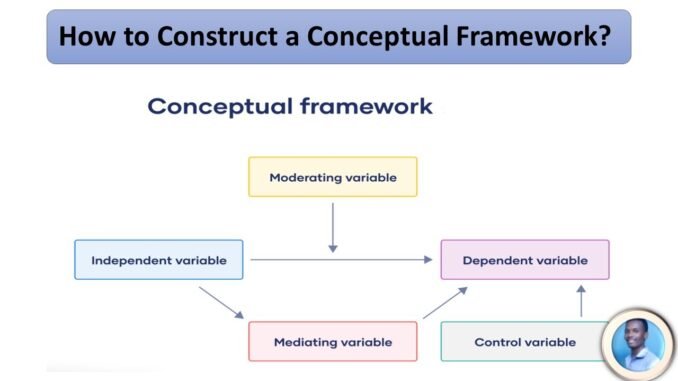
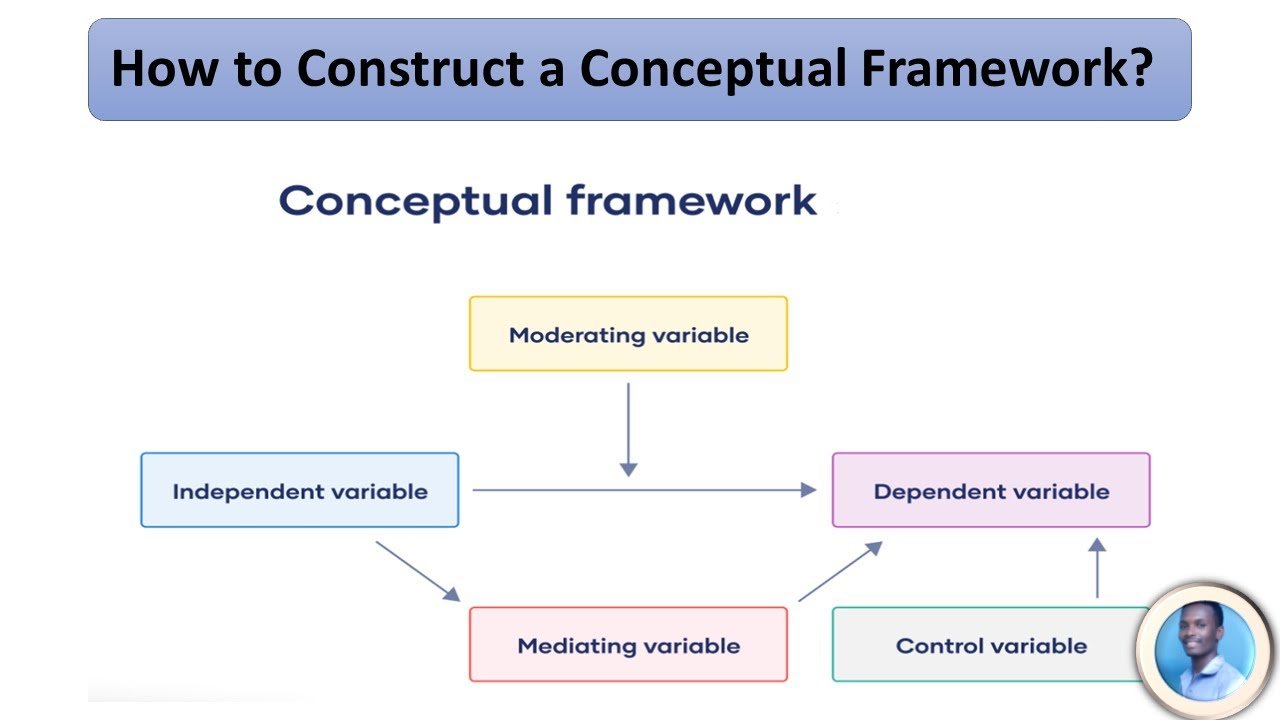
In academic research, the conceptual framework acts as a roadmap that guides every stage of the research process. It helps researchers organize ideas obtained from the literature review, identify the independent variable and dependent variable, determine possible mediating variables, moderating variables, or control variables where necessary, and illustrate how these elements contribute to answering the research questions or testing the research hypothesis.
Unlike a simple list of concepts, a conceptual framework demonstrates logical relationships. It is usually presented in two complementary formats. The first is a conceptual framework diagram, which visually illustrates the connections among variables or constructs. The second is a written explanation that describes the framework, justifies the relationships using empirical research and scholarly literature, and explains why the selected variables are appropriate for the study.
For example, a researcher investigating the effect of social media marketing on customer purchase intention may identify social media marketing as the independent variable and customer purchase intention as the dependent variable. Customer trust may serve as a mediating variable because it explains how social media marketing influences purchase intention. Brand reputation could function as a moderating variable because it affects the strength of the relationship between social media marketing and customer purchase intention. These variables and their relationships collectively form the conceptual model for the study.
A well-developed conceptual framework should always reflect the specific objectives of the research, remain consistent with the literature review, and align with the selected research design and research methodology.
Why Is a Conceptual Framework Important in Research?
The conceptual framework is one of the most valuable sections of academic research because it establishes a clear direction for the study. Rather than collecting information without focus, the researcher uses the framework to organize ideas, identify important variables, and explain the expected relationships among concepts.
One major benefit of a conceptual framework is that it provides clarity. Research often involves multiple variables, theories, and concepts that can easily become confusing. By creating a conceptual framework, researchers simplify these relationships and make the study easier to understand for readers, supervisors, examiners, and journal reviewers.
Another important function is that the framework connects the literature review to the research methodology. During the literature review, researchers examine previous studies, identify research gaps, and understand how other scholars have explained similar problems. The conceptual framework transforms these findings into a structured research model that can be tested or explored through empirical research.
The framework also supports the formulation of research objectives and research questions. Every objective should be represented within the conceptual framework, ensuring consistency throughout the study. When research hypotheses are included, they are usually derived directly from the relationships illustrated in the framework.
In addition, the conceptual framework helps researchers identify the most appropriate variables and operational definitions. Every concept included in the framework should be clearly defined, measurable where necessary, and relevant to the research problem. This improves the overall quality of data collection and analysis.
For quantitative research, the conceptual framework identifies measurable variables and explains expected cause-and-effect relationships. Researchers often investigate how one or more independent variables influence a dependent variable while considering possible mediating variables, moderating variables, or control variables.
For qualitative research, the framework may focus on concepts, themes, experiences, or processes rather than measurable variables. Instead of testing hypotheses, qualitative researchers use the framework to organize concepts emerging from previous studies and guide data collection and interpretation.
Mixed methods research combines both approaches by integrating quantitative variables with qualitative concepts into a single research framework. This flexibility makes the conceptual framework applicable across different research methodologies and academic disciplines.
Beyond improving the organization of research, the conceptual framework also strengthens academic writing. A clearly explained framework demonstrates that the researcher understands the research problem, has conducted a thorough literature synthesis, and can logically connect previous studies with the proposed investigation. This enhances the credibility and trustworthiness of the research.
Finally, a strong conceptual framework helps readers understand not only what the researcher intends to study but also why the selected variables, constructs, and relationships are important. It creates a solid foundation upon which the entire research project is built.
Conceptual Framework vs. Theoretical Framework
One of the most common areas of confusion among students is the difference between a conceptual framework and a theoretical framework. Although both provide guidance for research, they are not the same and should not be used interchangeably.
A theoretical framework is based on one or more established theories developed by recognized scholars. It explains the theoretical foundation of the research by applying existing theories to understand or predict a phenomenon. The theories selected provide established principles that support the study and explain why certain relationships are expected to exist.
A conceptual framework, on the other hand, is developed by the researcher after reviewing scholarly articles, empirical research, previous studies, and academic literature. Rather than relying entirely on one existing theory, it combines relevant concepts, variables, and findings from different sources to create a customized research framework for the specific study.
Another important distinction lies in flexibility. A theoretical framework generally follows the assumptions of existing theories, whereas a conceptual framework allows researchers to develop their own conceptual model based on available evidence, research objectives, and identified knowledge gaps.
For example, a study examining the effect of financial literacy on investment decisions may use the Theory of Planned Behavior as its theoretical framework. However, after reviewing the literature, the researcher may create a conceptual framework showing financial literacy as the independent variable, financial confidence as a mediating variable, risk tolerance as a moderating variable, and investment decision as the dependent variable. While the theory explains the general behavior, the conceptual framework illustrates the specific variables investigated in the study.
Another difference concerns presentation. A theoretical framework is usually discussed in narrative form by explaining the selected theories and their relevance to the study. A conceptual framework typically includes both a conceptual framework diagram and a written explanation describing the relationships among concepts and variables.
Despite these differences, the two frameworks often complement each other. The theoretical framework provides the underlying theoretical foundation, while the conceptual framework translates that foundation into a practical research model that can be investigated through data collection and analysis.
Researchers should carefully determine whether their study requires only a conceptual framework, only a theoretical framework, or both. Many quantitative studies include both sections, while some qualitative and exploratory studies rely primarily on a conceptual framework developed through extensive literature review and conceptualization.
Understanding these differences helps researchers avoid one of the most common academic writing mistakes and ensures that the framework chosen aligns with the research methodology, research design, and overall objectives of the study.
Core Components of a Conceptual Framework
Every high-quality conceptual framework contains several interconnected components that collectively explain the focus and direction of the study. Although the exact structure may differ across disciplines such as education, accounting, business, psychology, healthcare, nursing, management, and the social sciences, the underlying principles remain largely the same.
Research Problem
The research problem forms the starting point of every conceptual framework. It identifies the issue, challenge, or knowledge gap that the study seeks to address. A well-defined research problem provides the foundation for selecting relevant concepts, variables, and relationships.
Every component of the conceptual framework should contribute to solving the research problem. If a concept does not directly relate to the problem being investigated, it should generally not be included in the framework.
Research Objectives
The research objectives explain what the researcher intends to achieve. These objectives guide the selection of concepts and variables within the framework and ensure that every relationship illustrated serves a specific purpose.
For example, if one objective is to determine the effect of employee training on organizational performance, both employee training and organizational performance should appear within the conceptual framework, along with any supporting variables identified through the literature review.
Research Questions
Research questions further refine the study by specifying what the researcher wants to investigate. The conceptual framework should provide a logical structure for answering each research question. Consistency between the framework and the research questions improves the overall quality of the research proposal, thesis, or dissertation.
Research Variables and Constructs
Variables are among the most important elements of a conceptual framework. In quantitative studies, researchers commonly identify the independent variable, dependent variable, mediating variable, moderating variable, and, where applicable, the control variable. Each variable should be clearly defined through operational definitions and supported by previous empirical research.
In qualitative research, measurable variables may be replaced with broader research concepts or constructs that represent experiences, behaviors, perceptions, or processes. Regardless of the research methodology, every concept included in the framework should contribute meaningfully to addressing the research problem.
Relationships Between Variables
A conceptual framework is more than a collection of concepts. It should clearly explain how the variables or constructs are expected to interact. These variable relationships are often illustrated using arrows within a conceptual framework diagram and described in the accompanying narrative.
The relationships should be supported by findings from scholarly research, previous studies, and literature synthesis rather than personal opinion. This evidence-based approach strengthens the credibility of the conceptual framework and demonstrates that the proposed research model is grounded in existing knowledge.
How to Write a Conceptual Framework: Step-by-Step Guide
Now that you understand what a conceptual framework is, why it is important, and how it differs from a theoretical framework, the next step is learning how to develop a conceptual framework that accurately represents your study. Although the exact approach may vary depending on your discipline and research methodology, the overall framework development process follows a logical sequence. By following these steps, you can create a conceptual framework that is academically sound, easy to understand, and aligned with your research objectives.
Step 1: Clearly Define the Research Problem
Every conceptual framework begins with a well-defined research problem. Before identifying research variables or drawing a conceptual framework diagram, you must understand the issue your study seeks to address.
Ask yourself questions such as:
- What problem does this research intend to solve?
- Why is this problem important?
- What knowledge gap exists in previous studies?
- What outcomes do I expect from this research?
The answers will guide the entire research process and help determine the concepts that should appear in your research framework.
For example, if your study investigates the effect of employee motivation on organizational productivity, the research problem revolves around understanding how employee motivation influences productivity and what factors strengthen or weaken that relationship.
A vague research problem often results in a weak conceptual framework because the researcher struggles to determine which concepts are relevant. Therefore, spend sufficient time refining your research problem before moving to the next stage.
Step 2: Conduct a Comprehensive Literature Review
The literature review is the foundation of every conceptual framework. It allows you to identify what previous scholars have discovered, where research gaps exist, and which concepts have consistently been associated with your topic.
During this stage, consult peer-reviewed journal articles, textbooks, conference papers, university publications, dissertations, government reports, and other scholarly research relevant to your topic.
Rather than simply summarizing previous studies, analyze them critically by asking:
- Which variables have previous researchers examined?
- What theories supported their studies?
- What relationships were established?
- Were the findings consistent?
- What limitations did the studies identify?
- What recommendations were made for future research?
This literature synthesis enables you to identify recurring concepts and establish a theoretical foundation for your own conceptualization.
For instance, if several empirical research studies conclude that employee training improves organizational performance through employee competence, you may identify employee competence as a mediating variable in your own conceptual model.
The literature review should not only justify your selected variables but also explain why certain variables have been excluded. This strengthens the credibility of your framework development process.
Step 3: Identify the Key Concepts, Constructs, and Research Variables
Once you have completed the literature review, identify the concepts most relevant to your study.
In quantitative research, these concepts usually become measurable research variables. The most common types include:
Independent Variable
The independent variable is the factor believed to influence another variable.
Examples include:
- Employee motivation
- Financial literacy
- Digital marketing
- Social media usage
- Service quality
Dependent Variable
The dependent variable represents the outcome or effect influenced by the independent variable.
Examples include:
- Organizational performance
- Customer satisfaction
- Academic performance
- Purchase intention
- Employee productivity
Mediating Variable
A mediating variable explains how or why an independent variable affects the dependent variable.
For example:
Employee Training → Employee Competence → Organizational Performance
Here, employee competence explains the mechanism through which training improves performance.
Moderating Variable
A moderating variable changes the strength or direction of the relationship between two variables.
For example:
Social Media Marketing → Purchase Intention
Brand Reputation (Moderator)
Strong brand reputation may strengthen the effect of social media marketing, while weak reputation may reduce it.
Control Variable
A control variable represents factors that may influence the dependent variable but are not the primary focus of the study.
Examples include:
- Age
- Gender
- Educational level
- Firm size
- Industry type
- Years of experience
Controlling these variables helps improve the accuracy of empirical research.
In qualitative research, instead of measurable variables, researchers often identify major concepts, experiences, perceptions, or themes. These constructs still form the conceptual framework but are explored through interviews, observations, or document analysis rather than statistical testing.
Step 4: Define Every Variable Using Operational Definitions
After identifying your variables, clearly define each one.
Many students make the mistake of mentioning variables without explaining exactly what they mean within the context of the study.
Operational definitions describe how each variable will be measured or understood during the research process.
For example:
Employee Motivation
The level of psychological, financial, and organizational incentives that encourage employees to perform their duties effectively.
Organizational Performance
The extent to which an organization achieves its strategic, financial, and operational objectives.
Providing operational definitions improves clarity and ensures consistency during data collection and analysis.
Step 5: Establish Relationships Between Variables
The next step is determining how your variables relate to one another.
This stage requires careful conceptualization because every relationship should be supported by previous empirical research rather than personal assumptions.
Ask questions such as:
- Does Variable A influence Variable B?
- Is the relationship direct?
- Is another variable explaining the relationship?
- Is another factor strengthening or weakening the relationship?
For example:
Financial Literacy → Investment Decision
Financial Confidence (Mediator)
Risk Tolerance (Moderator)
Previous studies may indicate that financially literate individuals develop greater financial confidence, which subsequently improves investment decisions. At the same time, individuals with higher risk tolerance may respond differently from those with lower risk tolerance.
Each relationship included in your conceptual framework should be justified using scholarly research discussed in your literature review.
Step 6: Develop the Conceptual Framework Diagram
After identifying variables and their relationships, organize them into a conceptual framework diagram.
The diagram visually represents your research framework and enables readers to understand your conceptual model quickly.
Although different universities have different formatting requirements, most conceptual framework diagrams include boxes representing concepts or variables connected by arrows indicating the direction of influence.
A simple example might appear as follows:
Employee Training → Employee Competence → Organizational Performance
Another example:
Financial Literacy → Financial Confidence → Investment Decision
Risk Tolerance moderates the relationship between Financial Confidence and Investment Decision.
When designing your conceptual framework diagram:
- Keep the layout simple.
- Arrange variables logically from left to right or top to bottom.
- Avoid crossing arrows where possible.
- Use consistent terminology.
- Include only variables relevant to the study.
- Ensure the diagram matches your written explanation.
A cluttered conceptual framework diagram often confuses readers rather than helping them understand the study.
Step 7: Write the Narrative Explanation
Many students assume that drawing the conceptual framework diagram is enough.
It is not.
The diagram should always be accompanied by a detailed narrative explaining every component of the conceptual framework.
Your explanation should include:
- The research problem.
- The major concepts.
- The identified variables.
- The relationships between variables.
- The justification for each relationship based on previous studies.
- The relevance of the framework to the research objectives.
For example:
“This study proposes that employee training positively influences organizational performance. However, this relationship is expected to occur through employee competence, which functions as a mediating variable. Previous empirical studies have consistently reported that training improves employee knowledge, skills, and abilities, leading to improved organizational outcomes.”
This narrative connects your conceptual framework to your literature review and demonstrates academic reasoning.
Step 8: Ensure Alignment with the Research Methodology
A conceptual framework should never exist independently of the rest of your study.
It must align with your:
- Research objectives
- Research questions
- Research hypothesis (if applicable)
- Research methodology
- Research design
- Data collection methods
- Data analysis techniques
For example, if your conceptual framework contains measurable research variables, your research methodology should include methods capable of measuring those variables.
Likewise, if your conceptual framework focuses on experiences or perceptions, qualitative methods such as interviews or focus groups may be more appropriate than questionnaires.
Consistency across these sections improves the overall quality of the research proposal, thesis, dissertation, or journal article.
Step 9: Review and Refine the Framework
Before finalizing your conceptual framework, review it critically.
Ask yourself the following questions:
- Does every variable relate directly to the research problem?
- Are the relationships supported by scholarly research?
- Are all operational definitions clear?
- Does the conceptual framework diagram match the written explanation?
- Does every research objective appear within the framework?
- Is the framework consistent with the literature review?
- Does the framework align with the research methodology?
- Is unnecessary complexity avoided?
A careful review often reveals inconsistencies that can be corrected before submission.
How to Draw a Conceptual Framework Diagram
Drawing a conceptual framework diagram is often easier than students expect.
The purpose of the diagram is to simplify the conceptual model and show readers how different variables or concepts interact.
Begin by listing every major variable identified during your literature review.
Next, classify them according to their roles:
- Independent variable
- Dependent variable
- Mediating variable
- Moderating variable
- Control variable
Place the independent variable on the left side and the dependent variable on the right side.
Position mediating variables between them.
Moderating variables are usually placed above or below the relationship they influence.
Control variables may be positioned separately while indicating their influence where appropriate.
Once the structure has been arranged, connect the variables using directional arrows.
Finally, compare the completed conceptual framework diagram with your narrative explanation to ensure complete consistency.
Remember that a conceptual framework diagram is a visual summary rather than a substitute for explanation. Readers should be able to understand the overall research model from the diagram while obtaining detailed justification from the accompanying narrative.
Tips for Developing a Strong Conceptual Framework
Developing a high-quality conceptual framework requires more than connecting boxes with arrows. The most effective research frameworks are built on careful analysis, logical reasoning, and credible evidence.
Consider the following best practices:
- Base every relationship on findings from previous empirical research.
- Avoid including variables that do not contribute directly to your research objectives.
- Keep your conceptual framework simple enough for readers to understand quickly.
- Ensure consistency between the literature review, research methodology, and conceptual framework.
- Define every construct and operational definition clearly.
- Use a clean conceptual framework diagram with consistent formatting.
- Review examples from reputable journals within your discipline.
- Update your framework if new evidence from the literature review justifies changes.
- Ask your supervisor or experienced researchers to review your conceptual model before final submission.
Following these practices will help you create a conceptual framework that is logical, evidence-based, and suitable for undergraduate projects, master’s theses, PhD dissertations, and other forms of scholarly research.
Conceptual Framework Examples
Understanding how to write a conceptual framework becomes much easier when you examine practical examples. Although the concepts and research variables differ across disciplines, the framework development process remains largely the same. The following examples demonstrate how a conceptual framework can be developed for different areas of scholarly research.
Conceptual Framework Example for Accounting
Suppose a researcher wants to investigate the effect of audit committee characteristics on the financial performance of listed manufacturing companies.
Research Problem
Many organizations have implemented corporate governance mechanisms, yet financial performance continues to vary significantly among firms.
Research Objectives
- Examine the effect of audit committee independence on financial performance.
- Determine the influence of audit committee expertise on financial performance.
- Assess the relationship between audit committee size and firm performance.
Research Variables
Independent Variables
- Audit committee independence
- Audit committee financial expertise
- Audit committee size
Dependent Variable
- Financial performance
Control Variables
- Firm size
- Firm age
- Leverage
Conceptual Framework Narrative
The conceptual model proposes that stronger audit committee characteristics improve corporate monitoring and financial reporting quality, thereby enhancing financial performance. Firm size, leverage, and firm age are included as control variables because previous empirical research suggests they may influence financial outcomes.
Conceptual Framework Example for Business
A researcher intends to examine how digital marketing affects customer loyalty among online retail businesses.
Independent Variable
- Digital marketing
Mediating Variable
- Customer satisfaction
Dependent Variable
- Customer loyalty
Moderating Variable
- Brand trust
The conceptual framework assumes that digital marketing improves customer satisfaction, which subsequently increases customer loyalty. However, the strength of this relationship depends on customers’ level of trust in the brand.
Conceptual Framework Example for Education
Suppose a study investigates the relationship between teachers’ instructional methods and students’ academic performance.
Independent Variable
- Teaching methods
Mediating Variable
- Student engagement
Dependent Variable
- Academic performance
Control Variables
- Class size
- Learning resources
The framework suggests that effective teaching methods improve student engagement, leading to better academic performance.
Conceptual Framework Example for Healthcare
A healthcare researcher examines the effect of health education on medication adherence among patients with chronic illnesses.
Independent Variable
- Health education
Mediator
- Patient knowledge
Dependent Variable
- Medication adherence
The framework proposes that improved patient knowledge explains how health education influences adherence to prescribed medication.
Conceptual Framework Example for Social Sciences
A researcher studying youth unemployment investigates whether entrepreneurship training improves employment outcomes.
Independent Variable
- Entrepreneurship training
Mediator
- Entrepreneurial skills
Dependent Variable
- Employment outcomes
Moderator
- Access to finance
The conceptual framework proposes that entrepreneurship training develops entrepreneurial skills that improve employment opportunities, while access to finance strengthens this relationship.
These examples illustrate that although the subject matter changes across accounting, business, education, healthcare, nursing, psychology, management, and the social sciences, the principles of conceptualization remain consistent. Every conceptual framework identifies important concepts, establishes variable relationships, and explains how those relationships address the research problem.
Common Mistakes When Writing a Conceptual Framework
Even after understanding the framework development process, students often make mistakes that weaken the quality of their research. Avoiding these common errors can significantly improve your conceptual framework.
Confusing a Conceptual Framework with a Theoretical Framework
One of the most common mistakes is treating both frameworks as identical. A theoretical framework explains the theories underpinning the study, while a conceptual framework presents the research model developed from previous studies, concepts, and research variables.
Including Too Many Variables
Some researchers attempt to include every variable identified during the literature review.
Doing so often produces an overly complicated conceptual framework diagram that becomes difficult to explain.
Only include variables that contribute directly to achieving the research objectives.
Using Variables Without Supporting Literature
Every variable relationship should be supported by previous empirical research.
Avoid introducing concepts solely because they appear interesting.
Instead, demonstrate through scholarly research why each relationship is expected to exist.
Failing to Define Variables
Variables should never be introduced without operational definitions.
Readers should clearly understand how each construct will be measured or interpreted during the research process.
Poor Conceptual Framework Diagram
Some diagrams contain excessive arrows, inconsistent terminology, or relationships that contradict the written explanation.
An effective conceptual framework diagram should be simple, organized, and easy to interpret.
Disconnect Between the Framework and Research Objectives
Every research objective should be represented within the conceptual framework.
If an objective cannot be linked to a concept or variable within the framework, the study lacks consistency.
Ignoring Research Methodology
The conceptual framework should align with the chosen research methodology and research design.
For example, measurable variables are appropriate for quantitative research, while broader concepts and experiences may be more suitable for qualitative research.
Copying Another Researcher’s Framework
A conceptual framework should not be copied directly from another thesis or dissertation.
Instead, develop your own conceptual model by synthesizing evidence from multiple scholarly sources while adapting it to your specific research problem.
Best Practices for Writing a Conceptual Framework
Developing a strong conceptual framework requires critical thinking, careful literature synthesis, and logical reasoning.
The following recommendations can help improve the quality of your framework.
Conduct an extensive literature review before identifying variables or concepts.
Use recent peer-reviewed studies together with established research methodology textbooks.
Ensure every concept contributes directly to solving the research problem.
Keep the conceptual framework diagram simple and easy to understand.
Explain every relationship using evidence from previous empirical research.
Maintain consistency between the conceptual framework, research objectives, research questions, research hypothesis, research methodology, and data analysis techniques.
Review several conceptual framework examples from reputable journals within your discipline.
Seek feedback from supervisors or experienced researchers before finalizing your framework.
Revise your conceptual framework whenever additional literature provides stronger evidence or reveals new perspectives.
Remember that a conceptual framework should evolve as your understanding of the research topic improves.
Checklist Before Submitting Your Conceptual Framework
Use the following checklist to evaluate your work before submitting your research proposal, thesis, dissertation, or journal article.
- Is the research problem clearly defined?
- Are the research objectives consistent with the framework?
- Have all research questions been addressed?
- Have the important concepts been identified?
- Are the independent and dependent variables clearly stated?
- Are mediating variables, moderating variables, or control variables included where necessary?
- Are operational definitions provided?
- Is every relationship supported by previous empirical research?
- Does the conceptual framework diagram match the narrative explanation?
- Does the framework align with the selected research methodology?
- Is the research design consistent with the conceptual model?
- Have unnecessary variables been removed?
- Is the framework easy for readers to understand?
- Have all major concepts been supported with credible scholarly research?
If you answer “Yes” to each question, your conceptual framework is likely to be well organized and academically defensible.
Frequently Asked Questions
What is a conceptual framework in research?
A conceptual framework is a structured research model that illustrates the important concepts, constructs, or research variables within a study and explains the relationships among them. It guides the research process by connecting the research problem, literature review, research objectives, and research methodology.
How do you write a conceptual framework?
Writing a conceptual framework involves defining the research problem, conducting a comprehensive literature review, identifying key concepts or research variables, establishing logical relationships among those variables, developing a conceptual framework diagram, and providing a written explanation supported by scholarly research.
What should a conceptual framework include?
A conceptual framework should include the research problem, research objectives, key concepts or variables, operational definitions where appropriate, variable relationships, supporting literature, a conceptual framework diagram, and a narrative explaining how the framework addresses the study.
What is the difference between a conceptual framework and a theoretical framework?
A theoretical framework is based on established theories that explain a phenomenon, whereas a conceptual framework is a researcher-developed conceptual model that organizes concepts and variables based on previous studies and the specific objectives of the research.
Can qualitative research have a conceptual framework?
Yes. Qualitative research can use a conceptual framework to organize concepts, themes, experiences, or processes that guide data collection and interpretation. Unlike quantitative research, the emphasis is often on conceptual relationships rather than measurable variables.
Can quantitative research use a conceptual framework?
Yes. In quantitative research, the conceptual framework usually identifies measurable research variables, including the independent variable, dependent variable, mediating variable, moderating variable, and control variable, together with the expected relationships among them.
Where should the conceptual framework appear in a thesis or dissertation?
Most universities include the conceptual framework within the literature review chapter, immediately after discussing relevant theories and empirical studies. However, institutional guidelines may differ, so researchers should always consult their department’s formatting requirements.
How many variables should be included in a conceptual framework?
There is no fixed number. Include only the variables necessary to answer the research questions and achieve the research objectives. Adding unnecessary variables may complicate the research model without improving the quality of the study.
Is a conceptual framework mandatory in every research study?
Many universities and journals require a conceptual framework, especially for quantitative and mixed methods research. Even when not explicitly required, developing one helps organize ideas and strengthens the overall quality of the research.
Conclusion
Learning how to write a conceptual framework is one of the most valuable skills every researcher can develop. Whether you are preparing an undergraduate project, master’s thesis, PhD dissertation, research proposal, or journal article, a well-developed conceptual framework provides the structure that connects your research problem, literature review, research objectives, research questions, research methodology, and data analysis into one coherent study.
A strong conceptual framework does not emerge by chance. It is developed through careful conceptualization, extensive literature synthesis, critical evaluation of previous empirical research, and thoughtful selection of relevant concepts and research variables. Every relationship presented in the conceptual framework should have a logical explanation supported by credible scholarly research, while every concept should contribute directly to addressing the research problem.
Throughout this guide, you have learned that developing a conceptual framework involves more than drawing a conceptual framework diagram. It requires understanding the difference between a conceptual framework and a theoretical framework, identifying the independent variable, dependent variable, mediating variable, moderating variable, and control variable where appropriate, providing clear operational definitions, and ensuring alignment with the research design and research methodology. You have also explored conceptual framework examples from accounting, business, education, healthcare, and the social sciences, demonstrating how the same framework development principles apply across different disciplines.
As you prepare your own conceptual framework, remember that clarity, relevance, consistency, and evidence should guide every decision. Keep the research model focused, avoid unnecessary complexity, and ensure that the narrative and conceptual framework diagram complement one another. Most importantly, rely on authoritative academic sources and current empirical research to justify every concept and relationship.
By following the framework development process outlined in this guide and continuously refining your work through feedback and careful review, you will be able to create a professional conceptual framework that strengthens your research, communicates your ideas effectively, and provides a solid foundation for meaningful academic inquiry.
Be the first to comment